Marketing Intelligence
Competitive Intelligence · 16 de mayo de 2026 · 9 min de lectura
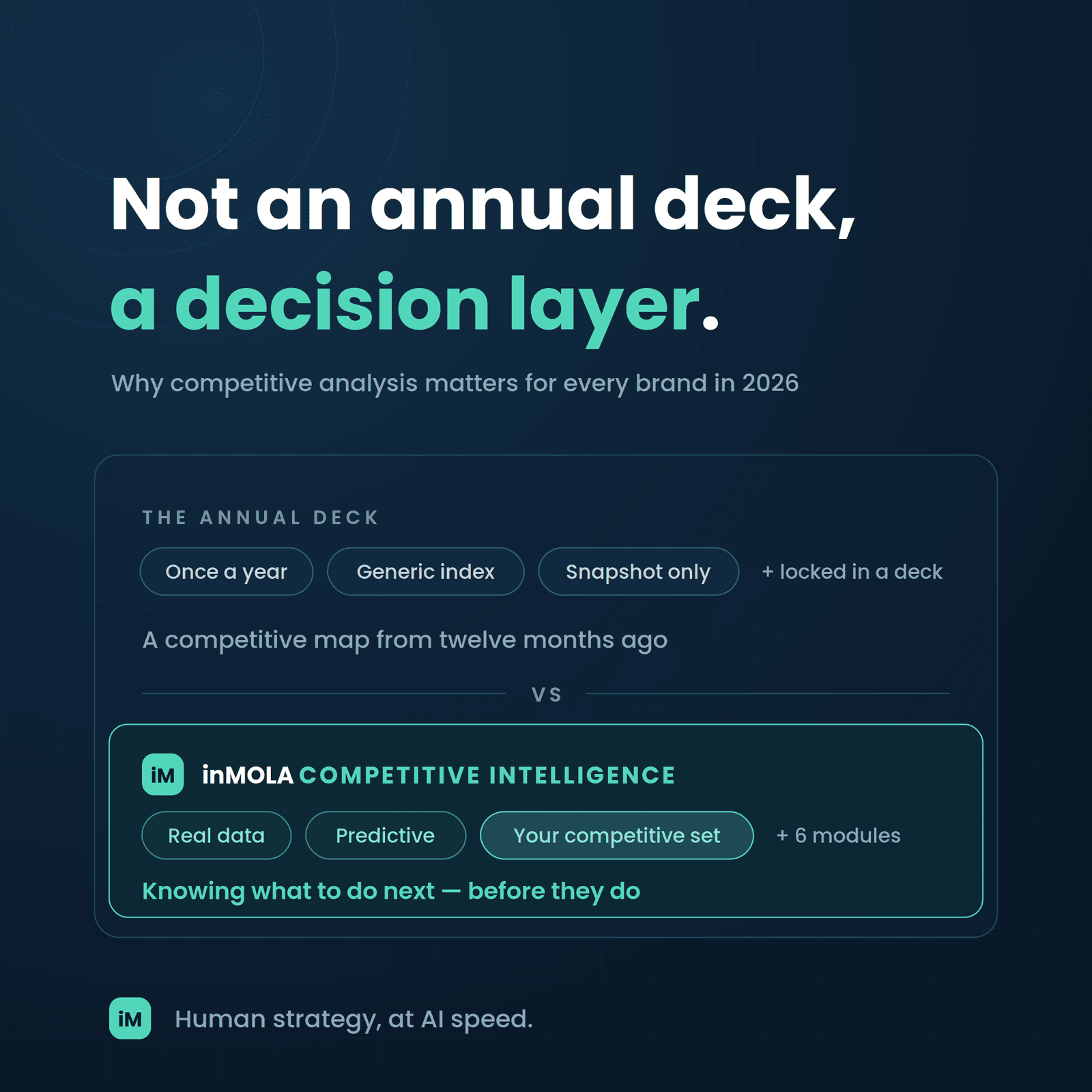
Most brands still run competitive analysis as an annual PowerPoint deck. In 2026, the timing is too slow, the data is too generic, and the decision layer is missing. Here is why competitive analysis is the one discipline no brand can skip — and what real competitive intelligence looks like when it is done right.
Ask a hundred marketing leaders whether competitive analysis matters and every one of them will say yes. Ask the same hundred whether they actually run it as a continuous discipline — real data, monthly at minimum, hooked into their decisions — and the answer changes fast. The majority still run competitive analysis as an annual PowerPoint deck. In 2026, that is no longer good enough.
Markets move faster than they did five years ago. Buyers now see you and your competitors in the same AI-generated answer, the same paid impression, the same social feed. Brand equity is contested every week, not every quarter. And what you are not watching, your competitors are already exploiting.
This piece explains why competitive analysis is the one discipline no brand can afford to skip in 2026 — and what real, decision-grade competitive intelligence looks like when it is set up properly. And yes, we will explain where inMOLA fits in, honestly.
A competitor can rebrand, cut price, launch a new SKU, publish a viral asset, or acquire a company inside a single quarter. If your competitive read is refreshed once a year by an agency or a strategy consultant, you are effectively driving with a map from twelve months ago. The map is not wrong; it is stale. And stale is expensive.
Modern competitive analysis has to run continuously — every week if it is a fast category, every month at the absolute minimum. Anything slower is theatre.
In 2026, most buying journeys start with a single question typed into ChatGPT, Perplexity, or Gemini. The AI answer surfaces three or four brands at once — not one. Your buyer does not go to your website first anymore. They see your position, your competitors, and the descriptors attached to each of you in the same sentence.
That means competitive analysis is no longer optional context. It is the frame the customer is already using. If you do not measure how you are being described next to your competitors — and where you are missing entirely — you are outsourcing that judgment to an algorithm you never briefed.
Reputation now moves in real time. A single incident can cost a brand years of accumulated equity. A single well-timed campaign from a competitor can shift share of voice within days. The old rhythm — quarterly brand-tracker survey, annual perception study — cannot see these movements until it is too late to respond.
Competitive analysis has to include real-time signal on how the market is talking about you compared to how it is talking about your rivals. Without that, brand teams are the last to know when the tide has shifted.
Every blind spot is an opportunity for a smart competitor. The channel you stopped measuring, the region you deprioritized, the customer segment you assumed was safe — that is exactly where a well-run competitor is quietly moving in. Competitive analysis is not paranoia. It is the discipline of not being surprised.
Even brands that take competitive analysis seriously often set it up in a way that guarantees the wrong output. Three mistakes come up repeatedly.
Most platforms sold as "competitive intelligence" are actually generic web indexers. They index the entire internet — millions of domains, most of them irrelevant to you — and hand you a lookup tool. That is not competitive intelligence. That is a search engine with a competitor filter. Real competitive analysis is purposefully focused on your brand and your specific competitive set. Every metric, every signal, every decision is calibrated to the brands you actually compete with.
A competitor traffic number from last month is useful. A competitor traffic trend that predicts what next month will look like is the decision. Most tools stop at the snapshot. The ones worth keeping give you a directional view — where the competitive set is heading, not just where it was.
When competitive analysis lives only in a CMO deck or a strategy report, it becomes an artifact — read once, discussed at a leadership offsite, then filed. The brands that actually move faster than their rivals push competitive signal down into the daily decisions of specialists, channel owners and brand managers. Decisions happen at every altitude, and competitive analysis has to be available at every altitude.
You do not win a market by knowing what competitors did. You win by knowing what to do next, before they do.
Once you strip away the marketing gloss, there are four properties that separate a competitive intelligence system worth having from one you will quietly stop using six months in.
These are not nice-to-haves. Any of them missing turns the whole discipline into ceremony rather than a competitive advantage.
inMOLA was built as a marketing decision engine, and competitive intelligence sits at the core of it. Rather than being a monitoring dashboard that hands you charts and leaves the interpretation to you, inMOLA is designed to turn competitive signal directly into prioritized decisions — for every level of the marketing team.
Concretely, that shows up in a few specific ways:
The philosophy is simple. Knowing what competitors did is not an advantage. Knowing what to do next is. inMOLA is built for the second question, not the first.
If competitive analysis in your organization is currently living inside an annual deck, a strategy team, or a generic web-monitoring tool, three practical moves will lift the discipline immediately.
Do those three things and competitive analysis stops being a slide in a deck. It becomes a decision layer running quietly under every marketing move you make.
That is where the advantage compounds — and that is exactly where inMOLA is built to sit.
Marketing Intelligence
Decision Intelligence
Marketing Intelligence