Marketing Intelligence
AI Visibility · 25 mai 2026 · 12 min de lecture
AI engines do not pick brands at random. There are twelve concrete signals ChatGPT, Perplexity, Gemini, and Claude weight when deciding which brand to mention, cite, or recommend. Here are the twelve, grouped by category, with what each one actually measures and what enterprises can do about it in 2026.
Ask ten SEO leads what they optimize for in Answer Engine Optimization and you will get ten different answers. That is not because AEO is vague. It is because the signals AI engines actually weight when recommending a brand are still poorly documented outside of the platforms themselves, and most enterprise teams are inferring the signals from output patterns rather than from a structured framework.
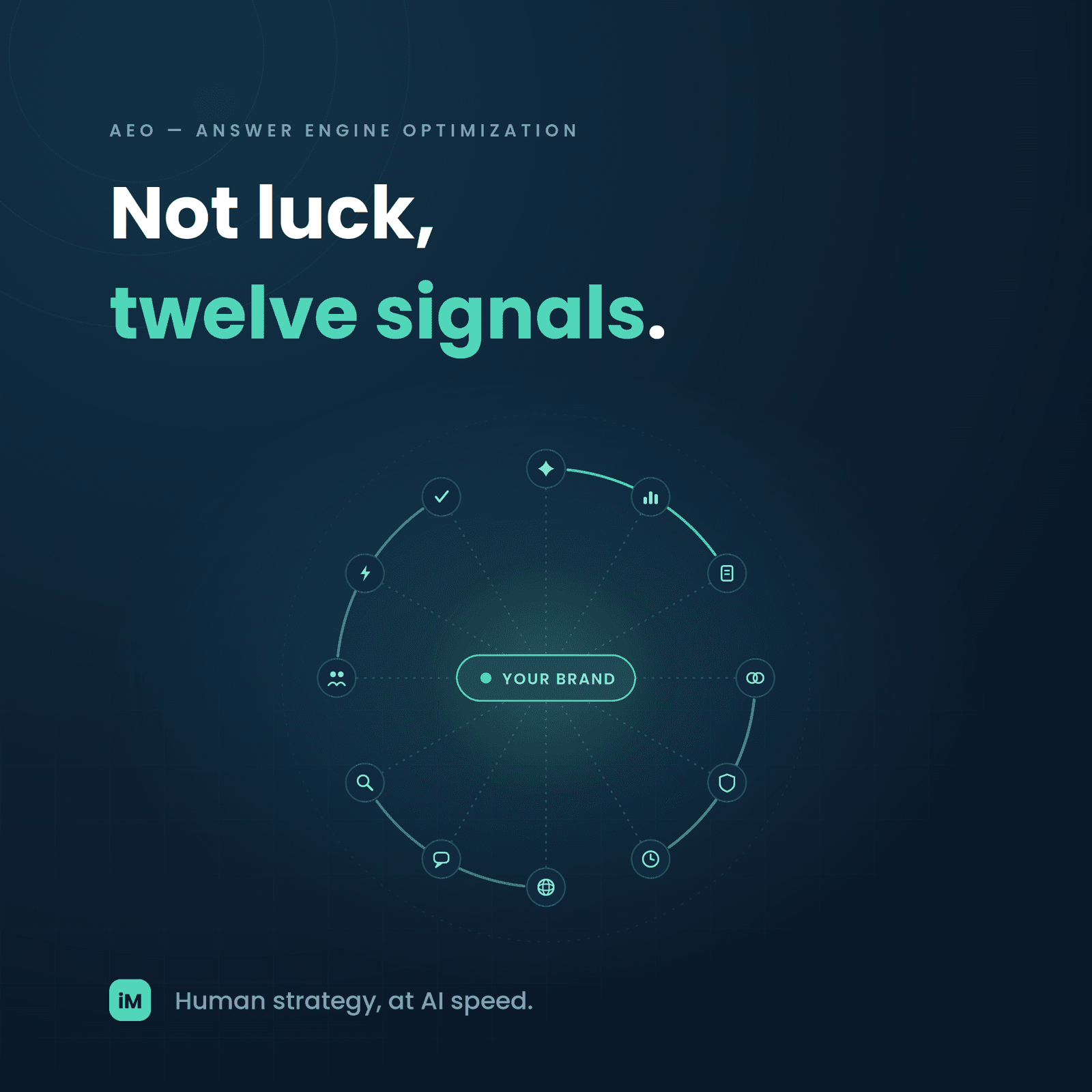
This piece names the twelve signals AI engines demonstrably weight, based on observed behavior across ChatGPT, Perplexity, Gemini, and Claude, and on the public statements each platform has made about how their retrieval and ranking work. The twelve are grouped into four categories that mirror how AI engines actually process content — discovery first, trust second, extraction third, citation-worthiness fourth. Together they form the operational checklist most enterprise AEO programs are missing.
Along the way we will name where inMOLA's AI Visibility module fits, because the measurement layer that turns these twelve signals into competitive intelligence is exactly what inMOLA was built for.
AI models do not rank sources the way search engines rank pages. There is no single "AEO score" the way there is a rough SEO rank. Instead, AI models make a series of decisions during response generation: which sources exist about this query, which sources are authoritative, which sources have extractable content, and which sources are worth attributing. Each decision uses different signals.
That distinction matters. Optimizing for one decision — say, discovery — without optimizing for the others can result in your brand being known by the AI but never used in an answer. Or being used but never cited. Or being cited but described inaccurately. The twelve signals below cover all four decisions.
Discovery is the first filter. If your brand does not clear it, none of the other signals matter. Three concrete signals decide discovery.
AI engines cache and reference brand identity by canonical URL. If your brand's About page moved three times in the last two years, if your product taxonomy changed URL structures, if redirects are inconsistent — the AI's mental model of your brand is fragmented across old and new URLs. That fragmentation lowers your surface area in every subsequent decision the AI makes.
The practical fix is boring and hard: pick canonical URLs for your brand identity, product taxonomy, and thought leadership content, and hold them stable. Every URL change is a Layer 1 setback.
AI engines cross-reference brand identity across sources — your own site, Wikipedia, LinkedIn, Crunchbase, industry directories, news outlets. When those sources agree on what your brand is called, what category it operates in, and what its core positioning is, the AI's entity resolution is confident and clean. When they disagree, the AI hedges — often by picking the most-cited version rather than the most-accurate one.
Enterprises with legacy brand renames, subsidiary confusion, or unclear parent-child brand structures often fail this signal without realizing it. The fix is a systematic audit of how your brand is described across the sources AI engines actually read.
Modern AI engines represent brands as entities, not strings. "Adyen" is not just a word; it is a linked entity connected to "Netherlands," "payment processing," "public company," and so on. The completeness and accuracy of that entity graph determines how AI engines respond to nuanced queries — "European payment processors that support crypto," for instance.
The signal here is whether your brand's entity graph is populated with the right adjacent concepts. If AI engines associate your brand with an outdated category, or fail to connect it to a relevant industry vertical, your discoverability on nuanced queries suffers even if your top-level discovery is fine.
Discovery gets you into the candidate set. Trust decides whether AI will actually pick you when composing an answer. Three signals dominate the trust decision.
This is not the same as SEO backlinks. AI engines specifically weight citations from sources they consider authoritative — reference sites (Wikipedia, Britannica for older concepts), industry publications, academic and analyst sources, established news outlets. A hundred backlinks from low-authority sites move traditional SEO metrics but move AEO signals barely. Ten citations from Wikipedia, Reuters, and a Big Four consulting firm move AEO signals substantially.
The practical implication is that AEO backlink strategy differs from SEO backlink strategy. Enterprises pursuing AEO seriously invest disproportionately in earning citations from a much smaller set of high-authority sources.
AI engines have a stable list of reference sources they weight heavily — Wikipedia, industry association directories, curated benchmark reports, academic publications. Inclusion in these sources is a stronger trust signal than any amount of self-published content.
For enterprises this often means investing in industry-body membership visibility, ensuring Wikipedia entries are accurate and well-sourced, and pursuing inclusion in curated industry benchmarks. These are slow, deliberate off-page investments that pay off in AEO where they would not directly pay off in SEO.
Older, stable domains get more trust than young or recently-changed ones. This is not a novelty penalty on new brands; it is a stability check. A young brand with a stable domain and clear identity can still perform well. A brand that has changed domains twice in five years struggles to accumulate trust regardless of its actual authority.
Practical takeaway: domain migrations are not just SEO liabilities. They are AEO liabilities. If you must migrate, invest heavily in preserving the identity signals — canonical URLs, redirect chains, backlink profile, entity references.
Once AI decides your brand is authoritative, it needs to extract specific information from your content to include in a response. Content that is trustworthy but hard to extract loses to content that is slightly less trustworthy but well-structured. Three signals dominate extraction.
Schema.org markup remains one of the highest-leverage AEO investments. Article schema, Organization schema, Product schema, FAQ schema, HowTo schema — each tells AI engines exactly what a piece of content contains and how to parse it. Well-implemented structured data can be the difference between AI extracting the correct fact and AI hallucinating a nearby one.
Most enterprise sites have structured data implemented on some pages but not others, or implemented inconsistently. A systematic audit and completion pass is one of the fastest AEO wins available in 2026.
Beyond schema markup, content structure itself signals extractability. Clear H2 and H3 hierarchies. Self-contained paragraphs that make sense out of context. Definition-style openings. Comparison-style tables and lists. TL;DR summaries at the top of long articles. Each of these is a structural pattern LLMs are trained on and extract from more reliably.
A useful test: take any paragraph from a page on your site and paste it into an AI assistant with no context, then ask what the paragraph is about. If the AI can accurately summarize the paragraph, the content is extractable. If the AI needs the surrounding context to make sense of it, the content is not.
AI engines preferentially extract from paragraphs with high fact density — specific numbers, named entities, dates, verifiable claims. Marketing copy that is high on adjectives and low on facts scores poorly on this signal, even when the underlying brand is authoritative.
The fix is not to strip your content of positioning language, but to ensure that positioning is supported by specific, verifiable facts within the same paragraph. "inMOLA is fast" is low fact density. "inMOLA's Core implementation runs in three days" is high fact density and extractable.
The final category is the one most enterprises overlook. Being extracted is not the same as being cited. AI engines make an additional decision about whether to attribute a claim to the source or paraphrase it without attribution. Attribution matters because cited brands accumulate more trust for the next query. Three signals influence citation-worthiness.
AI engines strongly prefer to cite original sources for factual claims. A blog post that publishes original data on 2026 customer acquisition costs by industry is a natural citation target. A blog post that summarizes someone else's data is not — the AI will cite the original source, not the summary.
Enterprises building AEO strategy in 2026 are increasingly investing in first-party research, original benchmarks, and proprietary data collection — not because these generate SEO traffic, but because they make the brand an unavoidable citation for anyone writing about the topic afterward.
The second-highest-leverage citation-worthiness signal is coining a named framework or methodology and defining it clearly. "The four-layer GEO framework." "The 3-2-1 rule of B2B content." Named frameworks give AI engines something specific to attribute, and once attributed, the citation compounds — every future explanation of the framework references the source.
The strategic implication is that publishing analysis with proprietary framing produces higher AEO returns than publishing the same analysis without it. This is not intellectual property theater; it is a specific mechanism by which AI engines attribute ideas to sources.
AI engines weight content authored by named experts more heavily than anonymous or corporate-attributed content. A byline that includes credentials, tenure, and topic-relevant expertise is a strong citation-worthiness signal. AI engines are increasingly able to resolve author entities across publications, so a consistent expert byline that appears in multiple authoritative outlets compounds over time.
For enterprises this means investing in the expert-brand pairing: a small number of named subject-matter experts whose bylines carry your content in multiple authoritative venues, not a large number of anonymous corporate posts.
AEO advice from 2024 and early 2025 included some tactics that have aged poorly. Three worth flagging:
AI engines do not pick brands at random. They pick brands that are discoverable, trustworthy, extractable, and citation-worthy — in that order.
inMOLA's AI Visibility module measures brand presence across ChatGPT, Perplexity, Gemini, and Claude at three moments (shortlist, comparison, validation), and diagnoses which of the twelve signals above are the gap when a brand under-performs. Rather than reporting a generic "AI visibility score," the module surfaces the specific signal category — discovery, trust, extraction, or citation-worthiness — where the gap is, so the fix is targeted rather than diffuse.
The measurement is competitive by default. Every score is compared against your defined competitive set, not against an abstract benchmark. The output is not "you scored 62 on AI visibility." It is "your discovery layer is weaker than your two closest competitors, specifically for these five queries, and here is the signal category to fix first."
Because AI Visibility is one of 64 modules inside inMOLA's decision engine, the signal-level output connects to the wider marketing decision layer. Improving Signal 4 (external citation density) affects both AI visibility and traditional PR/brand health. Improving Signal 10 (first-party research) affects both AI visibility and thought leadership. The measurement never lives in isolation.
Working through twelve signals at once is impractical. The high-leverage approach is diagnostic: identify which signal category is your weakest, and fix that first.
Doing that consistently for three or four months typically produces measurable shifts in AI visibility. Enterprises that treat all twelve signals as equally important tend to make broad but shallow improvements. Enterprises that identify their weakest signal and go deep tend to produce sharp, competitive gains.
AEO in 2026 is not a mystery. It is a measurable set of signals that AI engines demonstrably weight. The brands that name the signals and work them systematically are pulling ahead. The rest are still guessing why they do or do not appear in AI answers — and running content strategies calibrated to the wrong signals entirely.
Marketing Intelligence
Decision Intelligence
Marketing Intelligence