
Marketing Intelligence
Brand Reputation Monitoring · 4 juillet 2026 · 12 min de lecture
Most enterprise brand monitoring runs the brand as if it existed in isolation — its own sentiment trend, its own volume history, its own theme distribution. The framing is comfortable and it makes the reporting easy, but it misses the most important thing about reputation, which is that reputation is comparative. A brand whose sentiment held steady while every competitor's improved is a brand that has effectively lost ground. A brand whose negativity rose in a period when the whole category's did is a brand that did not underperform. Neither pattern is visible without the competitor in the same monitoring frame. Here is why comparative monitoring has quietly become the operating standard for enterprises running reputation as a strategic metric, what the same-mirror view reveals that solo monitoring misses, and how the shift changes the executive conversation about brand health.
Most enterprise brand monitoring runs the brand as if it existed in isolation. Its own sentiment trend. Its own volume history. Its own theme distribution. The dashboard shows the brand's numbers moving up or down over time, and the executive audience reads those numbers as a report card on the brand's own performance. The framing is comfortable and it makes the reporting easy to produce, but it misses the most important thing about how reputation actually behaves, which is that reputation is comparative rather than absolute.
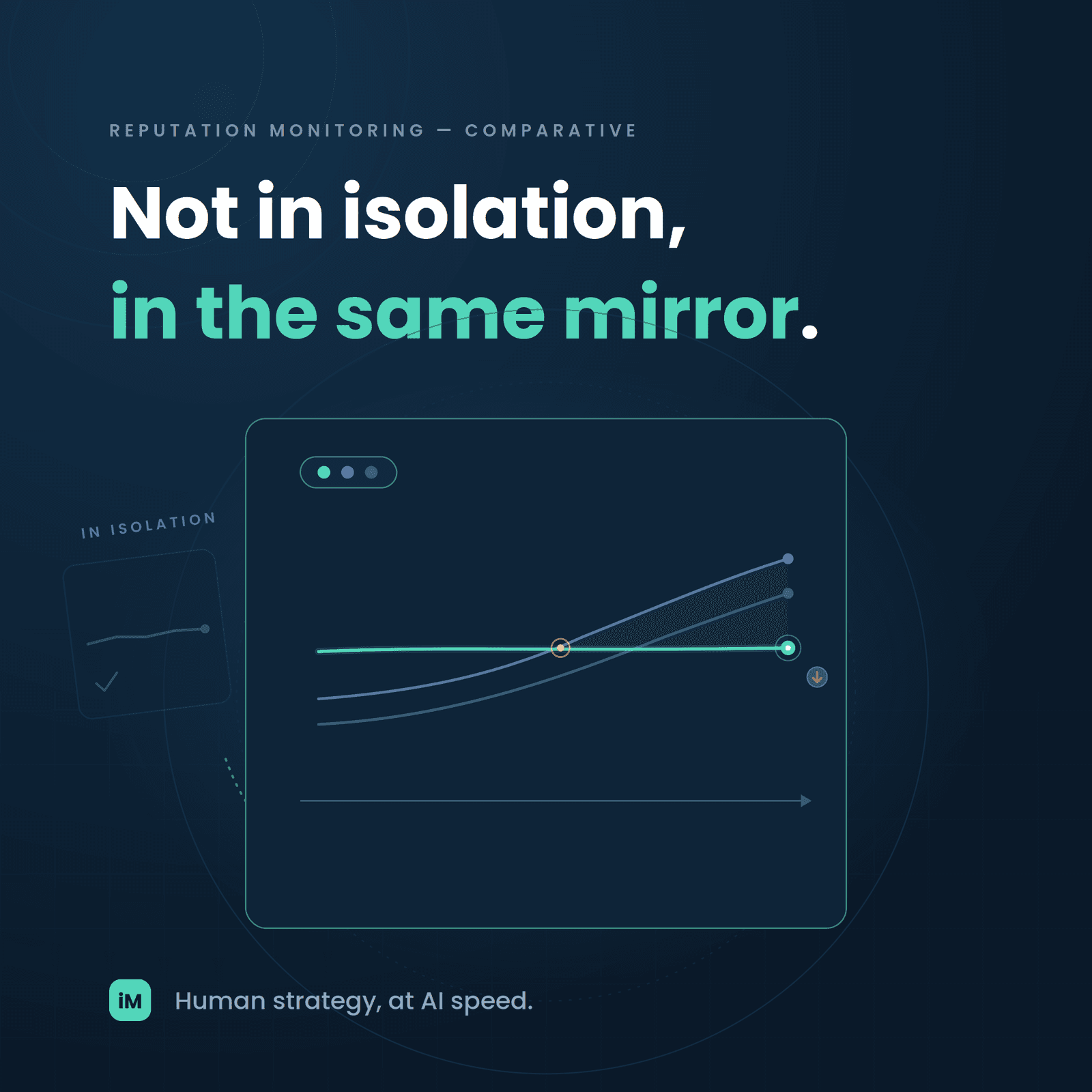
The comparative nature of reputation is not a subtle point. A brand whose sentiment held steady during a quarter when every competitor's improved is a brand that has effectively lost ground, even though its own numbers say nothing changed. A brand whose negativity rose during a period when the whole category's did is a brand that did not underperform, even though its own numbers look worse. A brand whose theme distribution shifted in a way that matches every competitor's shift is a brand caught in a category dynamic that no single brand's response can fix, even though its own numbers make it look like an internal problem. None of these patterns are visible in solo monitoring. All of them are visible in comparative monitoring.
Enterprises that have made the shift to comparative monitoring — running the same measurement, the same sentiment scoring, the same theme classification against their competitors' brands in the same monitoring surface — are reading their reputation position differently from enterprises that still run solo. This piece walks through why solo monitoring misses the actionable pattern, what the same-mirror view reveals, and how the shift changes the executive conversation about brand health.
Solo monitoring produces reports that answer a specific question — how is our brand doing on its own numbers. That question has a defensible answer, but it turns out to be the wrong question for most of the strategic decisions the executive audience needs to make.
The wrong-question problem shows up in three specific ways.
A quarter where the brand's negative-sentiment share rose from 8% to 10% could indicate several very different situations. The whole category could have moved from lower baseline negativity to higher baseline negativity because of a category-wide event, in which case the 2-point rise is category noise and not a brand-specific problem. The competitors could have improved from 8% to 6% while the target brand stayed at 10%, in which case the target brand has lost 4 points of relative position. The target brand could have moved from 8% to 10% while competitors held at 8%, in which case the target brand has lost 2 points of relative position but the underlying dynamic is brand-specific rather than category-wide.
The three situations require completely different responses. Solo monitoring shows all three as the same pattern — the brand's negativity rose 2 points — and the executive audience is left to reason about which underlying situation is producing the number. Without the competitor data in the frame, the reasoning is guesswork.
The trailing baseline that solo monitoring uses to define what is normal for the brand drifts over time with the category. When the category's baseline shifts — because of a category-wide event, a new competitor entrant, a platform algorithm change — the brand's own trailing baseline drifts along with it, and the shift in the baseline is invisible in the report. A brand whose sentiment score was 62 in Q1 and 60 in Q4 looks like it dropped 2 points. If the category's average was 55 in Q1 and 65 in Q4, the brand actually lost 12 points of relative position while the report indicates a 2-point solo decline. Solo monitoring cannot see this because the drift is in the reference frame.
The theme distribution of a brand's mention stream tells the enterprise what the audience is talking about when they talk about the brand. That is useful. But the strategic interpretation of the theme distribution depends on how it compares to competitors' theme distributions. A brand whose top theme is customer service reads as customer-service-oriented in solo view. If every competitor's top theme is also customer service, the brand is not distinctively customer-service-oriented — it is participating in a category-wide conversation. If competitors' top themes are innovation and design, then the target brand's customer-service theme actually is distinctive, and the strategic interpretation is different. Solo monitoring cannot make this distinction.
Running the same measurement against competitors in the same monitoring surface reveals patterns that solo monitoring cannot express. Four types of pattern are the most consequential for strategic reading.
The most straightforward comparative metric is share of voice. What fraction of the total category conversation is about the target brand versus the competitors. Share of voice is a direct measurement of competitive attention position, and it moves in ways that solo mention volume cannot capture. A brand whose absolute mention volume rose 20% while share of voice dropped from 32% to 28% is not gaining ground; it is losing it while the whole category is talking more. Solo monitoring would report the 20% mention rise as good news. The comparative reading catches the loss.
Where sentiment share sits relative to competitors is more informative than where it sits in absolute terms. A brand with 12% negative-sentiment share is doing well if the category average is 20% and doing poorly if the category average is 6%. The absolute number, without the comparative context, does not answer the strategic question. Comparative monitoring answers it directly by showing the target brand's sentiment share alongside each competitor's, and the gap is what matters.
The most strategically useful comparative pattern is theme distinctiveness. Which themes appear on the target brand's mention stream at a materially higher share than on competitors' streams, and which themes appear at a lower share. High-distinctiveness themes are where the brand is being talked about differently from its competitors. Low-distinctiveness themes are where the brand is participating in the same conversation as the rest of the category. The distribution of high- and low-distinctiveness themes tells the enterprise where its brand identity is actually differentiated in audience conversation, and where it is being read as generic. Solo monitoring cannot see this distinction because it has no reference frame to compare against.
The comparative frame reveals momentum patterns that are invisible to solo monitoring. A brand whose numbers held steady while every competitor's improved is showing negative relative momentum even though absolute numbers look flat. A brand whose numbers slipped while every competitor's slipped further is showing positive relative momentum even though absolute numbers look bad. The strategic interpretation depends on relative momentum, not absolute movement, and the relative frame requires the competitors in it.
Enterprises that move to comparative monitoring rebuild the executive brand-health conversation around a different set of primary metrics. The volume trend of the brand becomes context. The comparative metrics become the primary readings. Naming the specific shifts helps enterprises understand what the transition looks like from inside the executive audience's experience.
The comparative shift is substantial but does not solve every reputation-monitoring problem. Naming the residual challenges keeps the shift honest.
Comparative monitoring does not eliminate detection speed as an issue. The comparative frame still needs to run continuously, and the alerts still need to fire in the crisis window rather than in the monthly report. A comparative frame that runs on monthly cadence catches comparative patterns better than solo monthly monitoring but still misses the same crisis windows solo monthly monitoring misses. The comparative shift and the continuous detection shift are complements, not substitutes.
Comparative monitoring does not tell the enterprise what to do about the pattern it reveals. Knowing that share of voice has dropped by 4 points relative to a specific competitor tells the enterprise the competitive attention position has changed. It does not tell the enterprise whether the response is a campaign, a repositioning, a product statement, or something else. The comparative frame improves the diagnosis; the response strategy still requires the enterprise's own strategic judgment on top of the improved diagnosis.
Comparative monitoring does not eliminate the value of the brand's own solo metrics. The brand still needs to know its own trend across time, its own theme distribution, its own sentiment history. What changes is that these solo metrics move from primary to context, and the comparative metrics move from context to primary. The report structure changes, and the executive conversation changes with it.
Reputation is comparative. A brand's numbers, read in isolation, tell the enterprise how the brand's numbers are moving. A brand's numbers, read alongside competitors', tell the enterprise whether the brand is winning or losing the category conversation. The distinction is not small, and it changes almost every strategic decision the executive audience uses reputation monitoring to inform.
inMOLA's Brand Sentinel module supports multi-brand target definitions, so the enterprise can define its own brand and its competitors as tracked targets running through the same monitoring surface. Sentiment scoring, theme classification, and volume tracking run identically for every tracked brand, so the comparative frame is available without additional configuration — the same measurements that produce the target brand's numbers also produce every competitor's numbers.
The comparative views are first-class in the dashboard. Share of voice within the category. Sentiment gap versus each competitor. Theme distinctiveness across the tracked brands. Momentum comparisons over any chosen window. The executive who used to read a solo dashboard for the target brand can read a comparative dashboard that puts the same brand alongside its competitors in the same measurement frame, and the strategic questions that flow from the reading become genuinely comparative.
The strategic value of the comparative approach is not that it produces prettier reports. The value is that reputation stops being read as a solo score and starts being read as a competitive position. The executive audience learns to ask different questions — is the brand gaining or losing share of voice, is the sentiment gap widening or narrowing, are our distinctive themes still distinctive — and the reputation-monitoring layer produces answers that solo monitoring cannot express. In 2026 the enterprises operating this way are reading their reputation position more accurately than their competitors are, and the accuracy compounds into better strategic decisions across every reputation-adjacent conversation the executive audience has. The compounding is where the strategic difference between comparative and solo monitoring actually shows up over time.
Marketing Intelligence

Decision Intelligence

Marketing Intelligence