Marketing Intelligence
Influencer Marketing · 29 juin 2026 · 11 min de lecture
The industry loves single-number influencer scores. One rank, one leaderboard, one hero metric that decides who gets picked. In 2026 that framing is quietly failing enterprises, because the two questions single-number scores collapse — is this creator generally strong, and is this creator right for our brand — genuinely require independent answers. Here is why the two-score model has become the operating standard for enterprises running influencer programs at scale, what each score does, and how the shift from one rank to two separates the enterprises that pick creators who perform from the enterprises that keep hiring creators who look strong on a leaderboard that isn't theirs.
The influencer industry loves single-number scores. Influencer Score. Creator Rank. Impact Index. Every discovery platform seems to build its identity around a proprietary score that promises to reduce the messy question of who to hire into a single, comparable number. The single-number score gets people to sign up. It anchors the sales pitch. It looks good in a product demo. And it fails, quietly, at the actual job of helping a brand pick creators who will perform for that specific brand's campaign.
The reason single-number scores fail is not that the underlying metrics are wrong. The reason is that they collapse two genuinely independent questions into one output. Question one: is this creator strong in general terms — high engagement, active, authentic, sitting in a tier with proven ROI dynamics? Question two: is this creator right for our brand — do they speak the language of our audience, sit in our category niche, reach the country and demographic we are targeting, and clear the minimum-engagement bar our campaign is calibrated for? Both questions matter. Neither answers the other. And when a single-number score tries to combine them, the answer to one gets diluted by the answer to the other, and the enterprise ends up ranking creators against a metric that does not answer either question cleanly.
In 2026 the two-score model has quietly become the operating standard for enterprises running influencer programs at scale. Two independent axes. A Quality Score that captures how strong the creator is in general terms, the same for every brand. A Brand-Fit Score that captures how well the creator matches the specific brand's target profile, different for every brand. Together they produce a ranking that the enterprise can defend to a CMO and to a CFO, because it separates the general strength of the candidate from the brand-specific match. This piece walks through why the shift has become the standard, what each score is doing, and how the two-score model changes the campaign selection workflow in practice.
The failure of single-number scores is not a modeling problem. It is a semantic problem. Single-number scores work when the underlying question they answer is genuinely one-dimensional. They fail when the underlying question is inherently multi-dimensional, and influencer selection is one of the clearest examples of a multi-dimensional problem the industry keeps trying to flatten.
Consider a specific case. A skincare brand and a B2B software company are both evaluating the same creator — a 250,000-follower Instagram account with a 6% engagement rate, strong authenticity signals, and a well-defined audience concentrated in lifestyle and wellness content. Both brands see the same single-number score, because the underlying metrics that feed it are the same. The score tells them the creator is strong. It does not tell them that the creator is a probable fit for the skincare brand and a definite mismatch for the B2B software company. The enterprises walk away with the same number and different actual outcomes when they use the number to select.
The single-number score's failure mode is not that it lies. It is that it gives the same answer to two brands whose actual answer to "should we hire this creator" is genuinely different. The correction is not a better single number. The correction is to stop trying to answer both questions with one output.
The Quality Score captures how strong a creator is in general terms. Engagement level relative to their tier. Posting cadence and active days. Tier sweet-spot — micro creators earn a bonus because the ROI-per-dollar advantage of the tier is real. Authenticity signals like comment-to-like ratio that filter for genuine audiences rather than purchased ones. The Quality Score is the same for every brand that looks at the same creator, because the question it answers — is this creator generally a strong candidate — does not depend on which brand is asking.
The Quality Score does several jobs at once. It filters out obvious weakness at the front of the funnel — creators with low engagement, dormant accounts, purchased-follower profiles, or any of the other signals that indicate the creator will not deliver on any brand's campaign. It provides a shared reference for the industry — a creator's Quality Score is comparable across brands, agencies, and time, which makes market-level analysis possible in ways single-brand scoring does not. And it separates general strength from brand-specific fit, so that when a brand does evaluate a creator against its own targeting, the general-strength question is already answered and does not need to be reasoned about again.
A strong Quality Score is necessary but not sufficient for selection. Every creator on a brand's shortlist should clear a Quality Score bar. But clearing the Quality bar does not mean the creator will perform for the specific brand. That is the Brand-Fit Score's job.
The Brand-Fit Score answers a different question entirely. Does this creator match the specific brand's target profile, on the dimensions that decide whether the creator's audience is the brand's audience? Four dimensions carry most of the weight.
The most obvious dimension is language. A creator whose primary content is in Turkish is a strong fit for a Turkish-market campaign and a weak fit for a French-market campaign. A creator who publishes in English but has an audience concentrated in the US market is a strong fit for a US brand and a weaker fit for a UK brand pitching British-specific offers. Language match is not always about the language on the profile — it is about the language the audience is actually consuming and reacting to.
The second dimension is geography. A creator whose audience is 70% Turkish is a strong fit for a Turkish market campaign even if some of the reach spills to neighboring markets. A creator with a globally dispersed audience is a weak fit for a country-targeted campaign, because most of the reach is outside the target market. Country match is not perfectly captured by the creator's stated location — it is captured by the geographic distribution of the audience, which requires audience-level data rather than profile-level assumption.
The third dimension is category niche. A creator focused on skincare content has an audience aligned with a skincare brand's target segment. That same creator has an audience misaligned with a fintech brand's target segment. Niche match is the dimension where the biggest brand-fit gaps live, because creators can look strong on Quality but sit in a niche that is entirely off-target for a specific brand. The niche-match dimension turns the same general-strong creator into a strong Brand-Fit for some brands and a weak Brand-Fit for others.
The fourth dimension is calibrated fit — does the creator's tier and engagement pattern match what this specific campaign is optimized for. A campaign optimized for conversion typically wants a micro or mid-tier creator with a high engagement rate. A campaign optimized for reach concentration may accept a mega creator with a lower engagement rate. The Brand-Fit Score factors in the campaign's specific calibration so that the same creator ranks appropriately for a conversion campaign and a reach campaign, differently.
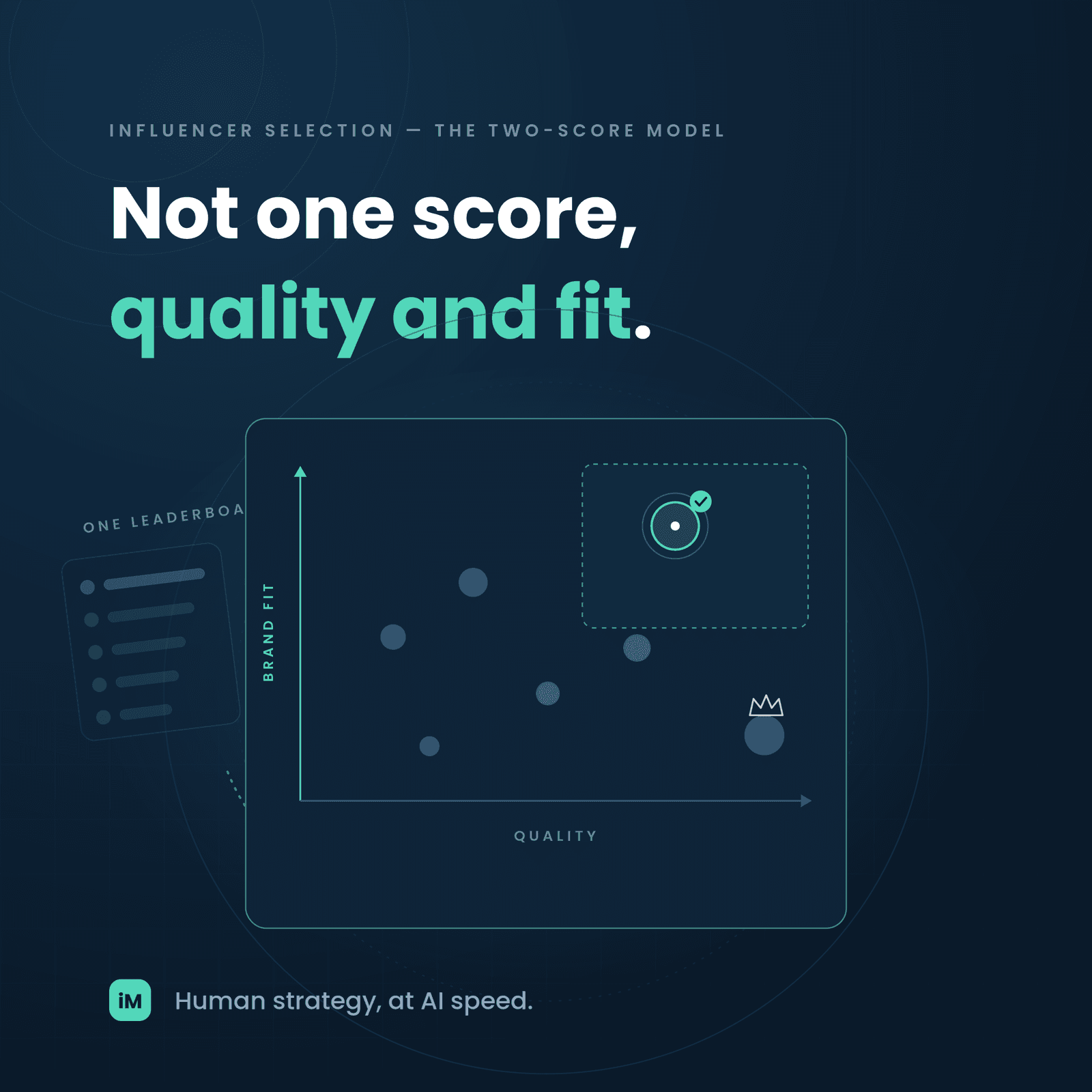
The two-score model produces a two-dimensional view of every candidate. The Quality Score is on one axis. The Brand-Fit Score is on the other. Every creator sits at a specific point in the space. The enterprise's selection is not made by picking the highest single number — it is made by looking at where the candidates fall in the two-dimensional space and choosing from the quadrant that best serves the campaign.
The two-score view makes the selection conversation both more precise and more efficient. The pursuing team can rank candidates within the strong-selection quadrant confidently. They can drop the misleading-quadrant candidates without second-guessing. They can consider the trap quadrant only when the fit is exceptional and the general strength gap is closable. And they can bypass the pass quadrant entirely without the wasted debate a single-number ranking sometimes provokes.
Enterprises that operate on the two-score model report several changes to how their influencer campaigns are actually built. Naming them helps enterprises see what the shift looks like from inside the workflow.
Single-number influencer scores answered one question when brands actually need two. The two-score model separates general strength from brand-specific fit — and lets enterprises rank creators by the dimension that actually decides whether the campaign works for them, rather than by a leaderboard that averages a question the leaderboard cannot answer.
inMOLA's Influencer Marketing module is built around the two-score model as the operating primitive. Every creator surfaced has a Quality Score (0-100) that reflects engagement, cadence, tier sweet-spot, and authenticity — the same score every brand sees for the same creator, comparable across campaigns and time. Every creator also has a Brand-Fit Score (0-100) calibrated to the specific brand's target profile — language, country, niche intersection, audience tier, and minimum engagement threshold — so the same creator ranks differently for different brands, appropriately.
The two-score view shows up throughout the workflow. The pool of candidates is rankable by either axis. The shortlist is filterable by both. The comparison view shows both scores side by side. AI analysis on any individual creator reads the two scores in combination rather than collapsing them into a single verdict. The enterprise can build a campaign shortlist entirely from the strong-selection quadrant, defend the shortlist to the CMO by pointing to both scores, and rerun the Brand-Fit calibration for the next campaign against the same Quality pool.
The strategic value of the model is that campaign selection stops being a leaderboard exercise and starts being a match exercise. The enterprise picks creators who are strong in general terms and specifically right for this campaign — not creators who happen to top a single-number list that averaged two questions the enterprise needed to keep separate. In 2026 the enterprises operating this way run campaigns whose ROI reflects the two-score alignment rather than the follower-count or single-metric fit that used to define selection. The difference between the two approaches compounds across campaigns, and the compounding does not slow.
Marketing Intelligence
Decision Intelligence

Marketing Intelligence