
Marketing Intelligence
Pricing Strategy · 2026년 6월 30일 · 12 분 읽기
Pricing in a single market is complicated. Pricing in eight is a different exercise entirely. The natural instinct — replicate the home-market pricing process eight times — misses the operating discipline that turns multi-country pricing into a working system rather than a set of parallel struggles. Here is what actually changes when pricing has to scale from one market to eight, what enterprises tend to underestimate, and how to build a pricing operating layer that stays consistent without becoming rigid.
Pricing in a single market is already a complicated exercise. Product cost. Overhead absorption. Go-to-market cost. Competitive set. Credible band. Quality perception. Scenario choice. Each input requires research, judgment, and a defensible rationale, and the pricing conversation in a single market can consume a real share of the pricing team's attention every quarter.
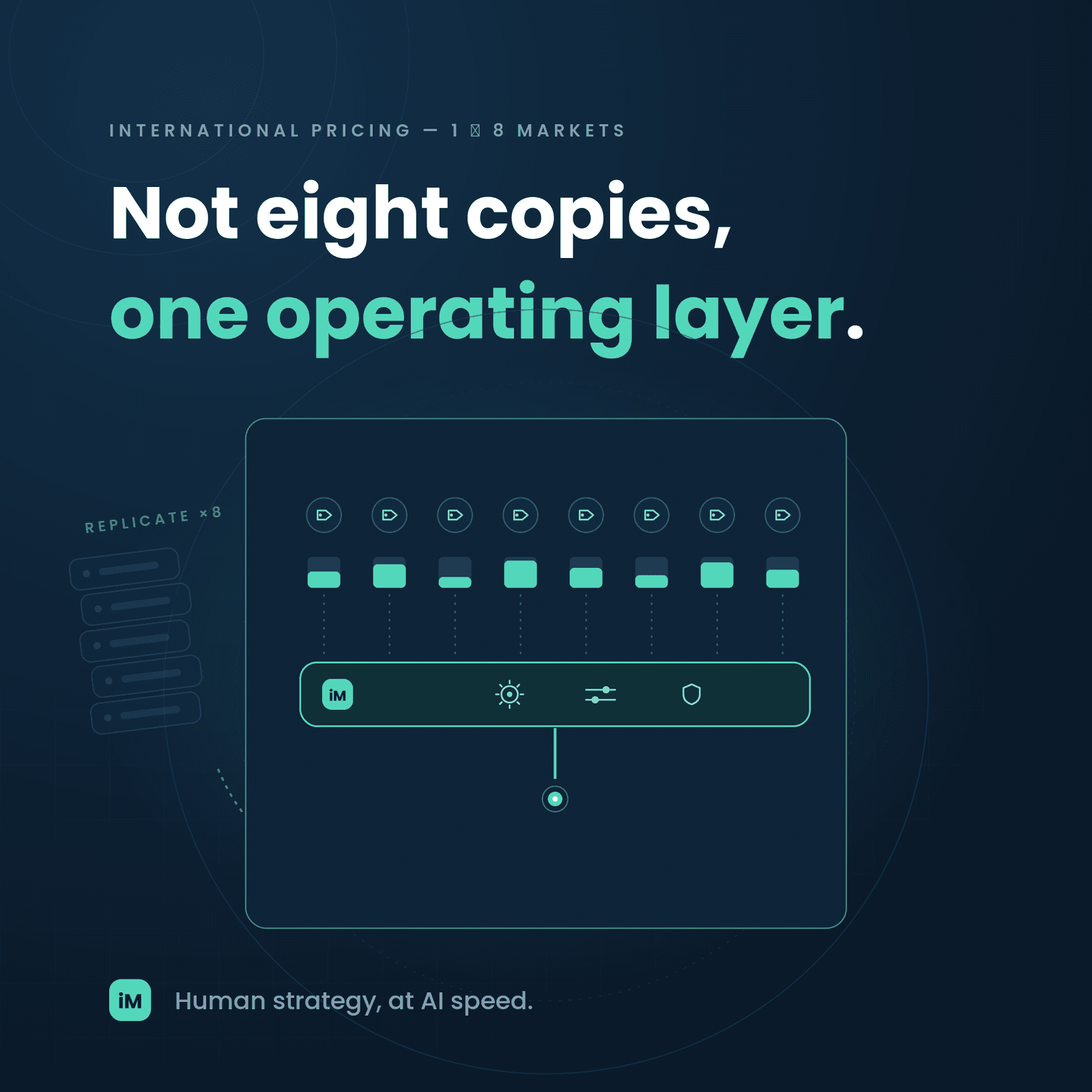
Pricing in eight markets is not the same exercise multiplied by eight. It is a different exercise entirely. The natural instinct — replicate the home-market pricing process across each additional market — produces a system that is technically running everywhere and operating well nowhere. The pricing team becomes overwhelmed by the volume of parallel decisions, the consistency across markets drifts as different local instincts pull in different directions, and the enterprise ends up with a portfolio of country prices that individually look reasonable but collectively fail to hold the strategic position.
What multi-country pricing at scale requires is not more capacity but a different operating layer. This piece walks through what changes when pricing has to scale across international markets, what enterprises tend to underestimate as they expand, and how to build a pricing system that stays consistent without becoming rigid. The goal is a pricing discipline that operates in eight countries with the coherence of a single-market operation and the sensitivity to local reality that only per-market decisions can produce.
Four shifts happen when pricing has to scale from a single market to a portfolio of countries. Each shift is easy to underestimate individually. Together they explain why enterprises that expand internationally often experience pricing as a recurring source of friction rather than as a strategic lever.
In a single-market operation, the pricing calendar is straightforward. Quarterly reviews. Occasional ad-hoc updates when a competitor moves or a promotion is planned. The team knows the rhythm and can prepare against it.
In an eight-market operation, the pricing calendar becomes a rolling schedule that is always active somewhere. Different markets have different competitive dynamics, different regulatory timing, different tax and currency events, and different local demand cycles. Coordinating a synchronized quarterly review across all markets produces reviews that are perfectly timed for none of them. Allowing each market to run on its own calendar produces uncoordinated pricing that drifts against the enterprise's strategic direction.
The resolution is a two-cadence calendar. A shared strategic cadence — usually semi-annual — that aligns the whole enterprise on positioning, scenario choices, and overall pricing direction. And a local operational cadence — usually quarterly per market, staggered to match local conditions — that executes the per-market decisions within the strategic frame. The two cadences run in parallel, one shaping the other, and neither trying to do the work of both.
In a single market, the competitive set is a defined group of products the pricing team monitors continuously. In eight markets, there are eight competitive sets, each with its own composition, its own dynamics, and its own signal patterns. The competitive set in Germany is not the same as the competitive set in the UK, which is not the same as the competitive set in the Netherlands, which is not the same as the competitive set in the UAE.
The pricing team cannot personally monitor eight competitive sets with the same depth it monitors one. The competitive intelligence infrastructure has to scale — through data systems, through per-market analyst coverage, or through some combination of the two — or the pricing decisions in the peripheral markets end up made with worse information than the decisions in the core markets. Uneven information produces uneven pricing quality, and the peripheral markets often become the site of the worst pricing errors as a result.
In a single market, the credible price band is something the team develops a feel for. It is anchored by the competitive set, the buyer's affordability, and the local perception of the category. Over time the team internalizes where the band sits and can price against it with confidence.
In eight markets, the credible band is different in each one, and the differences are often not intuitive. A market with lower absolute purchasing power may have a narrower band that sits lower on the price axis. A market with an active premium tier may have a wider band that stretches higher on the price axis. A market with a fragmented competitive set may have a diffuse band with a less well-defined middle. The band's location and shape are country-specific properties, and enterprises that assume the band translates linearly from one market to another price systematically wrong in the markets where the translation does not hold.
A brand that is Premium in its home market can be mid-market in a country where the international category leader occupies the premium tier. A brand that is mid-market at home can be premium abroad if the country has fewer international entrants and treats the brand as an aspirational option. A brand's placement on the price-quality map is country-specific, and the same brand can occupy different quadrants in different markets simultaneously.
The pricing implication is that the pricing decision has to reflect the country-specific quality position, not the home-market position. Pricing a country where the brand is genuinely Premium with a mid-market scenario captures less margin than the market would bear. Pricing a country where the brand is genuinely mid-market with a Premium scenario prices the product out of the credible band. Both errors are common, and both are avoidable if the pricing team explicitly models the country-specific quality position rather than assuming it translates from the home market.
Enterprises expanding internationally tend to underestimate three specific challenges when they scale their pricing from one market to eight. These are the challenges that produce the recurring frustration many enterprises describe as "we can't seem to get international pricing right no matter how much attention we give it."
The competitive intelligence that supported single-market pricing has to scale to cover the additional markets, and the scale is not one-to-one. Each additional market adds a competitive set to monitor, a set of local competitors to understand, a set of local pricing dynamics to track. The manual approach that worked for one market — pricing analysts checking competitor prices, reading market news, integrating information into the pricing view — does not scale linearly. Enterprises that try to maintain manual competitive intelligence across eight markets typically end up with high-quality intelligence for the two or three most important markets and progressively lower-quality intelligence for the rest, and the pricing errors cluster in the markets where the intelligence has thinned.
In a single market, consistency is easy — one team makes one set of decisions. In eight markets, different local teams tend to develop different pricing instincts, different definitions of "reasonable," different attitudes toward aggressive versus premium scenarios. Left alone, these differences produce a portfolio of country prices that individually reflect local judgment but collectively do not reflect a coherent strategic position. The enterprise ends up with markets where the brand is priced as Premium and markets where the same brand is priced as Economy without a strategic decision behind the difference.
The correction is not to centralize pricing decisions — central pricing loses the local judgment that makes per-market pricing work. The correction is to establish a shared decision framework that the local teams apply consistently, so that the differences across markets reflect genuine market differences rather than diverging local instincts. Building that shared framework is a real operating investment, and it is often skipped in the assumption that pricing decisions are naturally coherent.
Multi-country pricing generates coordination work that single-market pricing does not. Regional pricing reviews. Cross-market comparisons. Strategy alignment across country teams. Board reporting on the portfolio of country pricing decisions. This overhead is real, it accumulates over time, and enterprises that do not staff for it end up with pricing decisions that are made but not reviewed, aligned but not documented, and defended in individual conversations but not in the shared enterprise view.
The staffing question is not whether to add more pricing headcount. It is whether to build the coordination layer that lets the existing team operate coherently across eight markets. The layer is a mix of process, data infrastructure, and shared frameworks — and it is what separates enterprises whose multi-country pricing is a working system from enterprises whose multi-country pricing is a chronic source of alignment problems.
Enterprises that have built multi-country pricing into a working operating layer tend to share specific characteristics. Naming them helps enterprises that are early in the transition see what the destination looks like.
This is not a description of an unusually mature enterprise. It is a description of the operating layer that multi-country pricing requires to work, and it is achievable by any enterprise willing to invest in the infrastructure and the shared frameworks. The alternative — running eight parallel single-market pricing exercises — is more expensive over time, produces worse results, and burns out pricing teams faster than the discipline of a coherent multi-country operation.
Most enterprises do not scale from one market to eight in a single move. The scaling happens in stages, and the transitions between stages are where the pricing operation has to be rebuilt rather than extended.
The first extension is manageable with the single-market process. The pricing team applies the same discipline across three markets, and the calendar and consistency challenges are small enough to manage informally. Enterprises at this stage often do not realize that the process they are running does not scale, because it is still working.
The three-to-five transition is where the informal approach usually breaks. The pricing team can no longer maintain per-market intelligence with the same depth. The calendar starts to strain. Consistency across markets starts to drift. This is the transition where enterprises that will build a durable multi-country pricing operation start investing in the infrastructure — data systems, shared frameworks, coordination cadence — and where enterprises that do not start accumulating the frictions that will haunt them at eight markets.
The five-to-eight transition is where the infrastructure investments from the first rebuild are tested. Enterprises that built the operating layer see the transition as manageable — more markets on the same layer, with the layer bearing the additional load. Enterprises that did not experience the transition as a crisis, with pricing decisions falling behind, consistency problems escalating, and country teams calling for either more autonomy or more central support depending on where the pain is being felt. This is where the second rebuild happens, usually more expensively and under more pressure than the first.
Beyond eight markets, the pricing operation is a working system. Additional markets are added by extending the existing layer rather than by rebuilding it. The infrastructure carries the operational load, the shared frameworks maintain consistency, and the two-cadence calendar keeps strategic and operational rhythms aligned. Enterprises that reach this state describe multi-country pricing as a strategic asset rather than as a chronic problem.
Multi-country pricing is not single-market pricing done in more places. It is a different operating discipline that emerges when the pricing decisions have to be coherent across markets while remaining sensitive to each market. Building the discipline is a real investment. Not building it is a more expensive investment, paid in accumulating pricing errors.
inMOLA's Pricing Strategy module was built as the operating layer that multi-country pricing needs. Each product-country combination is a first-class record. The competitive set for each country is drawn from the same continuously refreshed data streams that power the wider inMOLA decision engine, so the intelligence quality is consistent across markets rather than concentrated in the core markets. The credible band is computed per market against the country's actual competitors, and the recommendation is anchored to the country's own reality.
The three-scenario range — aggressive, balanced, premium — is generated with the same structure in every market, which is what gives the enterprise the shared vocabulary that multi-country pricing coherence depends on. The scenarios in each market are anchored to that market's credible band and quality position, so the specific numbers vary by market while the framework holds constant. A country team choosing the balanced scenario means the same thing in Germany as it does in the UAE, even though the underlying prices differ.
The module's per-country records support the reporting and coordination overhead that multi-country pricing generates. The portfolio of country prices can be reviewed as a portfolio, cross-market comparisons can be made against consistent inputs, and the strategic conversation about coherence across markets is supplied by data rather than by anecdote. In 2026 the enterprises that operate this way are the ones for whom international expansion is a strategic option rather than a chronic operational challenge — and the difference is the operating layer that turns eight parallel struggles into a working system.
Marketing Intelligence

Decision Intelligence

Marketing Intelligence