Marketing Intelligence
AI Visibility · 28 мая 2026 г. · 11 мин чтения
AI search visibility looks like a global problem until you look at the UK, Netherlands, and UAE side by side. Regional dynamics — regulatory context, language mix, competitive intensity, buyer culture — reshape what enterprise marketers should measure and where they should invest. Here is what is actually different in each market, and what enterprises across all three are getting wrong in 2026.
Enterprise marketers running global brands often treat AI search visibility as a single, borderless problem. Optimize for ChatGPT, Perplexity, Gemini, and Claude, the thinking goes, and coverage in the UK, Netherlands, UAE, and everywhere else takes care of itself. That assumption is wrong. In 2026, AI search behavior varies enough across these three markets that a single global strategy produces uneven — sometimes deeply uneven — results.
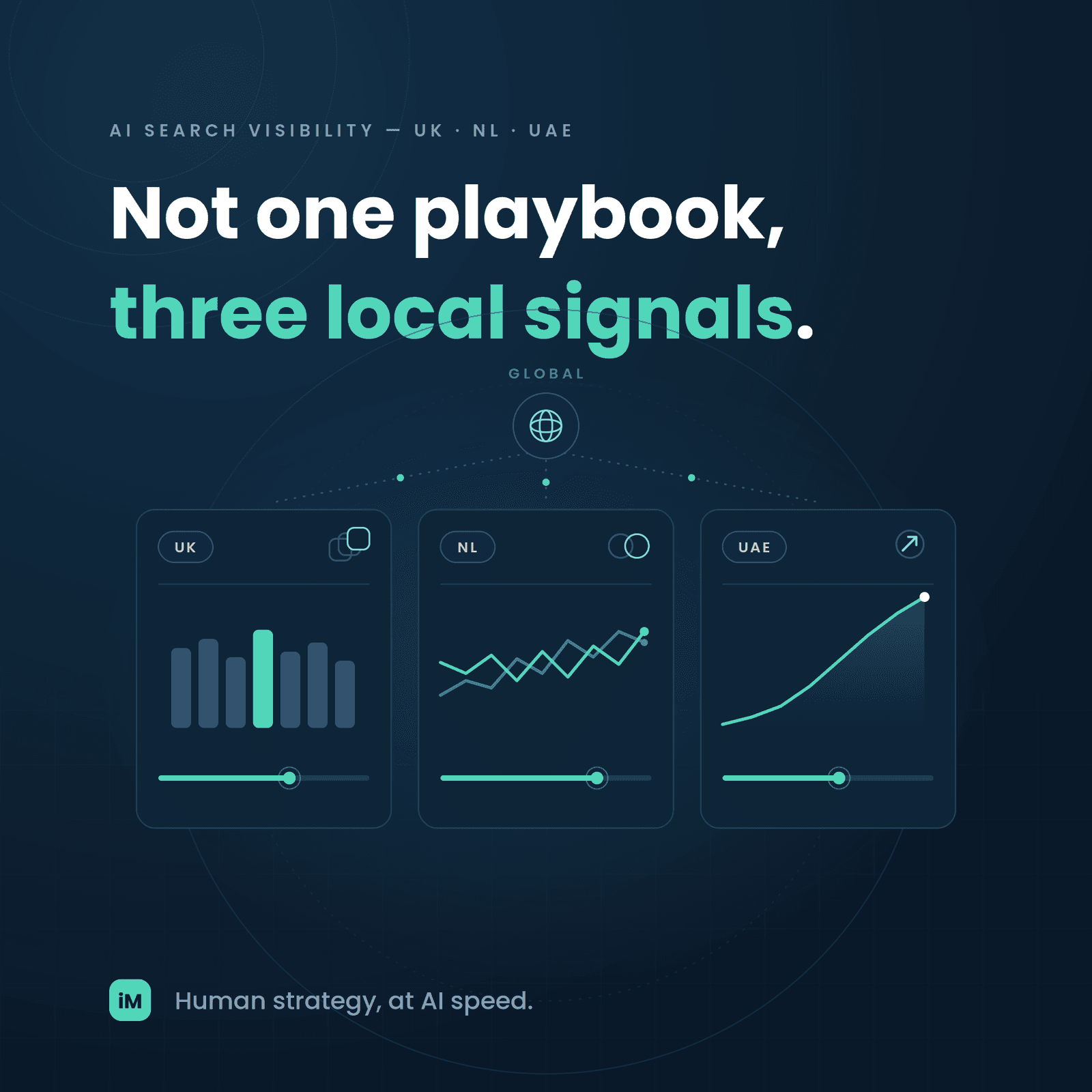
This piece maps what is actually different about AI search visibility in the UK, Netherlands, and UAE, why those differences matter for enterprise buying behavior, and what enterprise marketers targeting these three markets are getting wrong. We will end at where inMOLA's AI Visibility module handles the regional layer, because measuring AI visibility across multiple markets from a single decision layer is exactly what the module was built for.
AI search would be borderless if AI engines behaved identically across markets. They do not, for four structural reasons.
First, training data varies. Large language models trained on English-language content over-represent US and UK sources compared to Netherlands or UAE sources. This is not a bias in the intent-behind-training sense; it is a mechanical consequence of what content exists in the training data. A brand well-represented in US-English content is likely well-known to the model; a brand primarily represented in Dutch-language or Arabic-language content may be less-known even if it is dominant in-market.
Second, retrieval systems have regional biases. When AI engines use live web retrieval to answer queries, the sources they weight most heavily skew toward well-established English-language authorities. This favors UK enterprises whose peer set already has strong Western media coverage over Netherlands enterprises whose primary coverage is in the Dutch press or UAE enterprises covered mainly in regional business media.
Third, buyer behavior differs. UK B2B buyers heavily use ChatGPT and Perplexity for enterprise research, often in browsing/citation-heavy mode. Netherlands buyers show similar patterns but with higher usage of Claude for research-heavy tasks and a stronger preference for citing sources. UAE buyers show high AI-first behavior across all engines, but with a distinctive dual pattern — using English-language AI for global-vendor research and increasingly using Arabic-capable engines for regional or Arabic-first vendors.
Fourth, regulatory and cultural context shapes what buyers ask. UK financial-services buyers ask AI compliance-heavy questions that filter vendors before other criteria. Dutch enterprises ask GDPR and data-residency questions early in the funnel. UAE enterprises often ask cross-border compliance and localization questions. These queries change which brands surface, and which do not.
In 2026, the UK is the most mature enterprise AI-search market in Europe. AI Overviews from Google appear on a majority of commercial queries. ChatGPT and Perplexity have deep penetration in professional and knowledge-work settings. B2B research journeys that begin in AI are now the norm rather than the exception, particularly in financial services, retail, professional services, and technology.
The specific pattern that distinguishes the UK: measurable revenue impact from AI Overviews eroding traditional search traffic. Enterprise SEO teams at FTSE 100 brands are reporting significant year-over-year declines in click-through from Google's SERP as AI Overviews satisfy more queries directly. This has produced a defensive posture — many UK enterprises are optimizing to preserve Google organic traffic rather than proactively optimizing for AI answer inclusion.
The mistake that follows: treating AI search visibility as a defensive SEO problem rather than an offensive positioning problem. UK enterprises that measure only "how much organic traffic did I lose to AI Overviews" miss the more important question — "which competitors are being cited in AI answers where my brand should appear." The first is a traffic problem. The second is a shortlist problem. The shortlist problem is worse.
What UK enterprises specifically need to measure: shortlist inclusion rate for their category-level queries, competitor co-mention patterns in AI Overviews, and descriptor accuracy on regulatory/compliance queries where UK-specific framing matters (FCA compliance, GDPR, Consumer Duty, and so on).
The Netherlands presents a different pattern. Dutch enterprises like Adyen, Booking, ING, and KLM operate as global-first brands with English-language marketing content, but they also have significant Dutch-language brand presence for domestic customers and stakeholders. Their AI visibility fragments across those two languages in ways that surprise enterprise CMOs.
The specific pattern: strong AI visibility on English-language queries relevant to their global business, weaker AI visibility on Dutch-language queries relevant to their domestic market. This is because the AI engines have far less Dutch-language content in their training and retrieval sets, and because Dutch-language reference sources (Dutch Wikipedia, Dutch industry publications) are weighted less heavily than English equivalents.
The mistake that follows: assuming that English-first AI visibility strategy automatically covers Dutch-market performance. It does not. A brand can be heavily cited in English AI answers about payment processing and be functionally invisible in Dutch AI answers about the same category — because the Dutch-language sources the AI is retrieving from are a different set.
Compounding this: Dutch enterprises often frame AI visibility as a European compliance and brand-authority question, not just a marketing question. The framing is correct — GDPR, digital sovereignty, and data-residency concerns genuinely shape how Dutch buyers evaluate AI-recommended vendors. But that framing can result in AI visibility ownership sitting inside legal or compliance rather than marketing, which slows execution.
What Dutch enterprises specifically need to measure: language-split AI visibility (English vs Dutch answers separately), presence in Dutch-language reference sources (Dutch Wikipedia entries, Dutch industry directories, Nederlandse Vereniging membership pages), and descriptor accuracy on European regulatory queries where GDPR framing appears.
The UAE presents the most distinctive pattern of the three. AI adoption in enterprise workflows has been unusually fast, particularly in government-linked and financial-services organizations, DIFC-based businesses, and Dubai's technology and hospitality sectors. B2B research journeys that begin in AI now approach or exceed the rates seen in the UK, and often exceed them for cross-border and international vendor research.
The distinctive pattern: dual-language competitive dynamics. English-first AI queries dominate for global vendor research and cross-border B2B — a UAE enterprise evaluating global marketing platforms will ask ChatGPT in English. But Arabic-language AI capability has improved significantly in 2026, and Arabic-first queries are increasingly used for regional vendor research, government-facing services, and locally-focused categories. Enterprises with local-market Arabic presence perform differently across the two.
The mistake that follows: assuming that global English-language AI visibility strategy covers UAE performance. It usually does for cross-border research, but not for local-first categories or for buyers whose preferred language of research is Arabic. UAE enterprise CMOs often discover this gap late — when they realize a competitor with better Arabic content is being surfaced in Arabic AI answers where their brand should logically appear.
The regulatory and cultural context adds another layer. UAE buyers often ask AI cross-border compliance questions (regional financial regulations, DIFC-specific frameworks), local-license questions, and localization/service-in-Arabic questions. Global brands operating in the UAE often have strong presence on the category question but weak presence on the localization question, and that gap costs them shortlist inclusion for local-first buyers.
What UAE enterprises specifically need to measure: dual-language AI visibility (English and Arabic separately), presence in regional business and financial reference sources (Gulf News, The National, DIFC directories, regional analyst coverage), and descriptor accuracy on localization and cross-border compliance queries.
Beyond the market-specific mistakes, three failure patterns recur across enterprises operating in the UK, Netherlands, and UAE.
The most common error is measuring AI visibility as a single global number. "We are at 55% shortlist inclusion." That number, averaged across markets, hides catastrophically uneven performance. A brand can be at 75% in the UK, 45% in the Netherlands, and 35% in the UAE, and the global average obscures the fact that the brand is losing badly in two of its three target markets. Regional segmentation is not a nice-to-have. It is the minimum for actionable measurement.
The second common error is running a single content strategy — usually English-first, US-market-anchored — and expecting it to serve UK, Dutch, and UAE audiences equally. It does not. Each market weights different reference sources, different regulatory framings, and different language mixes. The content strategy that produces strong UK AI visibility does not automatically produce strong Netherlands or UAE AI visibility, and treating it as one strategy leaves both under-served.
The third common error is not assigning a regional owner for AI visibility performance. When AI visibility is owned centrally, regional gaps do not get closed because the central team lacks the context. When it is owned regionally without central coordination, the measurement fragments and comparability disappears. The right model is central measurement with regional accountability — one dashboard, three named owners, three regional improvement plans.
AI search visibility is a global problem measured locally. Enterprises that measure it globally miss where they are losing.
inMOLA's AI Visibility module measures brand performance across ChatGPT, Perplexity, Gemini, and Claude with explicit regional segmentation. Rather than reporting a single global score, the module reports market-level scores — UK, Netherlands, UAE, and any other markets configured — with separate query sets, separate competitive sets, and separate improvement recommendations for each.
The regional segmentation is not just a slicing of a global metric. It uses market-specific query sets (in the appropriate language mix for each market), market-specific competitor sets (the competitors that actually matter in each market), and market-specific reference sources. This is the difference between "we are strong on AI visibility globally" and "we are strong in the UK, weak in the Netherlands and UAE, and here is the specific query set and signal category driving the weakness in each."
Because AI Visibility sits inside inMOLA's 64-module decision engine, the regional output connects to the rest of the marketing decision layer — regional PR performance, regional brand health, regional competitive intelligence — so enterprise CMOs get a coherent regional picture rather than four disconnected regional dashboards.
Enterprises operating across the UK, Netherlands, and UAE can lift their regional AI visibility performance with three concrete moves:
Doing those three things produces a regional picture that most global brands operating in the UK, Netherlands, and UAE currently do not have. The picture matters because AI visibility performance in one market rarely predicts performance in another, and the brands acting on the regional picture in 2026 are compounding advantages while the rest chase a single global average that hides where they are losing.
The three markets are not the same. The AI engines behave differently, the buyers ask differently, the reference sources weight differently. Enterprises that treat them the same are optimizing for an average that describes none of them. Enterprises that treat them as three distinct AI visibility problems are the ones building durable regional presence — one market, one query set, one improvement plan at a time.
Marketing Intelligence
Decision Intelligence
Marketing Intelligence