
Marketing Intelligence
Pricing Strategy · 24 июня 2026 г. · 12 мин чтения
Cost-plus pricing produces a number quickly, but the number is often wrong in the same way: it covers product cost but leaves overhead uncovered, and the enterprise ends up busy without earning. Rebuilding the target margin so that it protects the full operating structure — product, overhead, go-to-market — is one of the highest-return pricing moves an enterprise can make, and one of the least well documented. Here is how to think about the target margin as a defense of profitability, not just an accounting output.
Cost-plus pricing is deceptively simple. Compute the product cost. Add a margin. Publish the price. It produces a number quickly, it is easy to defend as "rational," and every finance team has done it at least once. The problem with cost-plus is not that the arithmetic is wrong. The problem is that the arithmetic solves the wrong equation.
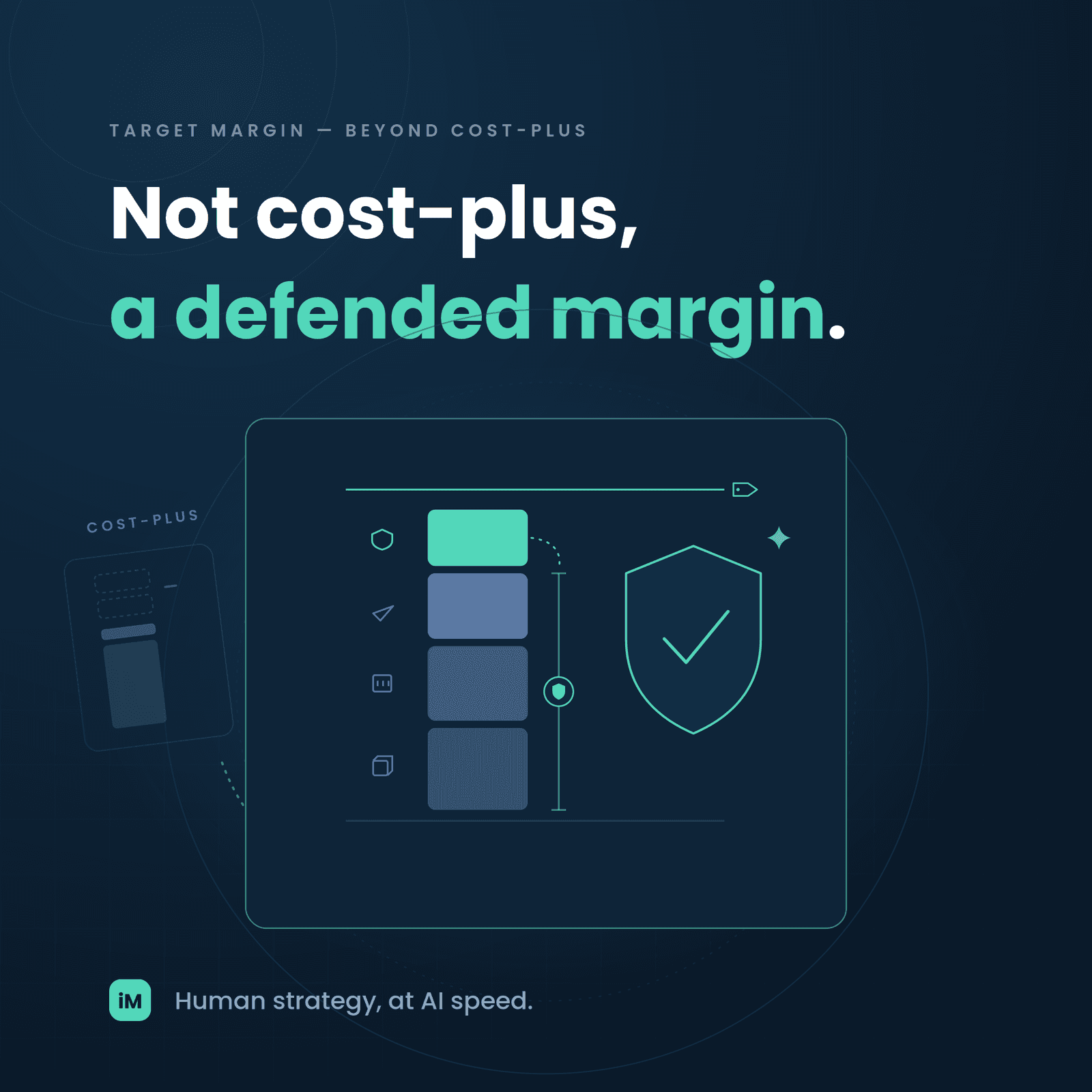
Cost-plus solves for a margin over product cost. It does not solve for a margin that keeps the enterprise profitable after overhead — rent, personnel, marketing, sales, technology, back-office. Those costs exist whether or not the product cost has been recovered, and they need to be recovered from the same pricing decisions. An enterprise that prices at cost-plus with a modest margin can operate busy every day, ship product every week, and still end the year with negative operating profit because the pricing was protecting product cost but not the full operating structure.
Rebuilding the target margin so that it protects the full operating structure — product cost plus overhead plus go-to-market — is one of the highest-return pricing moves an enterprise can make, and one of the least well documented in general pricing literature. This piece walks through why cost-plus falls short, what a target margin actually needs to protect, how to build one that survives the operating reality of the enterprise, and what the shift looks like in year one.
The cost-plus tradition emerged in industrial-era manufacturing, when the enterprise's cost structure was dominated by product cost — raw materials, factory labor, direct manufacturing overhead — and overhead outside the factory was a small share of the total. In that context, adding a margin to product cost was a reasonable approximation of the price needed to cover total costs plus a return, because product cost was most of total cost.
That context has shifted. In most modern enterprises — even those with meaningful product cost — the overhead outside of product cost has grown to a much larger share of the total operating structure. Marketing spend to acquire customers. Sales team compensation. Technology stack and platform fees. Rent and facilities in high-cost cities. R&D and product development. Customer support and success operations. These costs are real, they are recurring, and they need to be covered by the same price the enterprise charges, but they do not show up in the cost-plus arithmetic. Cost-plus is solving a problem that has become a subset of the actual pricing problem.
A target margin that is fit for a modern enterprise needs to protect three layers of cost, not one. Each layer has different characteristics, different visibility to the pricing team, and different sensitivity to volume — and skipping any layer produces a target margin that looks reasonable in the spreadsheet and fails in operations.
Product cost is the layer cost-plus already handles. Direct materials, direct labor if applicable, direct manufacturing or delivery overhead attributable to the specific product. This layer is visible to the pricing team, well-tracked in most enterprises, and relatively stable per unit. It is the layer that has to be covered first because every unit sold below its product cost destroys value, but covering it alone is not enough.
The pricing decision for this layer is essentially a floor decision — the price cannot go below product cost or the enterprise loses money on every unit. Cost-plus at least protects this floor. Where cost-plus stops working is when the target margin above the floor is set too low to cover the higher layers.
Overhead is the operating cost of running the enterprise that does not scale with the specific product being sold. Rent, personnel outside the product cost line, technology and platform costs, general administrative expenses. This layer is less visible to the pricing team because it is not tied to the specific product being priced. It is spread across the enterprise's total revenue base.
The pricing decision for this layer requires the pricing team to know what share of overhead the specific product needs to carry. If the product represents 20% of the enterprise's expected revenue, it needs to carry roughly 20% of the overhead — sometimes more, sometimes less depending on how the overhead breaks down. That share needs to be built into the target margin per unit, or the product will sell at a price that covers its own product cost while contributing nothing to the overhead the enterprise still has to pay.
Go-to-market cost is the cost of getting the product in front of buyers and closing the sale. Marketing spend to acquire the customer, sales team time to close the deal, retention and success costs to keep the customer, sometimes channel or referral fees. This layer varies materially by product, by market, and by channel. A product sold through a low-touch digital channel has a fundamentally different go-to-market cost from the same product sold through an enterprise sales team.
The pricing decision for this layer requires the pricing team to understand the go-to-market cost for the specific product and market being priced. A target margin built for a low-cost channel is not sufficient for a product sold through a high-touch channel, and vice versa. Enterprises that use a single target margin across channels tend to over-earn in the low-cost channels and under-earn in the high-touch channels, and the mix over time shifts toward the low-cost channels in a way that can hollow out the strategic position.
Building a target margin that protects all three layers is a specific analytical exercise. It is not more complicated than cost-plus in principle, but it requires the pricing team to have visibility into inputs that are often held by other functions — finance for overhead, operations for go-to-market cost. Getting the visibility organized is often the hardest part of the shift.
This exercise produces target margins that vary by product, market, and channel — because the underlying cost structure varies by product, market, and channel. That variation is a feature, not a defect. A single target margin across the enterprise is what cost-plus produces, and it is what causes the enterprise to over-earn in some corners and under-earn in others without knowing which is which.
Enterprises that make the shift from cost-plus to layered target margin tend to observe four specific failure modes in their previous pricing that the shift corrects. Naming them helps the pricing team understand what to look for as evidence that the shift is producing value.
The most common cost-plus failure is an enterprise that is operating at a high tempo — shipping product, closing sales, delivering service — but ending the quarter with operating profit meaningfully below plan. The pricing is covering product cost with a modest margin, but the modest margin is not enough to cover the overhead the enterprise still has to run. Volume is high, product margin looks reasonable per unit, but total earnings are low because the overhead absorption per unit is insufficient.
A layered target margin catches this failure at the pricing stage rather than the P&L stage. The required price includes the overhead absorption per unit, and if the market cannot bear that price, the enterprise sees the constraint before it accepts the business rather than after it delivers.
The second failure is products that are sold through high-touch channels — enterprise sales, complex delivery, hands-on onboarding — but priced with a target margin appropriate for low-touch channels. The go-to-market cost of the high-touch channel is not covered in the margin, and the enterprise effectively subsidizes the sales and delivery of the product out of general funds. The subsidy is invisible to the pricing team because the target margin looked appropriate at the time, and it accumulates over time as more high-touch business is closed at inadequate margins.
A layered target margin includes the go-to-market cost specific to the channel. High-touch products carry a higher target margin because the cost of delivering them is higher. Low-touch products carry a lower target margin because the cost of delivering them is lower. The enterprise stops subsidizing high-touch sales invisibly.
The third failure is more subtle. When cost-plus is used across a portfolio of products, the overhead is absorbed unevenly. Some products end up priced high enough to absorb their share of overhead and some others' share as well. Other products end up priced too low to absorb their own share, and the shortfall shows up in the total. The pricing team does not see this happening because each product's margin looks reasonable in isolation.
A layered target margin attributes overhead deliberately. Each product carries its documented share, and the pricing team can see which products are pricing above the attribution (earning excess) and which are pricing below (running a shortfall). The pricing conversation becomes explicit about which products are subsidizing which.
The fourth failure is specific to international expansion or new-segment entry. The enterprise enters a new market with the target margin used in the home market, without adjusting for the go-to-market cost specific to the new market. New markets typically have higher go-to-market cost per unit — brand-building spend, distribution setup, local sales support — that has to be recovered from a smaller initial volume base. The home-market target margin is insufficient, and the new market runs a shortfall for the first several years that is treated as "investment" when it is actually a pricing error.
A layered target margin builds the new-market go-to-market cost into the pricing decision from the start. The enterprise sees the required price early enough to either price the product into the new market appropriately or decide that the new market is not currently viable at a price the market will accept.
Cost-plus solves for a margin above product cost. A layered target margin solves for a margin above the whole operating structure. The difference is the difference between a pricing model that keeps the enterprise busy and a pricing model that keeps the enterprise earning.
Enterprises that shift from cost-plus to a layered target margin tend to hit specific patterns in the first year that indicate the shift is producing operating value.
inMOLA's Pricing Strategy module was built around the layered target margin approach rather than cost-plus. The calculation covers product cost, overhead absorption, and go-to-market cost as distinct inputs, and the recommended price is anchored to the target margin that protects all three — not just product cost. The result is a per-product, per-market recommendation that reflects the enterprise's real operating structure, not a cost-plus approximation of it.
The three-scenario range — aggressive, balanced, premium — is generated against this layered target margin. The aggressive scenario is the price closest to the credible band's floor that still covers all three cost layers. The balanced scenario is the default that fully covers the target margin at a mid-band price. The premium scenario is the price the market would bear at the top of the credible band, with the earnings above target margin captured as strategic upside. Each scenario is grounded in the layered structure and can be defended against finance's model rather than being an intuition-driven variation on a base number.
Because the module draws on the same continuously refreshed competitor and market data as the rest of the inMOLA decision engine, the credible band is grounded in the market's current state, not a stale snapshot. The pricing team can revisit the layered target margin decision every quarter with fresh market data and fresh operating data, and the resulting pricing is a running strategic decision rather than an annual accounting output. In 2026 that is the difference between enterprises that price to protect their business and enterprises that price to cover their product cost and hope.
Marketing Intelligence

Decision Intelligence

Marketing Intelligence