
Marketing Intelligence
Brand Reputation Monitoring · 15 мая 2026 г. · 11 мин чтения
Most brand monitoring is optimized to detect the wrong problem. Negative surge, viral incident, sentiment collapse — the entire alerting apparatus is built around noise, because noise is what the industry has learned to fear. In 2026 the more insidious reputation risk is the opposite: silence. The brand that used to be part of the category conversation quietly stops showing up in it, and the drift is invisible to every monitoring instrument tuned for volume or sentiment. Here is why brand silence has become one of the highest-leverage warning signals for enterprises, what it actually indicates, and why the enterprises building silence alarms into their monitoring stack are catching a category of reputation risk their competitors are not.
Most brand reputation monitoring is optimized to detect the wrong problem. Negative-sentiment surge, viral incident, coordinated attack — the entire alerting apparatus is built around detecting noise, because noise is what the industry has learned to fear. The tools promise to catch the crisis before it spreads, the tweet before it goes viral, the sentiment collapse before it consolidates. All of that matters. All of that is genuine reputation risk that a brand can and should catch.
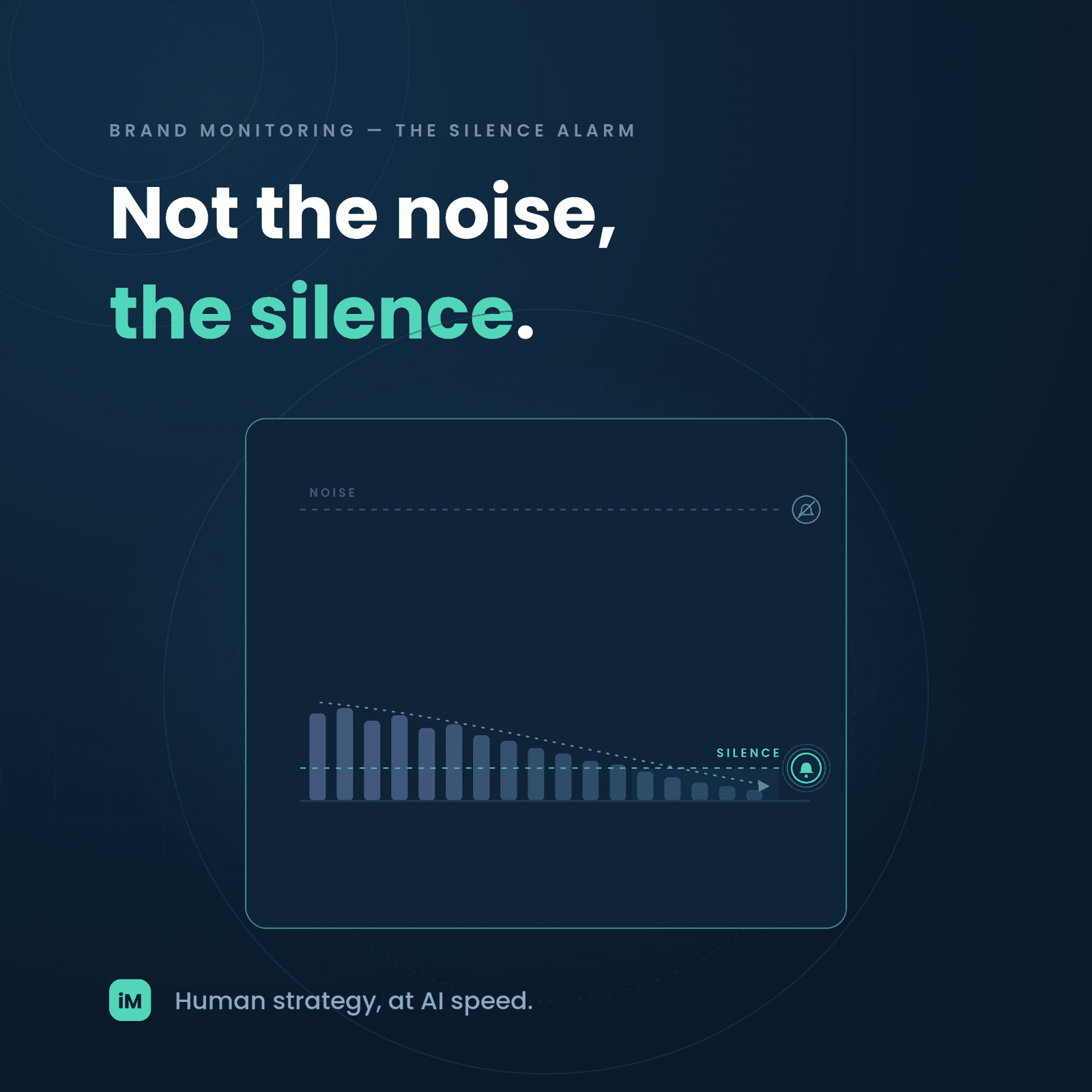
In 2026 the more insidious reputation risk is the opposite of noise. It is silence. The specific pattern of a brand that used to be part of the category conversation quietly ceasing to show up in it. The customers who used to reference the brand in their posts start referencing the competitor instead. The journalists who used to include the brand in category coverage stop doing so. The users who used to mention the brand when discussing the problem the brand solves talk about it without mentioning the brand at all. None of this is captured by a monitoring system tuned for negative surge or viral incident, because there is no negative and no viral to detect. The signal is the absence itself.
The enterprises that have started building silence alarms into their monitoring stack are catching a category of reputation risk that their competitors are not, because silence is the specific pattern that shows up before market share erosion becomes visible in the sales numbers. This piece walks through what brand silence actually indicates, why it is more consequential than most enterprises realize, and how enterprises are integrating silence detection into monitoring architectures that were originally designed only to detect noise.
Brand silence, as a reputation signal, is not the absence of any conversation. Every category has periods of low volume — post-holiday lulls, mid-quarter attention gaps, moments when the industry news cycle is dominated by unrelated stories. Silence in the diagnostic sense is a specific pattern that persists past those normal lulls and that co-occurs with continued conversation in the category the brand belongs to.
The precise pattern has three components that combine to distinguish diagnostic silence from routine low volume.
The first component is straightforward. Brand mention volume drops below the trailing baseline and stays below it for longer than the normal fluctuation window. A brand whose 90-day rolling median is 200 mentions per day, and whose current 14-day average has dropped to 80 mentions per day, is showing a silence pattern that is distinct from the routine week-to-week variance. The specific threshold and window vary by brand and category — some brands normally see day-to-day volume shifts of 3x that are not silence, others see 20% shifts that are — but the principle is that silence is a sustained departure below trailing baseline, not a single low day.
The second component is what distinguishes brand silence from category silence. The category the brand competes in continues to see active conversation. Competitors are being mentioned. Category-defining topics are being discussed. Adjacent brands are being included in comparisons. Only the target brand's participation in the conversation has dropped. This distinction matters because a brand whose mentions drop during a general category lull is not experiencing brand silence — the category is quiet, everyone is quiet, the pattern will reverse when category attention returns. A brand whose mentions drop while the category is loud is experiencing brand silence, and the reversal is not guaranteed.
The third component is the sharpest signal. In the same window that the brand's mentions have dropped below baseline, competitor mentions have risen or held steady. The audience has not lost interest in the category. The audience has redirected its attention to competitors instead of the target brand. This is the diagnostic pattern that separates silence-as-drift from silence-as-erosion. Drift is recoverable. Erosion — the specific pattern of audience attention shifting away from the brand toward competitors — is the reputation signal that most reliably precedes measurable market share loss.
The instinctive response to hearing that silence is a reputation signal is to accept it as concerning but rank it below actual negative sentiment. Negative sentiment feels worse because it is loud, specific, and directly attributable to a brand-damaging event. Silence feels neutral because it is quiet. In most cases this instinct has the ranking backward.
Negative sentiment, when detected in the crisis window, is a bounded problem. The trigger is specific. The response is specific. The audience view is still being shaped and can be influenced. The reputation impact, if managed well, heals over a defined timescale. Enterprises with playbook-driven crisis response typically recover from negative-sentiment events on quarterly timescales, sometimes faster.
Silence, by contrast, is an unbounded problem. There is no specific trigger to address. There is no discrete event the enterprise can respond to. There is only the pattern of drift — an audience that used to include the brand in its conversation quietly stopping — and the drift, unaddressed, tends to persist. The brand does not recover its position in the category conversation by chance. It recovers only through active intervention that reinserts the brand into the conversation it has faded from. Enterprises that do not detect the silence early enough to intervene often find that the conversation has consolidated around competitors, and re-entering it becomes an expensive campaign investment rather than a natural continuation of an existing position.
The financial expression of the difference matters. Negative sentiment costs a defined incident-response effort. Silence costs a fraction of category share that, once ceded, requires a much larger investment to recover. Enterprises that have run the retrospective analysis on their own reputation history typically find that the events that produced the largest long-term cost were not the loud crises they remember but the quiet silence periods they only detected months later. The loud crises hurt in the moment. The silence periods hurt for years.
The reason silence is one of the highest-leverage warning signals available to enterprise brands is that most monitoring architectures do not detect it. The tools are tuned for the opposite pattern — anomalous surge, sentiment breakdown, viral velocity. Their alerts fire when volume or negativity exceeds a threshold. They do not fire when volume drops below a baseline, because their default configuration treats low volume as normal or good.
The technical reason this happens is that traditional monitoring architectures were designed to solve the surveillance problem — to catch active events that require response. Silence, by definition, is not an active event. It is the absence of activity. The instrument that catches active events by design misses the absence of activity by design. Enterprises using default-configured monitoring tools are essentially blind to silence as a reputation signal, and they remain blind until the silence has persisted long enough to show up in the volume trend as an obvious anomaly — which is typically weeks or months after the pattern first began.
A properly configured silence alarm operates as a specific rule against the trailing baseline. When the brand's mention volume falls below a defined threshold — often expressed as a percentage below the trailing baseline — for a defined duration, and when the category-conversation and competitor-mention checks confirm that the silence is brand-specific rather than category-wide, the alarm fires. The specific parameters need calibration per brand — a large enterprise with heavy baseline volume needs different thresholds than a challenger brand with sparser baseline — but the structure is consistent.
The response to a silence alarm is different from the response to a negative-sentiment alarm. There is no specific incident to address. The response is diagnostic first, corrective second.
The first step is to understand what has changed. Has the brand's own content output dropped, so there is nothing new for the audience to react to? Has a competitor launched a campaign that has captured the category attention that used to be distributed more broadly? Has a category-defining topic shifted in a way the brand has not yet responded to? Has an executive change or brand-repositioning quietly moved the brand off the audience's mental map for the category? Each of these has a different response path, and getting the diagnostic right is what determines whether the response is effective or wasted.
The second step is to re-enter the conversation in a way that reflects the diagnostic. If the drift is caused by competitor category attention, the response is often a distinctive brand statement or campaign that reasserts the brand's position rather than competing directly with the competitor's frame. If the drift is caused by category shift, the response is a repositioning that connects the brand to the new frame the audience is using. If the drift is caused by internal content decline, the response is a re-establishment of consistent output. Each response works only if the diagnostic was correct.
The third step is to monitor whether the intervention actually reversed the silence. This is where the continuous monitoring layer is essential. The intervention is measured by whether the brand's mention share in the category conversation returns to baseline. If it does, the silence pattern was recoverable and the intervention worked. If it does not, the diagnostic was wrong or the intervention was insufficient, and the enterprise needs to re-diagnose rather than double down on an approach that is not producing the reversal.
The reputation risk that most enterprises fear is the loud one — the viral tweet, the sentiment collapse, the crisis that lands on the CMO's desk with an alert. The reputation risk that costs enterprises the most is often the quiet one — the specific pattern of silence that emerges when the audience stops including the brand in the conversation, and that persists long enough to consolidate around competitors. The enterprises that catch the quiet risk are catching what their competitors are still blind to.
inMOLA's Brand Sentinel module includes the silence pattern as a first-class alarm type alongside negative-trend surge and viral-negative-mention detection. The silence alarm fires when brand mention volume drops below the trailing baseline for a defined window, filtered through category-conversation continuity so the alarm distinguishes brand silence from category silence. The competitor-mention layer is available in the same monitoring surface, so the enterprise sees whether the silence pattern is co-occurring with rising competitor share — the diagnostic signal that most reliably predicts market share consequences.
The theme classification layer that operates on active mentions runs equally well on the residual conversation during a silence period, so the enterprise sees what the category is actually talking about while the brand is absent from it. That view is what supports the diagnostic — whether the silence is driven by a competitor push, a category shift, or an internal output gap — and the diagnostic drives the response path.
The strategic value of adding silence to the monitoring stack is not that the enterprise catches more crises. Silence is not a crisis in the sense the term is usually used. The value is that the enterprise catches the category of reputation risk that is not visible to noise-tuned monitoring, and that specifically costs the most when it is caught late. In 2026 the enterprises operating with silence detection layered onto their monitoring stack are holding category share across cycles that competitors are quietly losing. The compounding across cycles is where the strategic difference shows up, and it does not slow as long as the underlying reason silence matters — that audience attention, once redirected, does not naturally return — continues to hold.
Marketing Intelligence
Decision Intelligence

Marketing Intelligence