Marketing Intelligence
Influencer Marketing · 30 июня 2026 г. · 11 мин чтения
The fake-follower industry has grown into a shadow economy that costs brands hundreds of millions of dollars a year in wasted influencer spend. The economics work because the fraud is hard to detect and the detection responsibility sits with the brand, not the platform. In 2026 the authenticity signals that reliably separate real audiences from purchased ones are well understood, but most enterprises still do not use them systematically at the selection stage. Here is what those signals are, how they combine into an authenticity filter, and how enterprises that put the filter at the front of selection stop paying premium prices for audiences that will never engage.
The fake-follower industry is one of the more successful shadow economies of the past decade. Sophisticated services run at industrial scale, delivering plausible follower accounts to any Instagram, TikTok, or YouTube profile that pays for them, at prices that scale from a few hundred dollars for tens of thousands of followers up to five figures for accounts that add millions. The buyers are creators looking to raise their perceived tier before a brand negotiation, aspirational accounts trying to break through algorithmic gates, and — occasionally — accounts owned by opportunists who plan to monetize the inflated appearance directly.
The costs of this shadow economy are borne almost entirely by brands. When a creator with a genuine 200,000-follower audience adds 800,000 purchased followers to appear as a million-follower account, the brand that pays million-tier prices for a partnership is paying for a follower count that is 80% fictional and negotiating against a benchmark that is not real. The industry estimates for annual influencer-fraud losses are consistently in the hundreds of millions of dollars, and those estimates are almost certainly conservative because the enterprises absorbing the losses often do not know they have.
The paradox is that the fake-follower industry is not particularly hard to detect anymore. The authenticity signals that reliably separate real audiences from purchased ones are well understood — the industry has been mapping them for at least six years. But most enterprises still do not put those signals at the front of their selection process. This piece walks through what the authenticity signals are, how they combine into a filter that catches most fraud at the shortlist stage, and how enterprises that make the filter operational stop paying premium prices for audiences that will never engage.
The fake-follower industry keeps operating because three structural conditions make the fraud economically viable. Understanding those conditions helps enterprises see why the responsibility for detection sits with them rather than with the platforms.
A creator who adds 500,000 purchased followers for $5,000 can renegotiate their partnership rates upward by tens of thousands of dollars, sometimes hundreds of thousands. The purchase pays for itself many times over on the first campaign the creator wins at the inflated tier. And the follower count persists — the creator does not need to keep buying followers, they need to buy them once. The math is decisively in favor of the creator willing to run the fraud, and against the brand that would need to catch it before the negotiation closes.
Platforms perform periodic sweeps against obvious bot networks, and those sweeps do remove some purchased followers. But the sweeps target the low-quality end of the industry — the services that use obviously fake profiles, no photos, no bios, no activity. The high-quality end of the industry produces follower profiles that are indistinguishable from real accounts at the platform level. Profiles with photos, plausible bios, real posts, believable follow lists, and interaction patterns calibrated to look organic. These profiles survive platform sweeps because they look like the profiles the platform is trying to protect.
The third condition is that most brands still do not treat authenticity verification as a prerequisite before signing a partnership. They negotiate the deal, they pay, and the campaign runs against an audience whose real size is unknown. Some brands do post-campaign audits and discover the mismatch after the money is already spent. Very few brands make authenticity verification a gate before the negotiation begins. Until the gate exists, the fraud stays profitable, because the fraud is not being caught before it pays off.
Enterprises that put authenticity verification at the front of selection use a specific set of signals that combine to catch the vast majority of fraudulent accounts before a partnership is negotiated. None of the signals are individually decisive. All of them together produce a filter that is hard to game.
The most reliable single signal is the ratio of comments to likes on the creator's recent posts. Real audiences produce comments at a rate that is a meaningful fraction of the like rate — the exact ratio varies by category and creator, but typical healthy accounts sit somewhere between 0.5% and 3% of likes as comments. Purchased engagement almost always inflates likes more than comments because comment-purchase services are more expensive and less common. A creator whose comment-to-like ratio is an order of magnitude below the category norm is providing a signal that the like count is not fully organic.
The signal is not perfect. Some creators produce content that legitimately earns high like volume without many comments — visual content that people react to without commenting on. And some creators have communities that produce more comments than likes — text-forward creators, controversial content. The signal has to be read against the creator's content category and against the norm for creators of that type, not against a global constant. Read carefully, it is one of the strongest single indicators available.
The second signal is the shape of the creator's follower growth curve. Organic growth typically follows a pattern of steady acceleration, punctuated by occasional jumps when a specific post breaks out virally. Purchased growth typically produces sharp, unexplained spikes — a creator whose follower count jumped by 200,000 in a single day and then flatlined is showing a growth pattern that is not consistent with organic acquisition.
The signal requires historical data — the enterprise needs to see the growth curve, not just the current count. Discovery platforms that surface follower growth history are providing the input this signal needs. Discovery approaches that show only the current follower number are missing the shape that lets the enterprise distinguish organic accumulation from purchased spikes.
The third signal is the composition of the audience itself. Sampled audience-level data — the profiles of the followers, their activity levels, their own follower counts, their engagement patterns — reveals a great deal about whether the audience is a real audience. Purchased followers cluster into specific profiles that repeat across many creators who bought from the same services. Real audiences are heterogeneous. When a creator's follower base contains a high concentration of accounts that match known purchased-follower profiles, the signal is unambiguous.
This signal requires the most infrastructure — it requires sampled follower-level data and a reference library of purchased-follower profile characteristics. Enterprises with the tooling to compute it catch fraud that the surface-level signals miss. Enterprises without the tooling rely on the surface signals and catch most but not all of the fraud they need to catch.
The fourth signal is the alignment between the creator's posting cadence, the content they publish, and the size of the audience they claim. A creator with a million followers who posts twice a month, whose posts get engagement volumes appropriate for a 200,000-follower account, is providing a signal that the actual reachable audience is much smaller than the follower count suggests. The mismatch does not prove fraud — some creators are simply not posting well — but the mismatch is one of the strongest signals that the follower count is not translating into real reach, whatever the reason.
This signal often catches the residual fraud that other signals miss. When the comment-to-like ratio is borderline, the follower growth pattern is ambiguous, and the audience-quality sampling shows some concentration but not conclusively, the content-audience mismatch is often the final signal that tips the assessment. Enterprises using this signal in combination with the others catch fraud that any single signal would have let through.
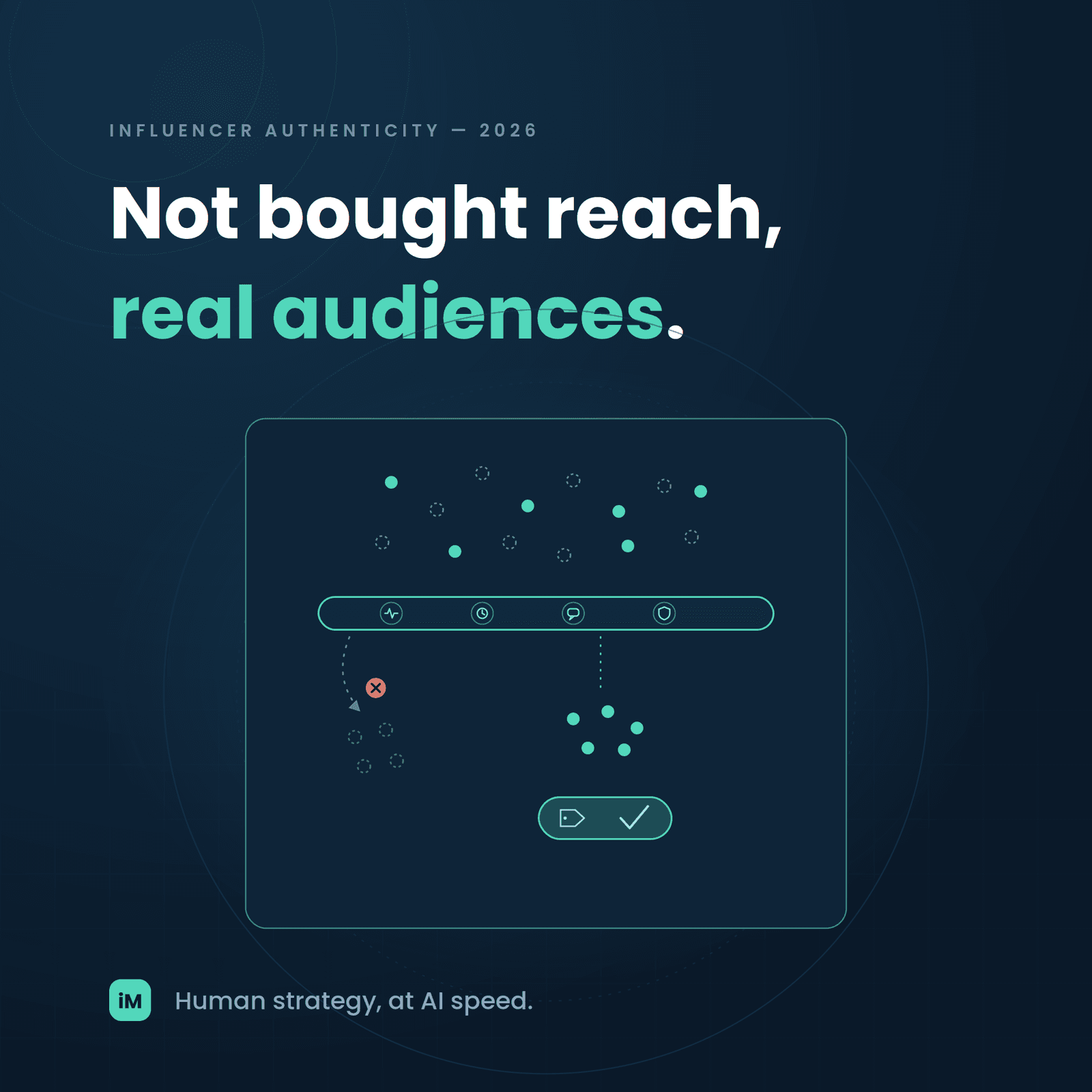
No single authenticity signal is decisive. In combination, they produce a filter that is hard to game because the fraud economy would need to spoof all of them simultaneously, and spoofing all of them is much more expensive than the fraud itself is worth. Enterprises operationalize the filter at the shortlist stage, before any negotiation begins.
The enterprise that operates this workflow essentially eliminates fake-follower risk from its shortlist. Not because every fraudulent creator is caught — some sophisticated fraud slips through — but because the combined filter catches the overwhelming majority, and the residual risk is contained enough that it does not shape the campaign's ROI. Enterprises that skip the filter run the ROI risk in every campaign, not because every campaign involves fraud, but because a portion of the campaigns do, and the enterprise does not know which.
Authenticity signals are one part of a broader brand-safety layer that enterprises running influencer programs at scale operate. The brand-safety layer catches other categories of risk that fake followers do not — content that would embarrass the brand if it went out under the partnership, past controversies that would carry over to the campaign, associations with categories the brand does not want to be near. The brand-safety layer is not automated in the same way authenticity detection is — some of it requires judgment — but it is structured, and it lives at the front of selection rather than being discovered after the campaign runs.
The two layers together — authenticity verification and brand-safety review — turn creator selection from an exercise in trust into an exercise in verification. The enterprise no longer takes the creator's numbers at face value. It runs the numbers against known fraud patterns and against brand-safety criteria before the negotiation begins, and the negotiation happens against a candidate whose actual audience is verified rather than assumed.
The fake-follower industry keeps operating because most brands do not make detection a purchase precondition. The signals that catch fraud are well understood, they are not exotic, and they combine into a filter that is hard to game. The enterprises that put the filter at the front of selection stop paying for audiences that will never engage. The enterprises that skip the filter keep discovering the same problem in the post-campaign audit — a few campaigns per year, quietly and without correction.
inMOLA's Influencer Marketing module surfaces authenticity signals as first-class outputs on every candidate. Comment-to-like ratio against category norms, follower growth pattern history, posting cadence, verified status, active days, and the composite authenticity signal that feeds the Quality Score directly — all visible at the candidate view rather than buried in a post-campaign audit report.
Brand-safety flags run alongside authenticity checks, catching categories of risk that authenticity alone does not — sensitive content associations, past controversies, category proximities the brand has flagged as off-limits. Together they form a filter the campaign team can apply before the shortlist is finalized rather than after the campaign has already run.
The strategic value of the filter is not that it produces new metrics. The value is that authenticity and brand safety move from post-campaign discoveries into pre-partnership gates. Campaigns get selected against verified audiences, from creators who have cleared the brand-safety review, at prices calibrated to the actual reachable audience rather than to inflated follower counts. In 2026 the enterprises operating this way are running campaigns whose ROI reflects the audiences they actually paid to reach. The enterprises that skip the filter keep running campaigns whose ROI is diluted by fraud they never caught — and the dilution compounds across the campaign portfolio.
Marketing Intelligence
Decision Intelligence

Marketing Intelligence