Marketing Intelligence
Your customer is no longer searching for your brand — they are asking about it. And if your name does not appear inside the answer an assistant produces, you are simply absent from that conversation. The good news: this layer is not left to chance. It is a channel you can work on.
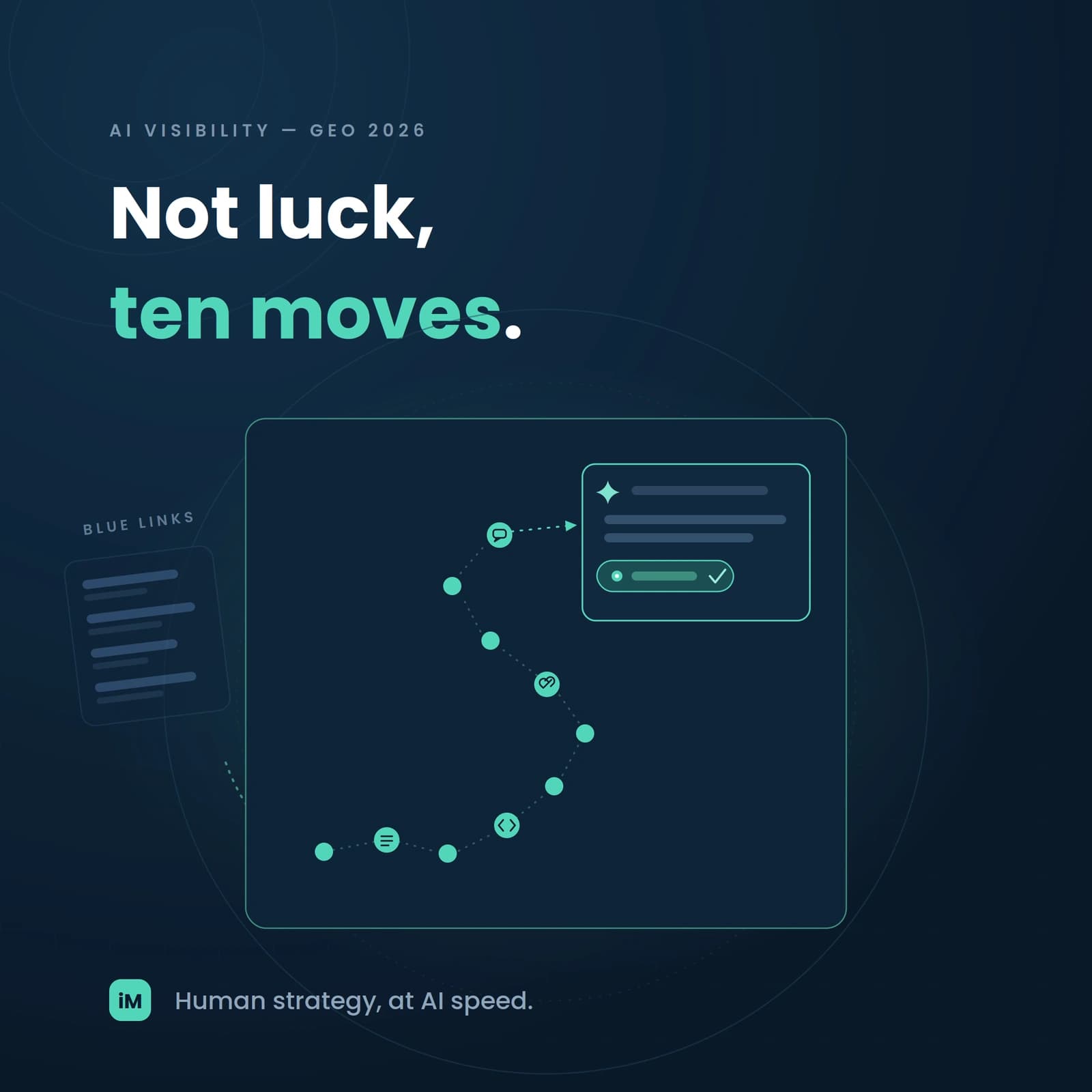
This is not a "what is AI visibility" piece. There are ten jobs here, in order, each with what it is, why it works, and how you verify the result once it is done. We covered the conceptual frame in two earlier articles; this one goes to the field.
The most common mistake teams make is collapsing everything into a single heading. There are three independent problems here, and each is solved by different work:
If the assistant does not know you, you need citable sources. If it knows you but describes you wrong, the problem is not content — it is contradictory sources. If it describes you correctly but never recommends you, what is missing are trust and comparison signals. The ten ways below distribute across these three.
Language models resolve a brand name as an entity. If your site says "inMOLA", LinkedIn says "Inmola Teknoloji" and the press says "InMola", the model struggles to merge those into one company — and ends up fully trusting none of them. Make the spelling, the one-sentence definition and the category identical everywhere: website, social profiles, industry directories, press releases.
How to verify: ask three different assistants about your brand name separately. Do all three describe the same company in the same category? If one confuses you with another firm, your entity resolution is broken.
Assistants look for sentences that still stand up when torn out of context. In the first paragraph of the page, answer the question that page exists to answer — in one sentence, with the brand name inside it. Long wind-ups, storytelling and "in this article we will explore" openers cannot be quoted.
"Our Solutions" is not a heading. "How brand visibility is measured" is. People ask assistants in question form; the closer your heading sits to that question, the stronger the match. For each important page, write the target question first, then build the page as the answer to it.
Models do not quote the general knowledge everyone repeats — they quote the number that exists nowhere else. A ratio pulled from your own customer data, a benchmark table built for your industry, an annual state-of-the-market report: this is the single biggest lever on your odds of being cited. It also happens to be the one thing a competitor cannot copy.
Organization, Article and FAQPage schemas let a model parse your page rather than guess at it. FAQPage is particularly effective, because a question-and-answer structure maps exactly onto the shape of the answer the assistant is about to generate. Schema is an engineering job, not a content job — set up once, it works across every page.
Your own site is not enough on its own; models cross-check. The same fact appearing identically in independent sources is what produces a trust signal. That is why industry directories, neutral comparison sites, press coverage and structured open sources like Wikidata matter. Existing in one source beats existing in none — but appearing consistently across three independent ones is far stronger.
Run this test: tear one section out of the article and read it alone. Does it still make sense? If it does, a model can quote it. Use short paragraphs, clear subheadings, tables, bullet lists and definition sentences instead of long winding prose. It also happens to read better for humans — a rare win-win.
When a question is asked in Turkish, the assistant answers largely from Turkish sources. Strong English content does not guarantee visibility in another language. Your non-English pages need to be written, not machine-translated — carrying local search habits, local terminology and local sources. For brands operating in a specific national market, this is the most frequently skipped step.
You may be blocking AI bots in robots.txt without realising it — check this first, because none of the other nine items work behind a closed door. Then add llms.txt: a short plain-text summary telling the model what your site is, which pages matter, and how your brand should be described.
AI answers shift within weeks as models update and source pools change. An assistant that recommends you this month may recommend your competitor next month — even if you changed nothing. Monthly reporting shows you that drift only after the event has closed. Your measurement cadence has to match the rate of change.
These ten jobs are not equal and they are not run in random order. Do number 9 first — if the door is shut, no content work pays off. Then number 1, because while entity resolution is broken, every piece of content you produce is filed under the wrong address. Numbers 2, 3 and 7 are edits you can start on existing pages today, and they return the fastest. Numbers 4 and 6 are long-term investments; the effect compounds over months, but they build the most durable advantage.
Every one of these ten items stays a matter of faith until you can see the result. "Did our AI visibility improve" is not answered by manually asking a few assistants — that method is one-off, not repeatable, and contains no competitor comparison.
The inMOLA AI Visibility module measures exactly this: whether assistants know your brand, how they describe it, which assistant surfaces you and which does not, and which competitor gets recommended in your place. It tracks the change month over month, flags misrepresentations, and produces the concrete steps needed to fix them. Module detail: inmola.com/products/ai-visibility
If you want a free starting point, the AI Visibility tool on our homepage scans your brand across three assistants and shows you where you stand.
Those four are a week of work and none of them need budget. The remaining six are a quarterly roadmap — but do not start them before measurement is in place, or you will never know what worked.
Marketing Intelligence
Decision Intelligence
Marketing Intelligence