
Marketing Intelligence
Social Media KPI · 18 يونيو 2026 · 11 دقيقة قراءة
For a decade, social media reporting was built on impressions — a number that inflated over time until it stopped telling anyone anything useful. In 2026 that number has quietly lost its authority, and the enterprises that still build their social decisions on it are optimizing against noise. This piece explains what changed, what a real-view measurement actually looks like, and why the shift toward genuine viewership numbers is one of the most consequential changes in social measurement in the past decade.
For roughly a decade, the default unit of social media reporting was the impression. A brand posted, the platform counted how many times the post appeared in a feed, and the number arrived in the monthly report as evidence of reach. Ten million impressions meant the campaign had worked. One million meant it had not. The number was easy to summarize, easy to compare across platforms, easy to put on a slide. It was the currency of social measurement, and it was mostly accepted at face value.
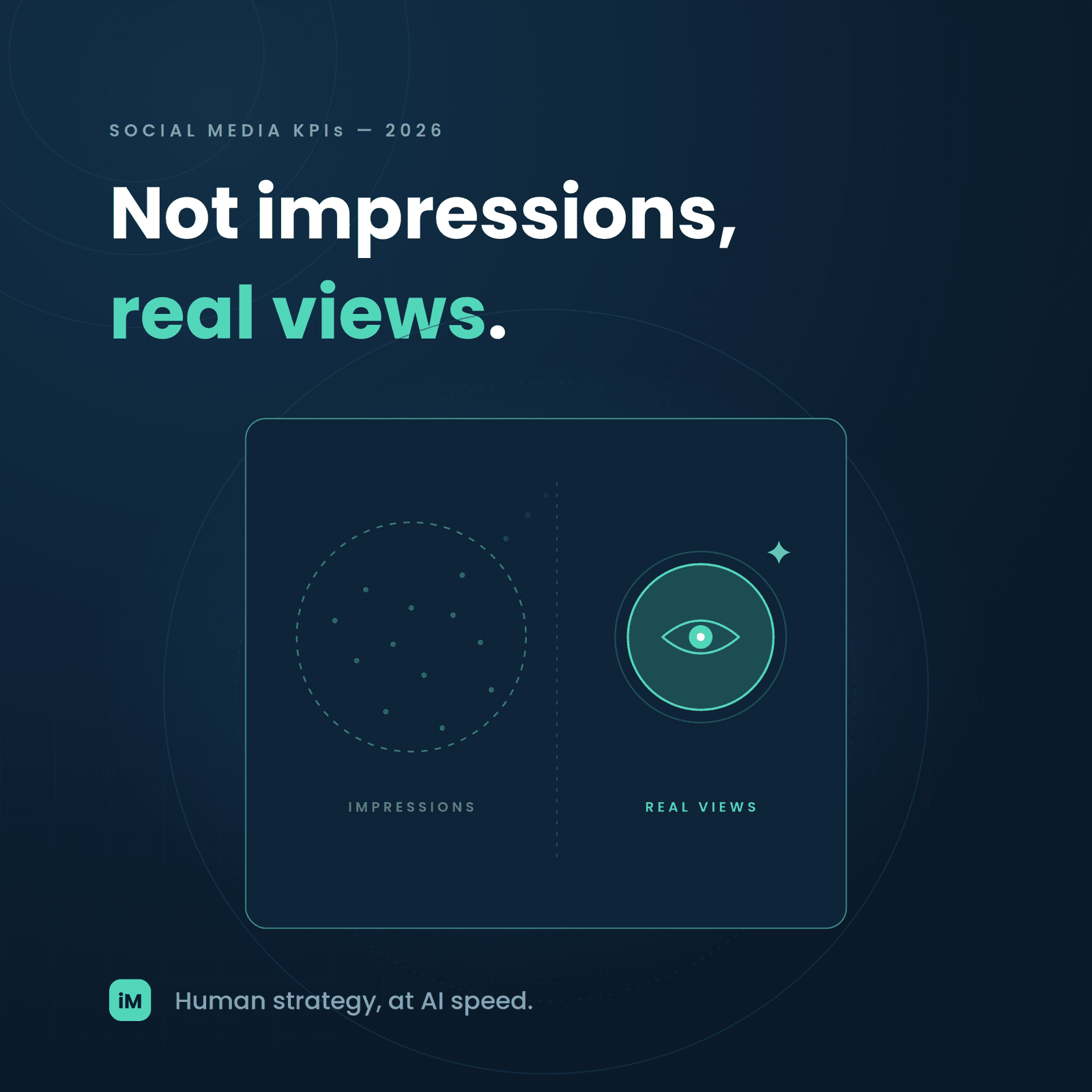
The problem with the impression era was that the number quietly stopped meaning what it originally meant. Platforms tuned their algorithms in ways that inflated impression counts without materially changing the underlying audience exposure. A single scroll past a post at high speed could count. A post that flashed on screen for a fraction of a second could count. Autoplay video that a user never actually watched could count. By 2023 the impression number on many platforms had inflated to the point where a brand could show impressive year-over-year growth while its actual audience engagement stayed flat or declined.
In 2026 the impression has quietly lost its authority as a decision-grade metric. The advertisers, the reporting teams, and the sharpest social leads have all internalized the same insight — the number they were treating as reach was measuring something closer to fleeting exposure, and it was not the input they should have been building strategy on. The shift toward real-view measurement is the response, and this piece walks through what changed, what a real-view metric actually looks like, and why the shift is one of the most consequential changes in social measurement in the past decade.
Impression inflation was not a scandal. There was no single moment when platforms decided to make the number bigger. It happened gradually through a series of individually reasonable product decisions, each of which was defensible in isolation and each of which added a little to the total.
First was the shift to more aggressive feed algorithms. As competition for attention grew, platforms tuned their feeds to keep users scrolling longer. Posts appeared in more feeds. Each user saw more content per session. From the platform's perspective this was engagement. From the impression count's perspective this was inflation — a single post could now appear in ten times as many feeds as it would have five years earlier, without the underlying audience getting ten times more interested in the brand.
Second was the change in what counted as an impression. In the early years, most platforms only counted an impression when the post entered the visible screen area. Over time the definition loosened. A post that was scrolled past at speed might count. A post that appeared in a story that the user swiped away from before it finished loading might count. A video preview that autoplayed in the feed might count as multiple impressions across its runtime. Each change was small. Together they added up.
Third was the rise of video content and the way video impressions were counted. A video that autoplayed for less than a second in a scrolling feed was often counted the same as a video the user actively watched. This was particularly severe on platforms where autoplay was aggressive and the video preview was less than a full second. The impression number was technically accurate — a video had been served to a screen — but it was not measuring anything a marketer would recognize as viewership.
Fourth was the growing gap between platforms in how they defined impressions, which made cross-platform comparison increasingly unreliable. A million impressions on one platform meant something very different from a million impressions on another. The number looked comparable in a reporting spreadsheet. Underneath the surface, the definitions had drifted apart to the point where the comparison was more misleading than informative.
The shift toward real-view measurement is not a single new metric that replaces impressions. It is a discipline of measuring what actually happened for each content type on each platform, rather than accepting whatever number the platform surfaces as the top line.
For video content, the real-view measurement is grounded in genuine viewership — actual seconds watched, completion rates, and platform-reported view counts that reflect meaningful engagement rather than autoplay flashes. Where the platform provides a distinction between short exposures and genuine views, real-view measurement uses the genuine view number. Where the platform does not make the distinction cleanly, the measurement discipline factors in the completion rate or the average watch time to sanity-check the raw view count. The output is a viewership number that a marketer can defend to a CFO as representing actual audience attention.
For static and image content, the real-view discipline is different. Static posts do not have the same watch-time signal that video does, so the real-view estimate has to be grounded in the audience the content genuinely reached. This is where follower-based reach estimation becomes valuable — the reach a piece of content can plausibly earn, given the follower base and the observed organic pattern, is a defensible estimate that does not depend on inflated impression counts. A post that reached roughly 15% of a follower base is a very different signal from a post that reached 80% of it, and the difference is genuinely informative even without an authoritative platform-supplied impression number.
The overarching principle is that different content types require different measurement grounding. Video views can be measured directly, with completion signals. Static content reach can be estimated from the follower base and the organic pattern. Neither is an inflated impression count. Both are numbers a marketer can defend as representing what actually happened, rather than as representing the platform's most-generous interpretation of what happened.
The shift from inflated impressions to real-view measurement changes several downstream decisions that most social teams make routinely.
When impression numbers are inflated at different rates across platforms, cross-platform comparison is unreliable. A team that reports "we grew impressions 40% year-over-year on Platform A and 15% on Platform B" cannot conclude that Platform A is more valuable, because it does not know how much of each number is inflation. Real-view measurement grounded in genuine engagement produces cross-platform numbers that are actually comparable. The team can conclude which platform is genuinely growing and which is not, and reallocate investment accordingly.
Content teams that use inflated impressions as their feedback loop struggle to learn which content is genuinely working. A post that got ten million impressions but had a very low engagement rate might have been served aggressively by the algorithm without producing real attention. A post that got two million impressions but had a strong engagement rate genuinely reached and held an audience. Real-view measurement makes the second post look more valuable, which is the correct signal for the content team's next decision. Inflated impression measurement can make the first post look more valuable, which trains the content team to make more of the wrong kind of content.
Executives who have started to notice the impression inflation problem are pushing back on impression-based reports. A CFO who is asked to fund a social program based on impression growth will increasingly ask what the impression number actually represents, and the answer "the platform served the content this many times" is a weak defense of the budget. A real-view-based report answers a different question — how many people genuinely saw or watched the content — and that answer is defensible without needing to explain platform quirks. Reporting teams that make the shift find their executive conversations become easier, not harder.
Real-view measurement lets brands separate organic reach from advertising reach in a way that inflated impressions blur. A brand can now see genuinely what its organic content is achieving, and separately what its paid content is achieving, without the numbers being combined into a single inflated total. The advertising decisions and the organic decisions are then made against their own baselines rather than against a shared inflated number that hides the mix.
The shift toward real-view measurement is a substantial improvement, but it does not solve every problem in social measurement. Naming the remaining challenges lets teams understand where real-view is decisive and where additional discipline is still required.
Real-view measurement does not solve attribution to conversion. Knowing that a post genuinely reached 200,000 people does not tell you how many of those people converted or how much revenue the post generated. The attribution challenge sits above real-view measurement and requires separate handling — through UTM tracking, downstream analytics, and time-series analysis of conversion patterns against social activity.
Real-view measurement does not solve creative quality assessment. A post can genuinely reach a large audience and still fail to move brand perception in the desired direction. The creative side of social measurement — did the content say what the brand wanted said, in the way the brand wanted said it — is separate from the reach measurement and requires its own assessment framework.
Real-view measurement does not solve competitive benchmarking on its own. Knowing your own real-view numbers is more useful than knowing your inflated impression numbers, but it does not tell you where you sit relative to competitors. Competitive benchmarking requires visibility into competitor content performance, which is a separate discipline that layers on top of real-view measurement rather than being solved by it.
Enterprises that are shifting from inflated impressions to real-view measurement tend to do it in a specific sequence. The sequence matters because the intermediate steps produce the operational learning that determines whether the shift sticks.
Impressions inflated quietly for a decade until the number stopped telling anyone anything they could act on. The shift to real-view measurement is the discipline of measuring what actually happened, rather than accepting what the platform decided to say happened. In 2026 that discipline is what separates social programs that inform decisions from social programs that produce reports.
inMOLA's Social Media KPI module is built around real-view measurement rather than inflated impression totals. For video content — Reels, Shorts, TikTok posts, YouTube video — the module surfaces the platform's genuine view counts, with completion signals where the platform provides them. For static and image content, where an inflated impression number would be least reliable, the module grounds reach in the follower base and the organic pattern rather than accepting the platform's most-generous number. The measurement each brand sees reflects what actually happened, not what the platform's algorithm decided to attribute.
Because the module tracks the six major platforms — Instagram, Facebook, YouTube, LinkedIn, X, TikTok — with the same measurement discipline, cross-platform comparison becomes honest. A brand can see which platform is genuinely growing its audience and which is not, decide where to invest incremental effort, and defend those decisions against executive scrutiny with numbers that are not inflated. The follower growth trend, the engagement rate, and the real-view numbers all sit in the same panel, which is what turns the monthly social conversation from a defense of an inflated number into a discussion of what is actually working.
The strategic value of the shift is not that the numbers look bigger — they mostly look smaller once the inflation is removed. The value is that the decisions being made against them are stronger. Content decisions get better signal. Platform investment decisions get honest cross-platform comparison. Executive reporting gets defensible answers to the questions executives are now asking. In 2026 the social programs that made the shift have already started to compound their advantage against the ones still reporting inflated impressions — and the compounding is not going to slow down.
Marketing Intelligence

Decision Intelligence

Marketing Intelligence