Marketing Intelligence
AI Visibility · 31 مايو 2026 · 11 دقيقة قراءة
The monthly SEO report told you what happened. In 2026, that rhythm is too slow for AI search. AI visibility is a live signal that shifts weekly, sometimes daily, as models update and the web around your brand changes. Here is why continuous AI visibility tracking has become the new operating requirement, what to measure, and what enterprises are getting wrong when they try to bolt AI tracking onto an SEO reporting cadence.
The monthly SEO report is a familiar artifact. Rank positions. Organic traffic. Click-through rates. Backlink additions. Delivered on a Monday morning to a marketing leader who reviews it, notes the top three concerns, and moves on to the next thing. That rhythm worked for SEO, because SEO shifts on quarterly timescales — algorithm updates, content investments, and link-building efforts take weeks to move the needle.
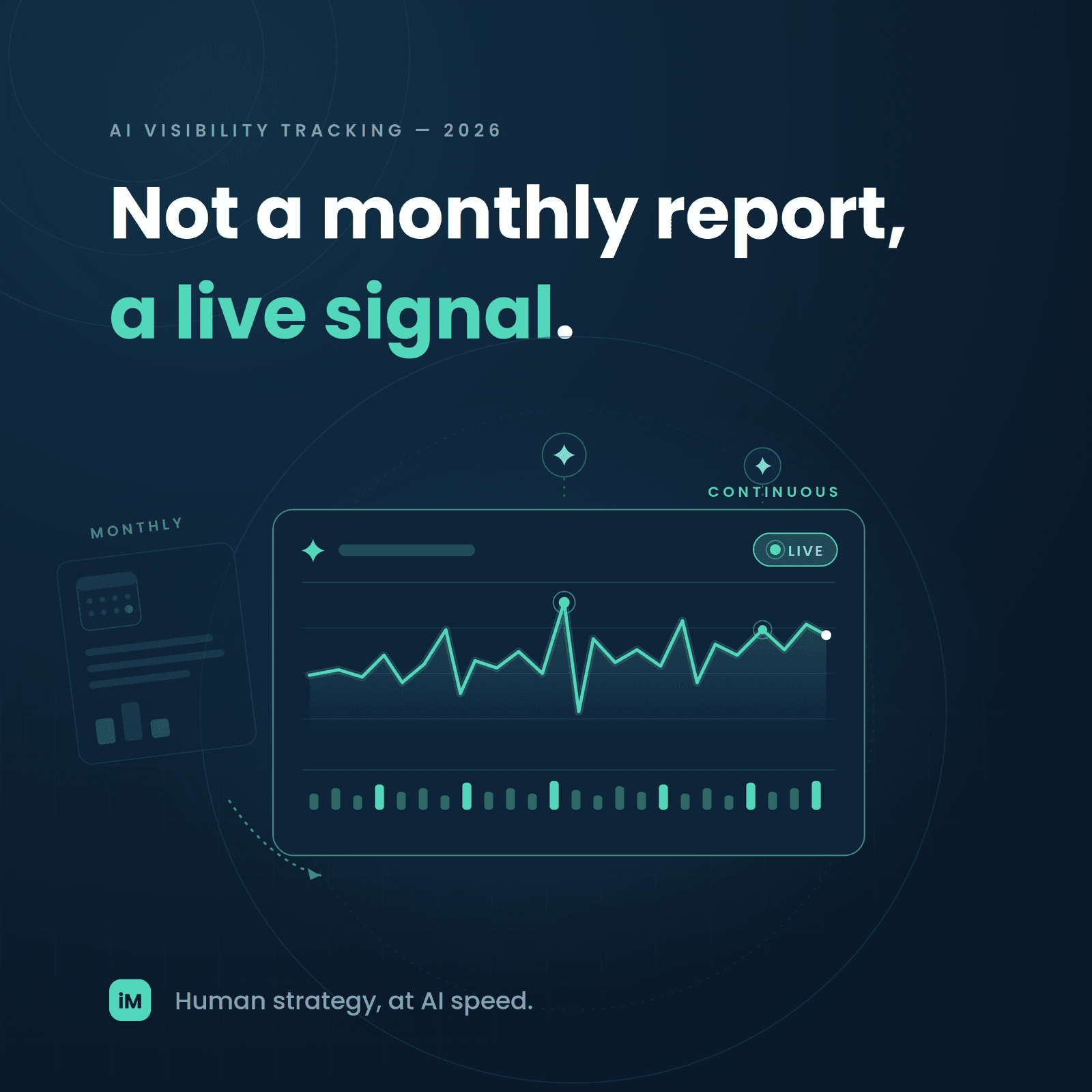
AI visibility does not work like that. In 2026, a brand's presence inside ChatGPT, Perplexity, Gemini, and Claude can shift materially in the space of a week — sometimes a day — as models are updated, as the sources they retrieve from change, and as competitors publish new material that reshapes how the AI describes the competitive set. The monthly report cadence that made sense for SEO is too slow for AI visibility. And enterprises that treat AI visibility as "another line in the SEO monthly report" are systematically missing the shifts that matter.
This piece argues for continuous AI visibility tracking as the new operating requirement for enterprise marketing, explains what continuous actually means and what it does not, and names where inMOLA's AI Visibility module fits — because continuous tracking is precisely the operating rhythm the module was built to sustain.
Three mechanisms make AI visibility a fast-moving signal in ways SEO is not.
First, model updates. Major AI engines push model updates on schedules that vary from monthly to more frequent. Each update can shift retrieval behavior, source weighting, and answer composition. A brand that was cited consistently in category-level queries before an update may find itself paraphrased without citation after one — or vice versa. These shifts are invisible to enterprises measuring only at monthly intervals; they appear as "performance changed" without a clear cause.
Second, live retrieval variability. AI engines increasingly use live web retrieval to answer queries. That means the sources they consult, and therefore the brands they mention, change as the web changes. A newly published industry report that mentions your competitor but not your brand can shift AI answers within hours. A Wikipedia edit to your brand's entry can propagate to AI responses across engines within days. These changes are outside the enterprise's direct control, but they are measurable.
Third, competitive content velocity. Competitors publishing new positioning content, new original research, or new comparison pages can shift how AI engines describe the competitive set. This is not the same as SEO ranking competition. It is descriptor competition — the adjectives, categories, and framings AI engines use about you versus your competitors. Descriptor competition moves faster than rank competition.
The compounding effect of these three mechanisms is that AI visibility is best modeled as a live signal, not a periodic snapshot. Enterprises that treat it as periodic are always looking at the past. Enterprises that treat it as live are looking at the present.
"Continuous" is easy to say and hard to define. In the context of enterprise AI visibility, continuous tracking has a specific operational meaning: a query set is being executed against the target AI engines on a schedule frequent enough to detect meaningful shifts, and the results are being compared to a rolling baseline that surfaces when performance has moved outside normal variance.
The scheduling frequency depends on category and competitive intensity. For most enterprise B2B categories in 2026, weekly execution against a defined query set is the minimum, with daily execution against a subset of high-priority queries. For fast-moving software and platform categories, daily execution is often the baseline with hourly spot-checks on critical queries. For slower-moving industrial or professional-services categories, weekly is often sufficient.
What continuous does not mean: running queries constantly and drowning marketing teams in noise. The value of continuous tracking is not in the raw frequency but in the ability to detect meaningful shifts against a baseline. Well-designed continuous tracking produces exception-based alerts — you hear about it when the baseline moves, not when everything is normal — while the underlying measurement runs in the background.
When an AI engine pushes a model update, the effects on brand visibility can be immediate but heterogeneous — a brand may gain visibility on some queries and lose it on others. Monthly reporting either misses this entirely (if the change reverses within the month) or reports a net effect that averages gains and losses without exposing the pattern. Continuous tracking catches the update at the moment it happens, isolates which queries moved, and enables a targeted response.
For enterprise marketers, the actionable insight from model-update tracking is often not "defend against the update" but "understand the direction the model is drifting." AI engines tend to shift systematically over time — toward certain source types, certain content styles, certain descriptor patterns. Enterprises that see those drifts early adapt their content strategy proactively. Enterprises that see them only in monthly averages adapt reactively, months later.
A competitor publishing a well-positioned piece of original research can shift how AI engines describe the competitive set in ways that reveal themselves quickly in continuous tracking and slowly, if at all, in periodic reporting. "Vendor X is known for A, B, C" becomes "Vendor X is known for A, B, C — and increasingly for D, where they are seen as leading." That "increasingly for D" is a descriptor shift, and it is often the leading indicator of a competitive move that will show up in shortlist inclusion three months later.
Continuous tracking catches descriptor shifts as they emerge. Periodic reporting catches them after they have already influenced multiple buying journeys. The difference is not academic — the enterprises that see descriptor shifts early respond with counter-positioning while the shift is still contested. The ones that see them late respond after the descriptor has hardened.
The queries buyers ask AI engines are themselves changing. New categories emerge. Old queries fade. The language buyers use to describe a problem shifts as the market matures. A query set defined in Q1 and used unchanged through Q4 will progressively drift from what buyers are actually asking, and the AI visibility measurements against that stale query set will progressively lose signal.
Continuous tracking supports continuous query-set curation. As buyers' language shifts, the tracked queries update. The measurement stays relevant. Enterprises that treat their query set as a fixed input and their AI visibility as a periodic output tend to end the year with a measurement system that is technically working but measuring the wrong questions.
The most common failure mode is asking the SEO team to "add AI tracking" to the existing monthly reporting rhythm. This produces two failures at once. It puts AI tracking on the wrong cadence — monthly is too slow. And it puts it in tools designed for SEO metrics — SERP tracking platforms that were not built to measure inclusion inside a synthesized paragraph. The output looks like a report but reveals nothing actionable.
Some enterprises implement continuous tracking but measure the wrong things at high frequency. Tracking daily changes in "AI visibility score" is a vanity metric if it is not decomposed into shortlist, comparison, and validation moments, and if it is not compared against competitors. Continuous measurement of a bad metric is worse than periodic measurement of a good one, because it creates false confidence in an operating rhythm that is not producing actionable insight.
Continuous tracking without a response mechanism is expensive telemetry. If your team can see that AI visibility shifted on Tuesday but cannot act on the shift until the next quarterly planning cycle, the tracking rhythm is decoupled from the operating rhythm and the value is not being realized. Continuous tracking requires a matching cadence of response — weekly review, monthly targeted action, quarterly strategic recalibration.
The monthly report told you what happened. Continuous tracking tells you what is happening. In AI search, that is the difference between reacting and deciding.
inMOLA's AI Visibility module runs continuous measurement against a configured query set — daily on high-priority queries, weekly on the broader set — across ChatGPT, Perplexity, Gemini, and Claude. Rather than delivering a monthly report, it maintains a rolling baseline and surfaces exception-based alerts when performance moves outside normal variance. The team sees the shift when it happens, not the average of shifts at the end of the month.
Each shift is decomposed into its likely cause — model update, source retrieval change, competitor content publication, query set drift — so the response is targeted rather than diffuse. This is the difference between "AI visibility declined 8% this month" and "AI visibility on your top three category queries declined after Perplexity's live-retrieval update prioritized a new industry publication that describes your competitors more prominently than you." One requires investigation. The other enables action.
Because AI Visibility sits inside inMOLA's 64-module decision engine, the continuous signal connects to the broader marketing decision layer. A shift in AI visibility is contextualized against competitor benchmark movements, brand sentiment changes, PR media value, and campaign performance — so the response is coordinated across the marketing operating team, not siloed in a specialist tracking function.
Enterprises still on a periodic AI reporting cadence can shift toward continuous tracking with three concrete moves:
Doing those three things converts AI visibility from a lagging monthly indicator into a live decision signal. That conversion is not just a reporting improvement. It is the difference between reacting to AI shifts and deciding what to do about them in the same cycle they occur.
In 2026, AI visibility is the layer where the next decade of enterprise marketing is being contested. The monthly report was designed for a slower world. The brands that shift to continuous tracking now compound their advantage against the ones still waiting for the end-of-month PDF. The measurement rhythm decides the decision rhythm — and in AI search, the decision rhythm decides the result.
Marketing Intelligence
Decision Intelligence
Marketing Intelligence