
Marketing Intelligence
Social Media KPI · 26 مايو 2026 · 12 دقيقة قراءة
Most enterprise social reporting still lives in a monthly slide deck — a document produced at the end of each month, reviewed briefly, and filed. That format made sense when social was a supporting channel. In 2026 it does not. This piece walks through how leading enterprises are shifting from monthly report production to a single-pane operating rhythm, what changes about the team's workflow, and why the shift compounds returns against enterprises still stuck in the monthly-deck cycle.
Most enterprise social reporting still lives in the same place it lived a decade ago — a monthly slide deck. The deck is produced at the end of each month by an analyst who pulls numbers from six platform dashboards, assembles them into a template, adds a few interpretive slides, and sends the file to the marketing leadership team. The leadership team looks at the deck briefly, comments on a few numbers, and files it. The cycle repeats the following month with a similar deck built from the same template.
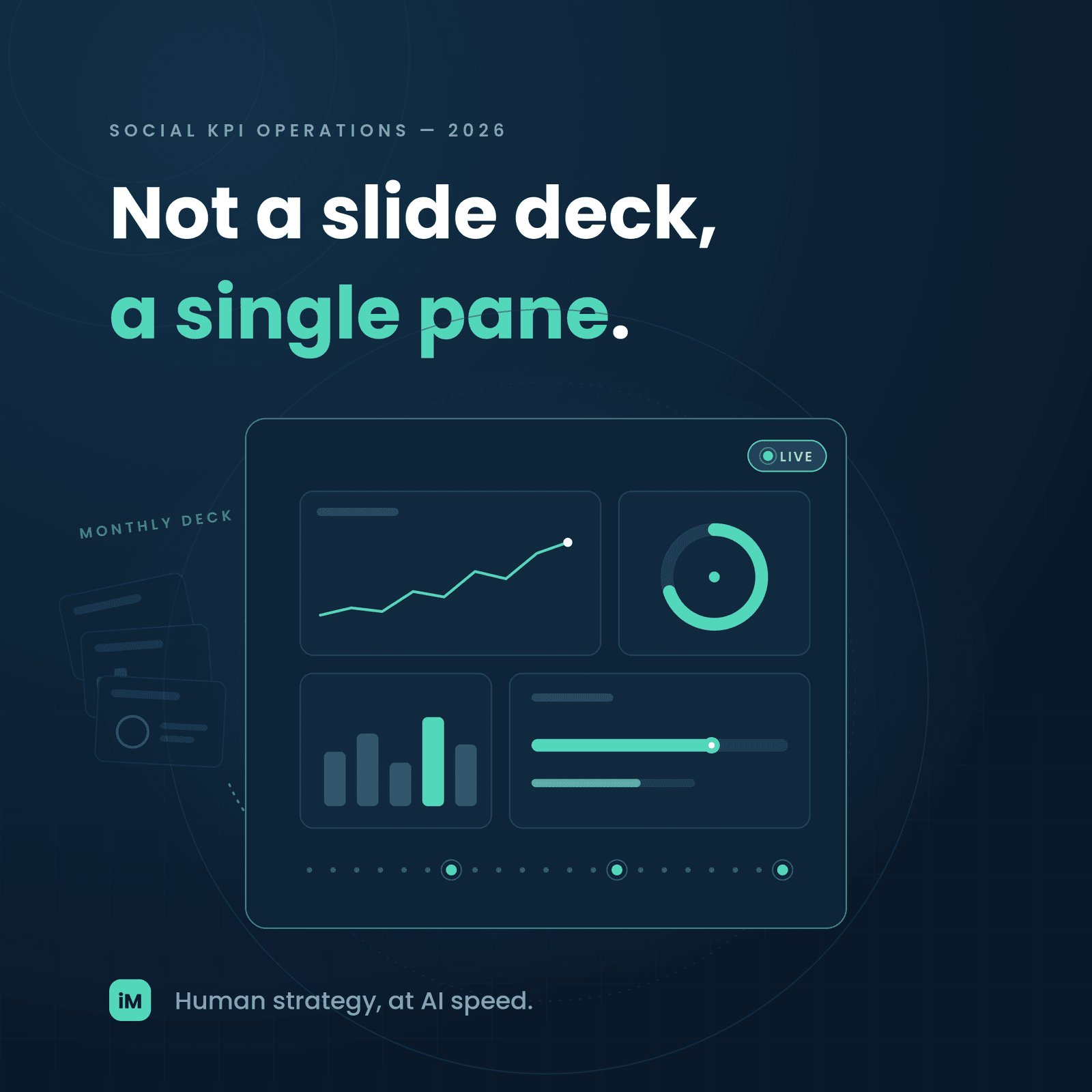
That format made sense when social media was a supporting channel — nice to have, tracked for completeness, but not driving the marketing operating rhythm. In 2026 it does not. Social media is now the primary signal source for several categories of marketing decision, and treating the reporting on it as a monthly artifact rather than as a living operating layer produces a systematic mismatch between how fast the market moves and how fast the enterprise can respond.
This piece walks through how leading enterprises are shifting from monthly report production to a single-pane operating rhythm, what changes about the team's workflow, and why the shift compounds returns against enterprises still stuck in the monthly-deck cycle. The end state is not a fancier report. It is a discipline of continuous attention against a shared view, with the monthly artifact reduced to a summary of what already happened rather than being the mechanism through which the team learns what happened.
The monthly slide deck as a reporting format has four properties that made it useful in an earlier era and that make it a bottleneck in 2026.
First, it lags behind the market. A deck produced at the end of the month captures the month that just ended. By the time leadership reviews it, the market has already moved two weeks past what the deck describes. Decisions made against the deck are decisions about a state that no longer applies. In a fast-moving competitive landscape, that lag is expensive.
Second, it separates the team from the signal. When social performance data lives inside a document produced by an analyst, the team responsible for reacting to that data is one degree removed from it. The content team does not see the engagement rate distribution live. The community team does not see the follower growth momentum shift as it happens. The marketing lead does not see the platform comparison until the analyst has finished the deck. Each degree of separation slows the response.
Third, it optimizes for the wrong audience. A monthly deck is primarily built for the executive audience that receives it. That framing shapes the data selection, the interpretation, and the visual presentation. The result is a document that reads well as executive communication but is not the working surface for the team that has to act on the data. Two different needs are being conflated into one artifact, and both are served poorly.
Fourth, it is expensive to produce. A monthly social deck typically consumes several days of an analyst's time. Multiplied across the year, that is weeks of analyst effort spent producing a document rather than analyzing what the document contains. The report-production cost has grown as the number of tracked platforms and metrics has expanded, without a corresponding growth in the value the report produces.
The alternative to the monthly deck is a single-pane view — a shared operational surface where the six platforms' key metrics are visible to the team at all times, refreshed on the natural cadence of the underlying data, without requiring monthly production work. The single pane is not a replacement for executive reporting. It is a replacement for the artifact-based reporting cycle that used to serve both operating and executive needs.
The single-pane rhythm has three characteristics that separate it from the monthly deck.
The metrics on the single pane reflect the current state of the platforms. Follower growth momentum for the past seven days. Engagement rate distribution for the posts published this week. Real-view counts on the video content that went live this morning. The team looking at the pane today sees what is happening now, not what happened three weeks ago.
The single pane is the same view for the content team, the community team, the marketing lead, and the analyst. Everyone is looking at the same numbers, updated on the same cadence, interpreted against the same context. This is different from the monthly-deck world where different roles see different subsets of the data at different times. The shared view produces shared understanding, and the shared understanding produces coordinated response.
The single pane surfaces the top-level view — Social Score, follower growth momentum, engagement rate distribution, platform comparison — for the team members who need to check status quickly. It also supports drilling into individual posts, individual platforms, and specific periods for the team members who need to investigate. The team member who has ten seconds to check whether anything is moving can do that. The team member who has an hour to figure out why a specific post overperformed can do that too. The same pane supports both.
When the single pane replaces the monthly deck as the primary reporting surface, several parts of the team's workflow change. Naming the changes helps enterprises see what the shift actually looks like from inside the team.
The team checks the single pane daily rather than reviewing a deck monthly. The daily check is fast — usually less than five minutes — and focuses on whether anything is moving against baseline. Most days nothing meaningful moves and the check is a quick reassurance. On the days when something does move, the team catches it immediately rather than at the end of the month.
Once a week, typically at a defined time, the team does a deeper review of the single pane. This is where the content team analyzes the week's post-level engagement distribution, the community team assesses follower growth patterns, and the marketing lead reviews the platform comparison. The weekly review replaces the monthly deck as the primary rhythm of active analysis, but it works from live data rather than from a produced artifact.
The monthly rhythm shifts from being about the team learning what happened to being about summarizing what has been happening for the executive audience. The monthly artifact still exists, but its content is different. It is not the first time the team is seeing the numbers. It is a curated summary of the story that has already been shaped through the daily and weekly reviews. This is much faster to produce because the analysis has already happened, and much more useful to executives because the interpretation has been road-tested rather than being invented at the end of the month.
When something interesting happens — a post breaks out, a platform shifts, a competitor moves — the team can investigate immediately using the single pane's drill-down capability. There is no waiting for the analyst to pull data. There is no waiting for the next monthly report. The investigation happens while the signal is fresh, which is when the investigation is most valuable.
The single-pane operating rhythm produces measurably better decisions in four categories that the monthly-deck rhythm was systematically slow at.
Enterprises shifting from monthly-deck rhythm to single-pane operating rhythm tend to do it in a specific sequence over one to two quarters. The sequence matters because premature abandonment of the monthly deck produces executive concern before the new rhythm has been proven, and prolonged parallel operation produces reporting fatigue that undermines the shift.
The executive audience's relationship with social reporting improves when the shift is done well. This is often counterintuitive — executives sometimes worry that removing the monthly deck will remove their visibility. In practice, they gain visibility rather than losing it.
The monthly executive summary they now receive is more analytical than the previous monthly deck because the underlying analysis has been running continuously rather than being produced in a rush at month end. The summary tells a story that has been developed over the month rather than assembled from raw numbers at the end. It is easier to read, more decisive, and more actionable.
Between monthly summaries, executives can access the single pane directly if they want to check on something. They no longer have to wait for the analyst to pull data or produce a mid-month update. The self-serve access changes the executive relationship with social metrics — from asking the team for numbers to being able to see them, which typically produces better questions and more productive conversations.
The strategic escalation channel also improves. When something material happens, the marketing lead can escalate to the executive with context that is fresh and specific, rather than with a general summary. Executives respond better to concrete escalations — this specific competitor did this specific thing and our follower growth on this specific platform decelerated in response — than to general narrative summaries.
The monthly deck was the right format when social was a channel to be tracked. The single-pane operating rhythm is the right format when social is a decision surface to be worked. The shift is not a reporting improvement. It is an operating discipline change, and the enterprises that make it compound their responsiveness in ways that the monthly-deck enterprises cannot match.
inMOLA's Social Media KPI module is designed as the single-pane operating surface that the modern rhythm requires. All six platforms — Instagram, Facebook, YouTube, LinkedIn, X, TikTok — are tracked in a shared view. The Social Score, the follower growth trend, the engagement rate distribution, the post-level performance, the platform comparison all sit on the same pane, updated on the natural cadence of the underlying data. The team's daily check, weekly review, and monthly summary all draw from the same surface rather than being separate artifacts.
The pane supports the different depths of engagement the operating rhythm requires. A team member checking status quickly gets the top-level view. A team member investigating a specific pattern can drill into individual posts, individual platforms, and specific periods. The pane's live-post links let the team see the actual content behind the numbers, which is what turns numerical analysis into content insight.
The strategic value of the shift from monthly deck to single-pane rhythm is not that the pane is a nicer artifact than the deck. The value is that the team's operating rhythm changes — daily attention against a shared view, weekly analytical review, monthly executive summary that curates the story rather than inventing it. In 2026 the social programs that operate on this rhythm are the ones whose responses to market shifts are proactive, whose content strategy improves cycle over cycle, and whose executive audience trusts the reporting because it has been road-tested rather than assembled at month end. The compounding across those effects is what separates leading social programs from the monthly-deck programs still trying to catch up to a market that keeps moving faster than their reporting cadence.
Marketing Intelligence
Decision Intelligence

Marketing Intelligence