
Marketing Intelligence
Portfolio Strategy · 15. Juni 2026 · 12 Min. Lesezeit
The classical BCG matrix was designed as an annual planning artifact. In 2026, portfolio dynamics move too fast for annual planning. This piece describes a continuous portfolio-tracking framework that combines the modernized BCG matrix with continuous competitive intelligence — updating quadrant positions as the underlying signals update, surfacing reallocation triggers between reviews, and turning portfolio management from a scheduled meeting into an operating discipline.
The classical BCG matrix was designed as an annual planning artifact. The inputs were annual — trailing revenue, category revenue growth. The review cadence was annual — a strategic planning meeting once a year. The output was annual — a portfolio allocation that held for twelve months. That rhythm made sense in a world where category dynamics moved on multi-year timescales and where the marginal cost of measurement was high enough to justify only a once-a-year exercise.
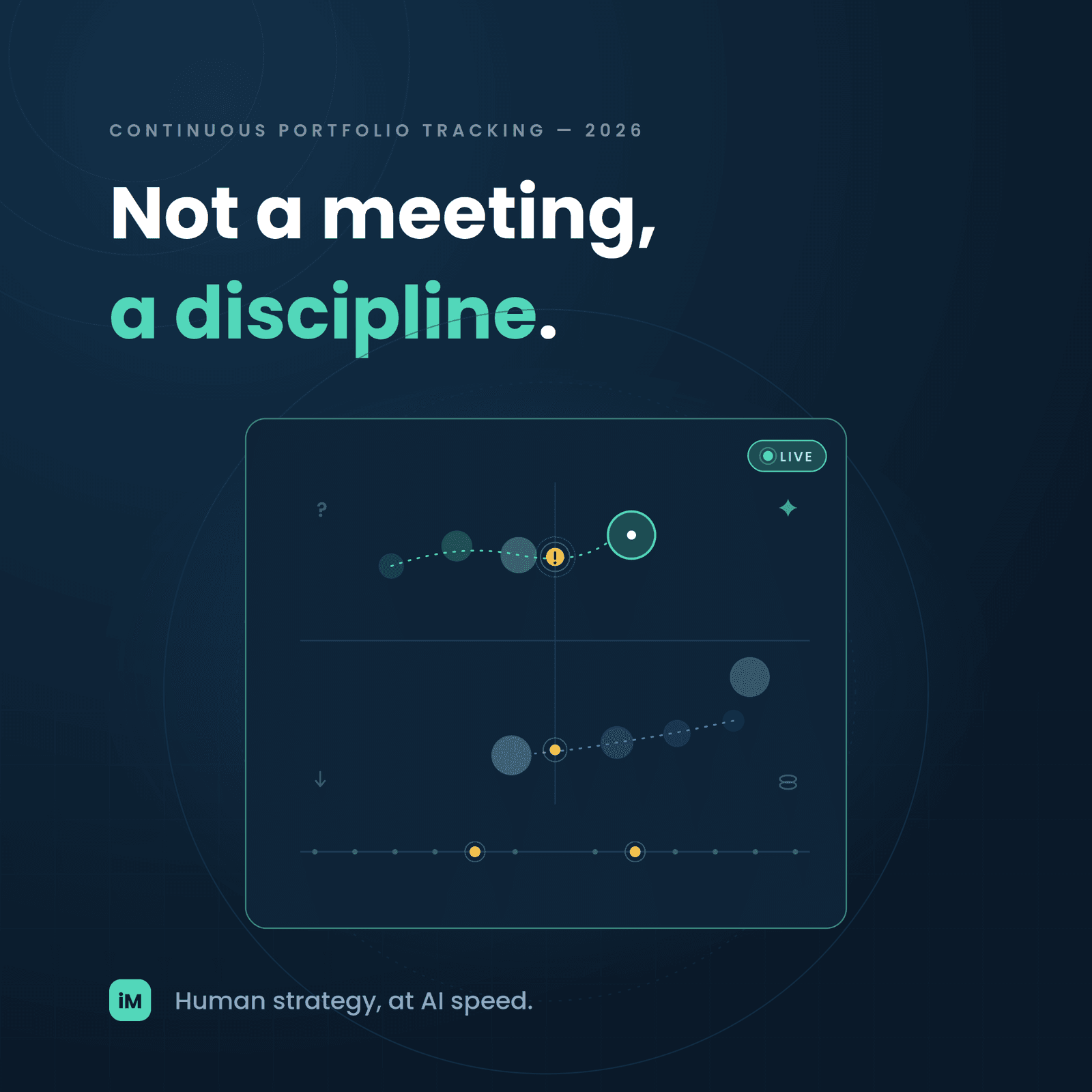
In 2026 that rhythm is misaligned with how the market actually moves. Categories reshape on quarterly timescales. AI-driven discovery shifts competitive perception on monthly timescales. Competitor content and positioning moves on weekly timescales. Portfolio allocations that hold for twelve months are systematically reallocating a year late. The alternative is not more frequent annual reviews. It is a continuous portfolio-tracking framework in which the matrix updates as the underlying signals update, quadrant positions shift when they cross meaningful thresholds, and reallocation triggers surface between the scheduled reviews so the portfolio operating rhythm matches the market's operating rhythm.
This piece describes such a framework — how it is structured, what it measures continuously, how the reallocation triggers work, and where the framework connects the BCG matrix to the surrounding competitive intelligence layer that supplies its leading indicators. The goal is portfolio management as an operating discipline, not as a scheduled meeting.
Continuous tracking is a term that is easy to misinterpret. It does not mean running the matrix every day, showering the leadership team with real-time alerts, or turning strategic planning into a live dashboard exercise. Continuous tracking means that the underlying signals feeding the matrix are refreshed on the cadence that matches how fast they actually move, that the composite scores update as those signals update, and that meaningful shifts against a rolling baseline generate a defined response — sometimes an alert, sometimes an ad-hoc review, sometimes a scheduled quarterly discussion — depending on the size and nature of the shift.
The rhythm is layered. Some inputs to the matrix update weekly, some monthly, some quarterly. The composite scores are recomputed whenever a material input updates. The plotted matrix reflects the current state. Reviews happen on a quarterly cadence for the standard portfolio conversation, but the framework surfaces between-review triggers when a shift is large enough to justify an ad-hoc conversation. Continuous tracking is a discipline, not a real-time obsession.
The framework operates on three layers. Each layer has its own cadence and its own decision surface. Together they form a continuous portfolio operating rhythm.
The signal layer collects and refreshes the inputs that feed the matrix's two axes. Vertical-axis inputs include category revenue growth (updated quarterly from finance), category demand momentum (updated weekly from search and social signals), AI category-recommendation share (updated weekly from AI visibility monitoring), and competitor investment velocity (updated monthly from competitive intelligence signals). Horizontal-axis inputs include relative revenue share (updated quarterly), AI mention share (updated weekly), composite benchmark score (updated monthly), and momentum vectors on all of those (computed from the trailing quarter's data).
The signal layer is where the continuous discipline is anchored. The signals refresh on their natural cadence, not on the calendar of the strategic review. When a signal moves, it is captured. When a composite score is recomputed, it reflects the current state of all its underlying signals. The signal layer is the foundation for everything above it.
The matrix layer takes the current signals from the signal layer and computes the composite vertical and horizontal scores per brand. The plotted matrix reflects the current portfolio position. Dynamic thresholds are recomputed as the medians of the portfolio's own composites, so the quadrant boundaries stay portfolio-relative even as the underlying scores shift.
The matrix layer is reviewed on a quarterly cadence for the standard portfolio conversation. The CFO, CMO, category leads, and — for material shifts — the board look at the plotted portfolio, decompose the composite scores for each brand, discuss the momentum vectors, and update strategic assignments per brand. The quarterly review is the natural home of the portfolio conversation, but it is supplied by continuously refreshed inputs rather than by inputs specifically gathered for the meeting.
The third layer is the trigger layer. Between the quarterly matrix reviews, certain shifts in the underlying signals are large enough or important enough to justify an ad-hoc portfolio conversation rather than waiting for the next scheduled review. The trigger layer defines those thresholds and surfaces them as they occur.
Typical trigger events include a brand crossing a quadrant boundary on the composite score; a material shift in a competitor's AI mention share that meaningfully changes the horizontal-axis denominator; a category demand signal moving outside its normal variance range; a divestiture-candidate brand showing one of the hidden-Star signatures on its leading indicators; or a Star-candidate brand showing early signs of momentum reversal. Each of these events has a defined response — sometimes a note in the next quarterly review, sometimes an ad-hoc meeting, sometimes an immediate reallocation decision — depending on the size and nature of the shift.
Portfolio strategy does not sit in a vacuum. The signals that feed the modernized matrix are the same signals that feed the wider marketing decision engine — AI visibility, competitor benchmarks, sentiment, PR, campaign performance. The three-layer framework connects the portfolio matrix to that wider engine in two directions.
In the incoming direction, the matrix draws on the same continuously refreshed signals that inform every other decision surface. The AI visibility layer supplies AI mention share and AI category-recommendation share. The competitive intelligence layer supplies benchmark composites and competitor investment velocity. The demand-monitoring layer supplies category and sub-category demand signals. The finance system supplies revenue growth and revenue share. The matrix layer combines them into composite scores; it does not gather them separately.
In the outgoing direction, the matrix's strategic assignments per brand inform the operating layers. A Star assignment shapes the incremental marketing spend, the sales resource allocation, and the product roadmap prioritization for the assigned brand. A Cash Cow assignment shapes margin optimization and defensive AI visibility investment where erosion is detected. A Question Mark assignment shapes the specific invest-or-exit hypothesis under test. A Dog assignment shapes the divestiture path or the rescue window. The matrix is not a standalone artifact; it is the top-level allocation layer that shapes what the operating layers do.
Not every signal movement is a trigger. A well-designed trigger layer surfaces only the shifts that justify the cost of a between-review conversation. Five trigger patterns cover most of the operationally useful signals.
Each trigger has a defined threshold, a defined response path, and a documented rationale. The triggers are not tuned to produce more or fewer alerts — they are calibrated to surface the shifts that actually change the portfolio allocation decision.
A well-run continuous portfolio-tracking framework has a rhythmic operating cadence that layers the three layers together into a working discipline.
This cadence turns portfolio management from a once-a-year strategic exercise into a continuously operating discipline. The strategic conversation still happens quarterly, but it is supplied by continuously refreshed signals, and between-review shifts do not have to wait for the next scheduled meeting to inform a reallocation decision.
The transition from an annual portfolio review to a continuous three-layer framework is a real operating change that takes about twelve months to embed. Portfolios that do it well tend to hit certain milestones on the way.
The move from annual portfolio review to continuous portfolio tracking is not a change in analytical technique. It is a change in operating rhythm. The rhythm decides which shifts the portfolio catches in time and which it catches only after they are already reflected in revenue that is too late to influence.
The three-layer framework is a specific description of the operating rhythm that inMOLA's decision engine was designed to sustain. The signal layer maps onto the continuously refreshed data streams that feed AI Visibility, Competitive Intelligence, Benchmark, Sentiment, and demand-monitoring layers. The matrix layer maps onto the BCG Box Matrix module, which computes the composite scores and plots the portfolio on demand. The trigger layer maps onto the alerting and decision-surface architecture that runs across the wider inMOLA decision engine.
The framework does not require an enterprise to buy or adopt inMOLA to implement — it is a general operating pattern that any enterprise can build against its own tooling. But the reason the pattern is difficult to implement without a purpose-built decision engine is the same reason continuous tracking has historically been rare: the manual reconciliation cost of gathering the inputs from finance, marketing analytics, AI visibility, competitive intelligence, and demand monitoring on a weekly cadence is prohibitive. The BCG Box Matrix module inside inMOLA closes that cost gap by drawing on data streams that are already flowing through the rest of the decision engine. The composite matrix updates as the underlying signals update. The trigger conditions are evaluated automatically. The between-review alerts surface without adding manual work.
The result is portfolio management as an operating discipline rather than a scheduled meeting. The CFO and CMO look at a plotted portfolio that reflects the current market position. The quarterly review is supplied by continuously refreshed inputs. The between-review triggers surface the shifts that justify ad-hoc reallocation. The annual framework review updates weights and definitions rather than gathering fresh data. In 2026, the portfolios that operate on this rhythm compound advantage against the ones still running the classical annual matrix once a year.
Marketing Intelligence

Decision Intelligence

Marketing Intelligence