
Marketing Intelligence
Decision Intelligence · 22. August 2026 · 15 Min. Lesezeit
We examine the core elements of InMola's marketing strategies and how they carry a brand to success. This article will help you sharpen your own marketing strategy.
The most common problem in marketing today is not a shortage of data. It is the opposite: brands have more data than ever. Analytics dashboards, social reports, ad platforms, CRM records, SEO tools — each one states its own version of the truth, and none of them acknowledges the others.
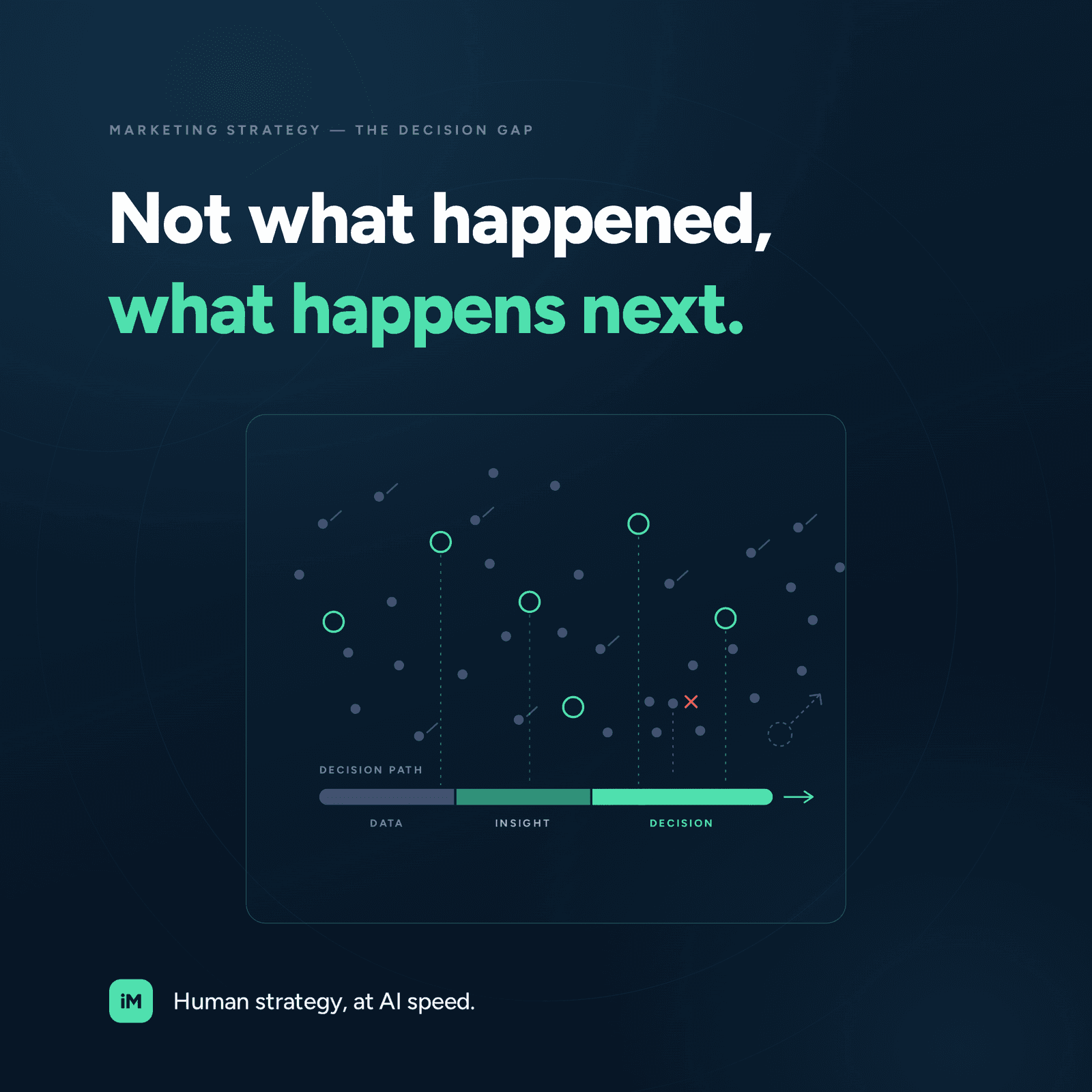
The real bottleneck sits in a single question: "Fine. So what should I do now?"
InMola's approach to marketing is built to close exactly that gap.
InMola's marketing strategy rests on six core elements:
One principle ties all six together: every measurement must connect to an action. A metric that cannot produce a concrete next step is decorative, not operational. Each element is covered below, along with how to apply it inside your own team.
The quality of a marketing decision is directly proportional to the completeness of the data behind it. A decision made on fragmented data is, at best, partially correct. InMola's strategy starts from a unified data layer, and the practical benefit is this: channels do not act on performance independently — they act on each other. A PR placement lifts branded search; rising branded search lowers the cost of performance advertising; lower cost improves budget efficiency. You can only see that chain when the data sits side by side. What to do: Move from channel-based reporting to journey-based reporting. Instead of "what did Meta do, what did Google do," ask which touchpoint played which role from awareness through purchase.
At the base of InMola's strategy sits a unified data layer. The practical benefit is this: channels do not act on each other one at a time, they act together. A PR hit lifts branded search; rising branded search lowers the cost of performance advertising; falling cost raises budget efficiency. You can only see that chain once the data sits side by side.
Actionable step: stop reporting by channel and start reporting by customer journey. Instead of "what did Meta do, what did Google do", ask "from awareness to purchase, which touchpoint played which role".
Conventional competitive analysis looks backwards: what did the competitor do, what did we miss. The flaw is obvious — by the time you notice, the advantage has already been taken. InMola's competitive intelligence approach pulls observation forward to the signal stage. A shift in a rival's ad intensity, an acceleration in their content cadence, a change of direction in their job postings, a movement in their search visibility — all of these are readable before a campaign ever goes live. What to do: Take competitor tracking out of the monthly report and turn it into a weekly signal list. Define five or six indicators with threshold values. When a threshold is crossed, get an alert — don't wait for month-end.
InMola's competitive intelligence approach moves observation up to the early-signal level. A shift in a competitor's advertising intensity, an acceleration in their content production, a change of direction in their job postings, a move in their search visibility — these are all readable before the campaign goes live.
Actionable step: take competitor tracking out of the monthly report and turn it into a weekly signal list. Pick 5-6 indicators to watch and define threshold values. Get an automatic alert when a threshold is crossed; do not wait for month end.
"Brand equity can't be measured" is one of the most expensive myths in marketing. What cannot be measured also loses the budget argument, which is why brand investment is the first line cut in a downturn. Sound brand strategy development treats brand equity as a concrete indicator set: Search demand: How often is your brand searched, and with what intent? Share of voice: Out of every 100 sentences spoken in your category, how many involve you? Sentiment direction: Are those conversations positive, neutral, or defensive? AI visibility: When someone asks an AI assistant a question in your category, does your brand appear in the answer? That last point is the fastest-growing and least-measured channel of the past two years. As search behaviour shifts toward AI assistants, a new battleground has opened alongside classic SEO rankings. InMola treating this as its own monitoring category is a good indicator of where the strategy is pointed. What to do: Define the 20 core questions in your category, put them to AI assistants on a regular schedule, and log how many answers include your brand each month.
A healthy brand strategy process treats brand equity through a specific indicator set: search demand, share of voice, sentiment direction and AI visibility.
That last one is the fastest-growing and least-measured channel of the past two years. As search behaviour shifts towards AI assistants, a new field called "AI visibility" has appeared alongside conventional SEO rankings. InMola treating it as a separate monitoring heading is what shows the forward-looking side of the strategy.
Actionable step: identify the 20 core questions in your category, ask them of AI assistants on a regular schedule, and record monthly how many answers your brand appears in.
Most marketing budgets are still built on last year's split. "This is how we did it last year" describes a habit, not a strategy. Contribution-based allocation asks three questions in order: Saturation: If I spend one more unit in this channel, what return do I get? Where does the diminishing-returns curve bend? Interaction: How does spend in this channel affect the performance of the others? Timing: How much of the return lands this month, and how much next quarter? InMola's performance advertising and budget optimisation logic evaluates all three together. Decisions driven by single-channel ROAS tend to inflate whichever channel is easiest to measure while unfairly starving the ones that build the brand. What to do: Ring-fence 10–15% of each quarter's budget as test spend and deliberately step outside the current split. You only learn where saturation sits by pushing against it.
Contribution-based allocation asks three questions in order: saturation (if I spend one more unit, what return do I get), interaction (how does spend on this channel affect the others) and timing (how much of the return lands this month, how much next quarter).
InMola's performance advertising and budget optimisation logic weighs those three dimensions together. Decisions made by looking at single-channel ROAS usually inflate the easiest channel to measure and unfairly cut the channels that build the brand.
Actionable step: set aside 10-15% of your budget each quarter as test budget. You only learn where the saturation points are by pushing against them.
Acquiring a new customer costs a multiple of retaining an existing one. Even so, the overwhelming share of marketing budget goes to acquisition. InMola's churn prediction and loyalty scoring approach inverts the logic: catch the leaving signals before the customer leaves. A drop in usage frequency, a rise in support tickets, a change in payment behaviour — these surface weeks ahead of the actual departure. What to do: Segment your customer base into three risk tiers and set a different communication rhythm for each. The message that goes to a high-risk account should not be the message that goes to a loyal one.
InMola's churn prediction and loyalty scoring approach inverts the logic: catch the signals of leaving before the customer leaves. A drop in usage frequency, a rise in support tickets, a change in payment behaviour — these become visible weeks before the departure.
Actionable step: split your customer base into three groups by risk score and set a different communication rhythm for each group.
Crisis communication usually activates after the incident breaks. But most crises do not appear all at once; they accumulate as small, scattered signals. An early-warning approach targets the abnormal spike in negative conversation volume, the concentration of a specific complaint theme, or the argument starting inside a niche community — before any of it jumps to the mainstream. That turns reputation management from a reactive cost into a proactive defence. What to do: Track velocity alongside volume in your brand monitoring. Ten mentions a day becoming forty is a far more critical signal than 300 monthly mentions becoming 320.
An early-warning approach aims to detect an abnormal rise in negative conversation volume, or an argument starting in a niche community, before it jumps to the mainstream. That turns reputation management from a reactive cost into a proactive defence.
Actionable step: track "velocity" alongside "volume" in your brand mention monitoring. Ten mentions a day becoming forty is a far more critical signal than three hundred mentions a month becoming three hundred and twenty.
Once the strategic frame is in place, execution moves to campaign level. The successful marketing tactics that follow from InMola's approach cluster into six habits: Open every campaign with a single decision question. "Increase brand awareness" is a wish, not an objective. "In which segment, from which competitor, and how much share are we taking?" is a measurable campaign definition. Write the success criterion before you launch. Picking whichever metric looks best after the campaign ends is not measurement — it is self-confirmation. Test creative variants, not one creative. Rather than committing the full budget to a single big idea, race three or four variants on small spend and scale the winner. Sequence channels concurrently, not serially. The point of omnichannel synchronisation is not repeating one message everywhere; it is delivering the message that fits the user's stage on the channel where they are. Measure post-campaign effect too. Part of the return materialises after the campaign ends. Capping the measurement window at the flight dates systematically understates brand impact. Define a kill threshold up front. Keeping an underperforming campaign alive because "it might turn around" is the most common form of budget waste.
Open the campaign with a single decision question. "Increase brand awareness" is not a goal, it is a wish. "In which segment, from which competitor, how much share are we taking?" is a measurable campaign definition.
Write the success criterion before you go live. Picking the metric that looks best after the campaign ends is not measurement, it is self-confirmation.
Test the creative variant, not the creative. Instead of committing the whole budget to one big idea, race 3-4 variants on small budgets and scale the winner.
Run channels concurrently, not sequentially. The purpose of omnichannel synchronisation is not repeating the same message everywhere; it is delivering the message that fits the stage the user is at, on the right channel.
Measure post-campaign effect too. Part of the return lands after the campaign ends. If you limit the measurement window to the flight period, you will systematically undercount brand effect.
Define an early-stop threshold. Keeping a poorly performing campaign alive because "it might recover" is the most common form of budget waste.
InMola's measurement logic runs in three layers, each with its own time horizon: Operational layer (weekly): Ad cost, conversion rate, channel efficiency, budget saturation points. Moves fast and demands fast intervention. Competitive layer (monthly): Market share, share of voice, search visibility, presence in AI-generated answers, and positioning against rivals. InMola Index's public brand performance rankings operate in this layer. Structural layer (quarterly): Brand equity indicators, customer lifetime value, loyalty scores, churn rate. Slow-moving, but this is the layer that determines long-term value. The critical distinction: InMola does not stop at reporting these indicators side by side. It establishes the causal relationships between them and produces a prioritised recommendation. That is the difference between "what happened" and "what to do next."
Operational layer (weekly): advertising cost, conversion rate, channel efficiency, budget saturation points. It moves fast and demands fast intervention.
Competitive layer (monthly): market share, share of voice, search visibility, rate of appearance in AI answers, positioning against competitors. InMola Index's public brand performance rankings operate at this layer.
Structural layer (quarterly): brand equity indicators, customer lifetime value, loyalty scores, churn rate. It moves slowly, but this is the layer that determines long-term value.
The critical distinction in measurement is this: InMola does not settle for reporting these indicators side by side. It establishes the causal relationship between them and produces a prioritised action recommendation. That is the difference between "what happened" and "what should we do now".
Each of the six elements has standalone value, but the real leverage appears when they operate together. InMola's structure of 64+ modules is built on exactly that idea of coherence: market entry analysis, portfolio strategy, customer lifetime value scoring and web personalisation all meeting on the same data foundation. The product family separates by organisational maturity: InMola Core for enterprise marketing teams and CMOs, InMola Spark for growing businesses and SMBs, InMola Pulse for executives building personal brand authority, and InMola Index for public brand performance rankings. When deciding where to start in your own organisation, this sequence works: Measure first. Establish how much of your existing data is actually connected. Then simplify. Strip out every metric that does not translate into action. Then build early warning. Define thresholds on the competitor, brand and customer side. Automate last. Automation applied before the process is clear only accelerates the error.
The product family separates by maturity level: InMola Core for enterprise marketing teams and CMOs, InMola Spark for growing businesses and SMBs, InMola Pulse for executives building personal brand authority, and InMola Index for public brand performance rankings.
When deciding where to start in your own organisation, this sequence works: measure first (establish how much of the data you hold is actually connected), then simplify (remove the metrics that never turn into action from your report), then set up early warning (define thresholds on the competitor, brand and customer side), and automate last — automation applied before the process is clear does nothing but accelerate the error.
The essence of InMola's marketing strategy fits in one sentence: turn data into insight, and insight into decisions. Most brands have already completed the first step — the data exists, the dashboards exist, the reports exist. The second step is where things stall. And competitive advantage is built precisely there, in the speed and quality of decisions. You do not need a major restructuring to begin. Start by writing, next to every metric in your next report, the answer to "what do I do if this changes?" The lines that stay blank will tell you exactly where your strategy needs strengthening.
In most organisations digitalisation gets equated with the wrong thing: tool count. Analytics was bought, then CRM, then automation, then social listening — and the result is six panels that do not talk to each other. As the tool count rose the answer did not get clearer; it got harder, because every tool reports its own number.
InMola approaches digitalisation from the opposite end: first identify the decision you cannot make, then choose the signal that feeds it, and buy the tool last. If you cannot say which decision a tool is attached to, that tool is not digitalisation — it is cost. Each of the six strategies above is a link in that chain: unifying data, anticipating competitors, making brand equity measurable, allocating budget by contribution, seeing customers before you lose them, and preventing crises.
Three rules, in order. First, every tool is attached to a decision — "everyone has one" is not a justification. Second, establish one source of truth; in a company where eight tools produce eight different numbers, the argument stops being about the data and becomes about whose panel the number came from. Third, match the tool's measurement cadence to the rate at which the thing it tracks actually changes; you cannot catch a signal that shifts within weeks using a monthly report.
The clearest sign of a successful transformation is not a new dashboard — it is that meetings get shorter and change subject. The argument about whether the data is right ends, and the argument about what to do begins. Three more signs: the same question does not return every quarter, because the reasoning behind the last decision was recorded; the budget conversation rests on contribution analysis rather than narrative; and knowledge stays in the organisation when the team changes. Transformation is not a project but a rhythm that keeps turning once established — it has no completion date.
InMola's marketing strategy consists of six elements: a unified data layer, predictive competitive intelligence, measurable brand equity, contribution-based budget allocation, churn prediction, and crisis early warning. The principle connecting them is that every measurement must translate into a concrete action.
Open with a measurable decision question, write the success criterion before launch, invest in variants rather than a single idea, run channels concurrently, measure post-campaign effect, and define a kill threshold in advance.
In three layers: weekly operational metrics (cost, conversion, budget efficiency), monthly competitive indicators (market share, share of voice, AI visibility), and quarterly structural indicators (brand equity, customer lifetime value, churn). The measurements are not simply reported side by side — the relationships between them are mapped and converted into a prioritised recommendation.
Conventional tools report the past. InMola is built to produce prioritised recommendations for what to do next.
Yes. The principles are scale-independent. Depth of implementation differs, and InMola Spark is positioned for exactly that need.
Operational improvements typically become measurable within a quarter. Brand equity indicators move more slowly; a meaningful trend needs at least two to three quarters of data.
In one sentence: start with the decision, not the tool. Identify the decision you cannot make, put the signal that feeds it under continuous measurement, and choose the tool last. In practice it rests on six links — a unified data layer, anticipating competitors, measurable brand equity, contribution-based budget allocation, pre-churn customer visibility, and crisis prevention.
Not as a one-off project but as a monthly rhythm. The marker of success is not how many dashboards you added; it is that the meeting subject shifts from "is the data right" to "what do we do", that decisions are recorded along with their reasoning, and that the knowledge stays with the organisation when the team changes.
By attaching every tool to a decision, running them off a single source of truth, and matching measurement cadence to the rate of change of whatever is being tracked. A tool whose decision cannot be named is not digitalisation — it is a line of cost.
Most brands today have completed the first step — the data is there, the panels are there, the reports are there. The blockage is at the second step. And competitive advantage forms precisely there: in the speed and the quality of the decision.
You do not need a major restructuring to start that shift. You can begin by writing, next to every metric in your next report, the answer to "what would I do if this changed". The lines that stay unanswered will already tell you where your strategy needs strengthening.
Marketing Intelligence

Decision Intelligence

Marketing Intelligence