
Marketing Intelligence
Influencer Marketing · 28 de junio de 2026 · 11 min de lectura
For fifteen years, the influencer industry has sorted creators by a single number — followers — and treated that number as the primary input to campaign selection. In 2026 that number has quietly stopped meaning what it originally meant. Bought followers, inactive accounts, and algorithm-inflated audiences have hollowed out the correlation between follower count and campaign performance, and the enterprises still using follower count as the primary selection filter are picking creators whose actual audiences are a fraction of the number attached to their profile. Here is what has replaced follower count as the reliable selection axis, and how the shift is separating the enterprises that get campaign ROI from the ones that keep buying vanity numbers.
For most of the past fifteen years, the influencer industry has sorted creators by a single number. Followers. It is the first metric on the profile. It is the primary sort column in every discovery tool. It is the shorthand used in briefs, in negotiations, in agency pitch decks. When a marketing team assesses whether a creator is worth a $50,000 partnership or a $5,000 partnership, the follower count is usually what they anchor to first. Everything else — engagement, niche fit, audience quality — is secondary to that anchor, treated as a modifier of the tier the follower count implies.
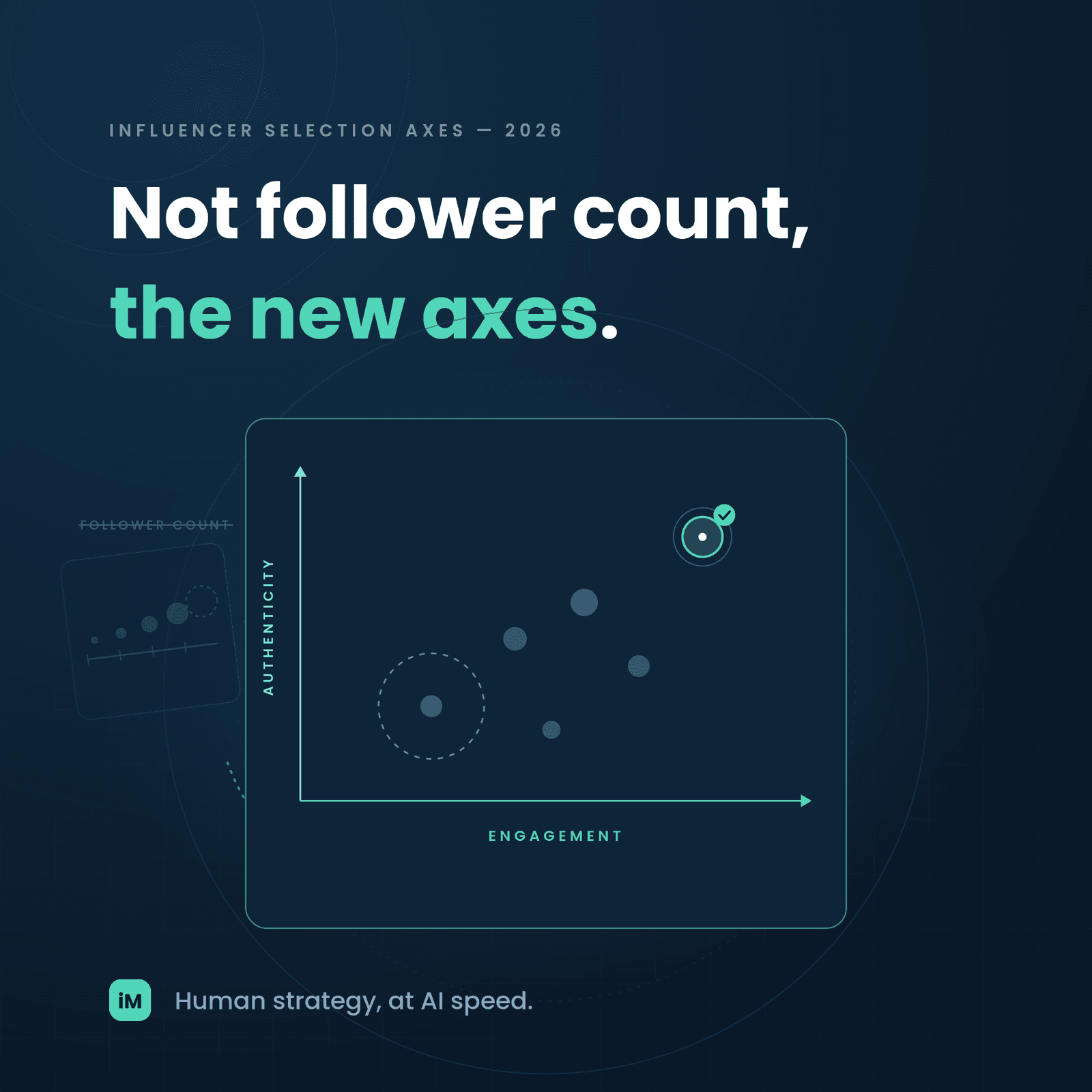
That mental model made sense in an earlier era of the industry. Follower counts were harder to game. Fake-follower services existed but were not industrialized. Platform algorithms weighted engagement more transparently. A creator with a million followers actually had a million people who had actively chosen to receive their content, and a meaningful share of those million were still active users who might see the post. The correlation between follower count and campaign performance was not perfect, but it was strong enough that the shorthand worked.
In 2026 the correlation has quietly hollowed out. Bought followers have industrialized to the point where a $500 investment can add 100,000 followers to a profile within days. Inactive accounts have accumulated across every platform as users churn without unfollowing. Algorithms have decoupled reach from follower count in ways that make the raw number a weak predictor of how many actual humans will see any given post. The enterprises still using follower count as the primary selection filter are picking creators whose actual reachable, engaged audience is a small fraction of the number attached to their profile — and paying prices calibrated to the total number, not the reachable one.
The decline of follower count as a selection input is not the result of a single event. It is the compounding of three separate developments that have all pushed in the same direction, and understanding them separately is what lets enterprises replace the metric with the specific alternatives that survive each of the three.
The fake-follower industry has professionalized over the past decade to the point where the follower profiles it delivers are indistinguishable from real accounts to platform-level detection. Profiles have photos. They have bios. They post occasional content. They follow a plausible mix of accounts. They interact with content at rates calibrated to look organic. Platforms perform periodic sweeps that remove obvious bot networks, but the sweeps miss the sophisticated services entirely, and the sweeps are performed against fraud that already sits inside accounts the creator would prefer the platform not investigate.
The practical effect is that a creator's public follower count contains an unknown but often meaningful share of accounts that will never engage with a sponsored post, never convert on an offer, and never do anything the campaign is trying to measure. The share varies by creator, by tier, and by acquisition history. But the share is real, and it is systematically higher for creators whose growth trajectory has depended on appearance rather than substance. Follower count as an input to campaign selection is treating an unknown mixture of real and purchased audience as if it were uniformly real.
The second force is inactive accumulation. Users create accounts, engage for a period, and then drift away. Some delete their accounts. Most do not. They simply stop opening the app. Their follows persist. Their follower contributions to every creator they ever followed persist. And over time, those persistent contributions accumulate into a meaningful share of the follower counts on every account with any history.
A creator whose peak activity was five years ago retains a follower count that reflects the peak, but the share of those followers who are still active users of the platform is much smaller than it was at the peak. A creator whose growth has been steady over time is diluted less by inactive accumulation, but is still diluted. The follower count on the profile does not distinguish between the two. The enterprise that selects on follower count treats them as equivalent when the reachable audience is materially different.
The third force is the platform algorithms themselves. All three major platforms — Instagram, TikTok, and YouTube — have shifted over the past several years toward interest-based content distribution rather than follower-based. A creator's post is served to their followers if the algorithm predicts the followers will engage with it, but the algorithm also serves the post to non-followers who match the interest profile, and it withholds the post from followers who match a non-engagement profile. The end result is that a post from a creator with a million followers may reach 30,000 of them or 300,000 of them depending on the algorithm's real-time predictions, and the follower count in isolation predicts almost nothing about the actual reach any given post will earn.
For campaign selection, this decoupling is decisive. The enterprise's real question is not how many followers a creator has. The enterprise's real question is how many humans will see the sponsored content, engage with it, and take the intended action. Follower count was once a defensible proxy for that. It is no longer.
The metrics that survive the three forces above are not exotic. They are metrics the industry has always been able to compute but has not been using as primary selection inputs. Two rise to the top.
Engagement rate — engagements divided by reach or followers, depending on the specific formula — is not immune to gaming, but it is much harder to game than follower count. Buying engagement requires ongoing, per-post investment that is far more expensive than buying followers. Inactive accounts do not contribute to engagement. And engagement rate has a much tighter correlation with campaign performance than follower count does, because engagement is closer to the actions a campaign is actually trying to drive.
A creator with 200,000 followers and an average engagement rate of 6% is delivering roughly the same absolute engagement as a creator with 5 million followers and an engagement rate of 0.25%. The follower counts look wildly different. The actual engagement volumes are comparable. The prices are usually not comparable, which is where the ROI difference comes from. Engagement rate as the primary selection input starts to align the enterprise's spending with the actual audience interactions the spending is meant to earn.
Once engagement rate becomes the primary axis, the question of whether that engagement rate is itself genuine becomes decisive. Two authenticity signals work well as secondary filters.
The first is the comment-to-like ratio. Real audiences produce comments at a rate that is a meaningful fraction of the like rate. Purchased engagement produces likes at a much higher rate than comments because comment-purchase services are more expensive and less common. A creator with an unusually low comment-to-like ratio is often a candidate for further investigation, and a creator with a healthy comment-to-like ratio is providing a signal that the engagement is coming from an audience that reacts to the content rather than from services that inflate a number.
The second is posting cadence and active days. A creator who posts consistently over months and quarters is running an active account that the platform continues to serve. A creator whose posting is intermittent or whose recent history shows gaps is either less committed to the account or has been through periods of platform demotion. Neither is disqualifying, but the pattern is a signal about the account's current relationship with the platform that follower count cannot express.
When follower count is demoted from primary selection input to background context, several parts of the campaign brief change. Naming the changes helps enterprises see what the shift actually looks like from inside the workflow.
The point is not that follower count contains no information. The point is that it should not be the primary selection filter. Follower count still tells you the tier the creator sits in, which affects the price band, the audience size, and the operational scale of the partnership. Follower count still matters for reach-focused campaigns where mass exposure is the objective. Follower count still functions as a rough sanity check — a creator with 5,000 followers and a 20% engagement rate may be a strong niche pick, but they are not going to move the needle on a national brand campaign.
The correct use of follower count in 2026 is as a background variable that establishes tier and price band, filtered against engagement rate and authenticity signals that decide whether the follower count is meaningful in the first place. Enterprises that make this shift find their selection process becomes more discriminating rather than less rigorous, and the campaigns they run start to hit ROI targets that follower-count-led selection quietly missed.
Follower count was the shorthand for an era when accounts were harder to fake, users were more active, and algorithms weighted follows more transparently. In 2026 the shorthand has broken along all three axes at once. Engagement rate and authenticity signals do the work follower count used to do — and they do it more honestly.
inMOLA's Influencer Marketing module scores every candidate on engagement rate and authenticity signals as primary inputs, with follower count sitting in support rather than in the lead. The Quality Score captures engagement level, posting cadence, tier sweet-spot, and authenticity together, so the enterprise sees a single number that reflects the four axes that actually decide campaign performance rather than the one axis that used to.
Comment-to-like ratio is one of the specific authenticity signals that feeds the score, so creators whose engagement rate is inflated by services that only buy likes get penalized rather than surfaced. Verified status, active days, and posting frequency are captured to distinguish active accounts from dormant ones. Follower count still appears on every profile view, but as background context rather than as the sort key that decides who gets on the shortlist.
The strategic value of the shift is not that a new metric replaces an old one. The value is that campaign selection stops being anchored to a number that no longer means what it originally meant, and starts being anchored to metrics that still connect selection to performance. In 2026 the enterprises that have made this shift are running campaigns whose ROI reflects what the underlying data has always been capable of delivering. The enterprises still sorting by follower count are running campaigns whose ROI reflects the number attached to a profile rather than the audience actually reachable through it. The difference is not marginal, and it is not narrowing.
Marketing Intelligence
Decision Intelligence

Marketing Intelligence