Marketing Intelligence
AI Visibility · 2026년 5월 19일 · 11 분 읽기
Traditional SEO ranked pages for Google's blue links. GEO — Generative Engine Optimization — makes your brand the one AI answers cite. Here is the 2026 framework enterprises are using to appear inside ChatGPT, Perplexity, and Gemini responses, plus what to measure and how to build it into an operating rhythm.
For twenty years, SEO won the click. In 2026, the click is optional. When a buyer types a question into ChatGPT, Perplexity, or Google's AI Overview, the system answers directly — often synthesizing three or four brands into a single paragraph, sometimes attributing the answer to sources, sometimes not. The click, when it happens at all, is a downstream consequence. The upstream decision was made when the AI chose which brands to mention.
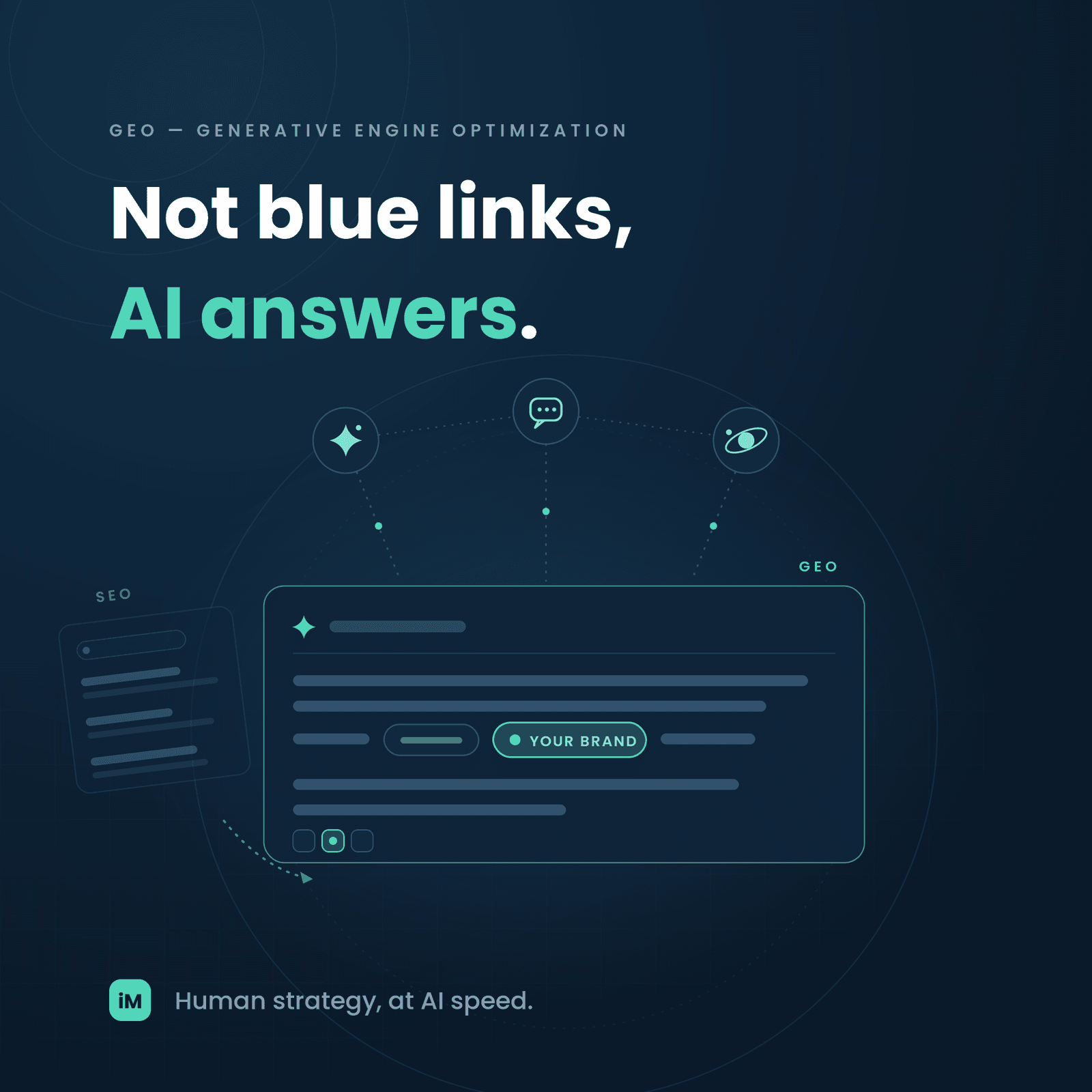
That upstream layer has a name now. Generative Engine Optimization — GEO — is the discipline of optimizing your brand's presence inside AI-generated answers. It is not SEO 2.0. It is not "make your content AI-friendly." It is a distinct measurement and content model with its own signals, its own tactics, and its own KPIs. In 2026, treating GEO as an extension of SEO is the single most common — and most expensive — mistake enterprises make.
This piece explains what GEO actually is, why 2026 is the inflection point, and the four-layer framework enterprises in the UK, Netherlands, and UAE are using to build it into an operating discipline. Along the way we will name where inMOLA's AI Visibility module fits — honestly, because AI search visibility is exactly the layer inMOLA was built for.
GEO is the practice of engineering your brand to be discovered, trusted, extracted, and cited by generative AI engines when a buyer asks a question in your category. The AI engines that matter for enterprise B2B in 2026 are ChatGPT (via OpenAI's models and the ChatGPT product), Perplexity, Google's Gemini and AI Overviews, and Anthropic's Claude. Each has its own retrieval mechanics, its own source preferences, and its own citation behavior. GEO is what happens when your content strategy, technical setup, and off-page authority are calibrated to those mechanics.
It is worth being precise about the terminology. "AEO" — Answer Engine Optimization — is often used interchangeably with GEO, and the overlap is real. The clearest distinction: AEO originated in the pre-LLM search world (voice search, featured snippets, position zero) and focused on extractable factual answers. GEO is the LLM-era evolution — it includes AEO tactics but adds the specific concern of being cited, paraphrased, or included inside a multi-source AI synthesis. A team thinking only about featured snippets is practicing AEO. A team thinking about how to appear when ChatGPT synthesizes an answer from six sources is practicing GEO.
What GEO is not: it is not classical SEO rebranded. Classical SEO optimizes for click-through from a list of ten blue links. GEO optimizes for inclusion inside a synthesized answer where the click may never happen. The two disciplines share DNA — both care about content quality, authority signals, and technical hygiene — but the target output is fundamentally different. Winning the SEO game meant ranking above your competitor. Winning the GEO game means being the source your competitor is compared against.
Three shifts converged this year that make GEO impossible to ignore for enterprise marketing teams.
First, buyer behavior. Multiple enterprise buying-behavior studies published in the first half of 2026 report that roughly 40% of B2B research journeys — and closer to 50% in software categories — now begin with a question typed into an AI assistant rather than a search engine. This is not the same as saying 40% of clicks now come from AI. Most of these journeys still end on a website, sometimes via a Google search several steps later. But the framing, the shortlist, and the descriptors attached to each brand are being decided inside the AI conversation, before the traditional funnel begins.
Second, AI search adoption at the mainstream layer. Google's AI Overviews now appear on a majority of commercial queries in English-language markets. ChatGPT crossed a threshold of daily active use where a plurality of knowledge workers report using it before Google for professional questions. Perplexity, still smaller in raw volume, has become the default for research-heavy B2B queries. The audience is no longer "early adopters." It is the buyer.
Third, the regional context matters. In the UK, financial services and retail enterprises are already reporting measurable revenue impact from AI Overviews eroding traditional search traffic. In the Netherlands, enterprise CMOs at brands like Adyen, Booking, and ING are treating AI visibility as a European compliance and brand-authority question, not just an SEO one. In the UAE — where English-first content strategies dominate for global-facing brands and where AI adoption in enterprise workflows has been unusually fast — AI search is often the primary entry point for cross-border B2B research.
The combined result is that in 2026, whether your brand appears in an AI answer is no longer a nice-to-have KPI. It is the frame in which every subsequent marketing decision is made.
GEO is not a single tactic. It is a system of four layers, each with its own signals and each requiring different work. Enterprises that treat GEO as a checklist tend to over-invest in one layer and under-invest in another. The four layers, in the order AI engines actually process them:
Before an AI can cite you, it has to know you exist. Discoverability has two mechanisms. The first is training data — whether the model has ingested content about your brand from crawls of the public web up to the model's training cutoff. The second is live retrieval — whether, at query time, the model's retrieval system (RAG, web browsing, or a specialized retrieval index) can find fresh content about you.
Practically, this means two things. Your brand needs authoritative, canonical URLs that models can reliably resolve — a stable About page, a clear product taxonomy, and cross-references from third-party sources. And your content needs to exist in places live-retrieval systems trust: your own site, Wikipedia where relevant, industry publications, and structured directories. A brand that only lives inside a walled community or gated content system is invisible to GEO.
Discoverability gets you into the model's candidate set. Trustworthiness decides whether the model will actually use you when composing an answer. Trust signals are the LLM-era descendant of Google's E-E-A-T framework — experience, expertise, authoritativeness, trustworthiness — but with important differences. AI engines weight external citations heavily. They weight expert bylines. They weight the presence of your brand in reference-style content (Wikipedia, industry associations, curated lists). They weight the age and stability of your domain, and they weight semantic proximity to authoritative topics.
For enterprise brands, the trust layer is often where the biggest gap sits. A large brand may be discoverable (Layer 1) but under-cited in the reference sources AI engines trust. Fixing this is a slow, deliberate off-page effort — earning citations in industry reports, being included in curated benchmarks, contributing expert commentary to authoritative outlets.
Once the model decides to use content about your brand, it has to be able to lift the specific fact or paragraph it needs. This is where content structure matters. LLMs consistently extract more accurately from content that uses clear semantic headings, self-contained factual paragraphs, definition-style openings, and structured data markup (schema.org for articles, products, organizations, FAQs).
A useful rule: every important page on your site should be readable in fragments. A paragraph pulled out of context should still make sense. A definition should be complete in a single sentence. A comparison should be structured as a labeled table or a bullet list. This is not a stylistic choice; it is how LLMs actually chunk and quote source material.
The final layer is the one most enterprises overlook. Citation-worthiness is not the same as authority. A brand can be authoritative and still uncited if it does not offer something the AI wants to attribute. AI engines cite for three reasons: to attribute a factual claim, to attribute a definition or framework, or to attribute a data point.
The practical implication is that citation-worthy content is content that offers a name, a number, or a framework. A blog post that says "customer acquisition is important" is not citation-worthy. A blog post that publishes original data on 2026 customer acquisition costs by industry, or that coins and defines a new framework, is. Enterprises building GEO strategy in 2026 are increasingly investing in first-party data, proprietary frameworks, and original benchmarks — not because they generate SEO traffic, but because they make the brand the source AI cannot avoid citing.
Traditional SEO KPIs — rank position, organic clicks, click-through rate — do not translate cleanly to GEO. A different measurement layer is emerging. The KPIs enterprises are converging on:
These five KPIs, tracked monthly against a defined query set, give a much clearer picture of GEO performance than any traditional SEO metric. They are also, importantly, the metrics AI models themselves surface most consistently — which means the measurement can be automated at scale.
The most common enterprise mistake is asking the SEO team to "add GEO" as a workstream, on the assumption that the disciplines are close enough that the same team, the same tools, and the same KPIs will translate. They do not. GEO requires a different measurement stack (AI-answer monitoring, not SERP tracking), a different content strategy (citation-worthy vs click-worthy), and a different competitive set (the brands AI groups you with, not the brands ranking above you). Bolting GEO onto SEO produces mediocre versions of both.
In 2026 there are dozens of AI assistants, chatbots, and search products. The enterprise reality is that four platforms account for the overwhelming majority of B2B-relevant AI answers: ChatGPT, Perplexity, Google's Gemini and AI Overviews, and Claude. Optimizing for these four is high-leverage. Optimizing for the long tail of experimental platforms is low-leverage. Focus wins.
GEO is not a project. It is an operating discipline. Enterprises that treat it as a one-time content refresh see initial gains and then flatten. The ones that build a monthly measurement rhythm — track the KPIs, refresh the query set, review competitive co-mention shifts — compound their advantage. This is the same lesson SEO taught fifteen years ago, and it is the same lesson GEO is teaching now: the discipline is in the operating cadence, not the launch.
Traditional SEO won you the click. GEO wins you the answer.
inMOLA was not built as an SEO tool and does not compete with SEO platforms. It was built as a marketing decision engine, and AI Visibility is one of its 64 modules. The reason it lives inside the decision engine — rather than as a standalone SEO add-on — is that AI search visibility is only useful when it is compared against your competitive set and translated into a next move. A number without a competitor is a metric. A number with a competitor and a decision is intelligence.
Specifically, inMOLA's AI Visibility module tracks how often and how prominently your brand appears inside ChatGPT, Perplexity, Gemini, and Claude answers for a defined set of buyer queries. It scores share of AI answers, tracks competitor co-mention patterns, and identifies query-to-mention gaps where your brand should logically appear but does not. The output is not a dashboard. It is a prioritized list of the specific queries and Layer 1–4 gaps that would move your GEO position most if closed this quarter.
In practice this means an enterprise marketing team can stop debating whether GEO matters and start working from a shared baseline: here is where we appear, here is where we do not, here is the first move that changes the picture.
GEO is not a future problem. It is a 2026 problem, and the brands that move now compound the advantage over the ones that wait. If you have not started, three practical moves will lift your baseline immediately:
Do those three things and you have moved from being invisible in AI search to being measurable. That is the entire game right now. Enterprises that can measure their GEO position can improve it. Enterprises that cannot measure it will find, in 2027, that their competitors already have.
GEO is the layer where the next decade of enterprise marketing is being decided. inMOLA's AI Visibility module is one way to measure and act on that layer. But whether you use inMOLA or build your own measurement stack, the discipline itself is not optional. In 2026, the brands that appear in AI answers are the brands buyers see. The rest are not on the shortlist.
Marketing Intelligence
Decision Intelligence
Marketing Intelligence