
Marketing Intelligence
Pricing Strategy · 2026년 6월 21일 · 11 분 읽기
Every pricing textbook says that lower prices increase demand. Every experienced pricing lead can name at least one product where cutting the price actually reduced sales. The paradox is not a market anomaly — it is a systematic phenomenon that appears when the price drops below the band that the buyer treats as credible for the quality on offer. Here is what "too cheap" actually signals to buyers, why the effect has strengthened in 2026, and how to price aggressively without triggering the trap.
Every pricing textbook opens with the same idea. Lower prices increase demand. The demand curve slopes downward. Charge less, sell more. It is such a fundamental premise of pricing that most enterprises treat it as a background truth and focus their pricing decisions on how much lower they can go before margin becomes unsustainable.
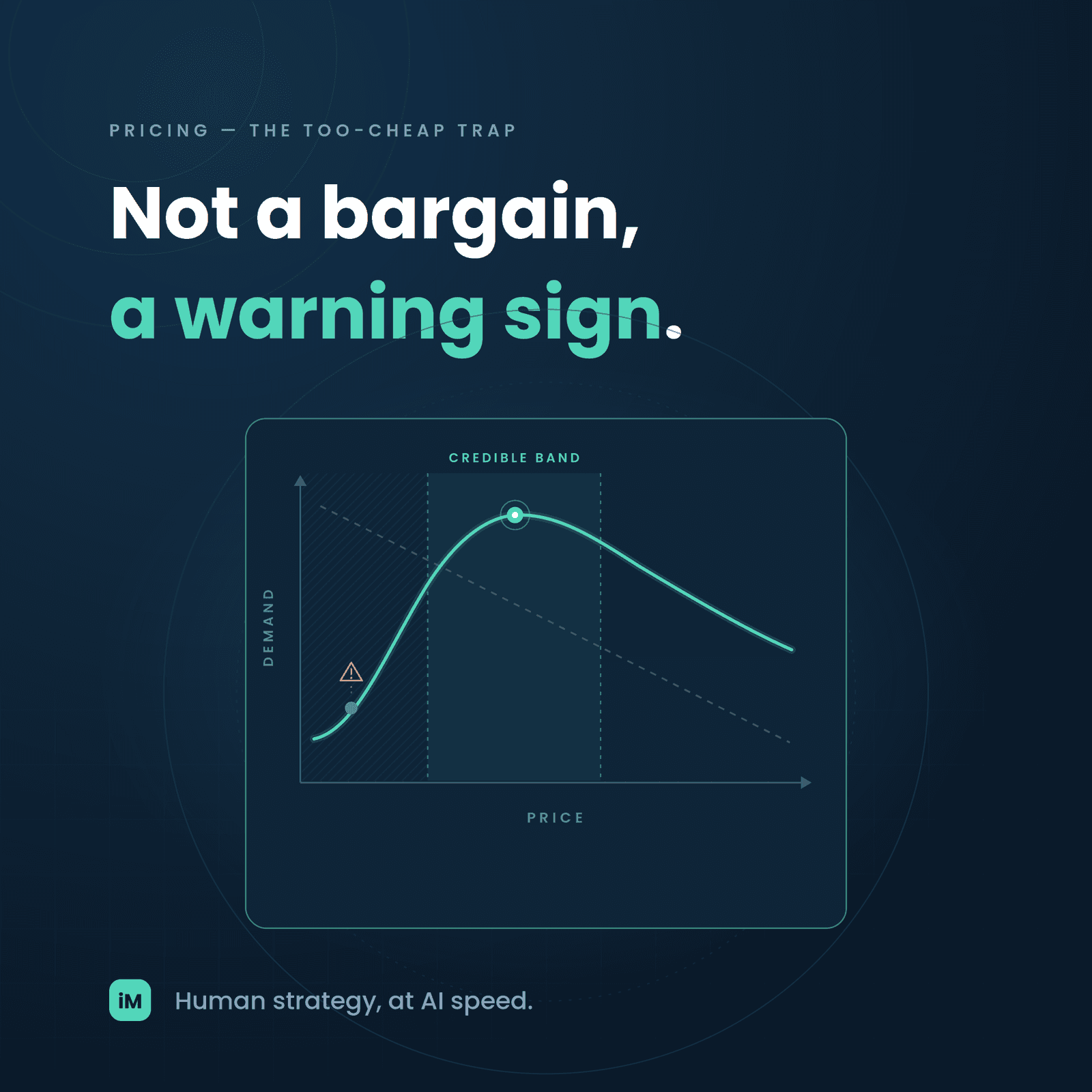
Every experienced pricing lead can name at least one product where cutting the price actually reduced sales. Sometimes dramatically. The product looked more affordable on paper, but customers stopped buying it. Marketing spend was ruled out. Product quality was ruled out. The only thing that changed was the price, and the direction of the response was the opposite of what the textbook predicted.
The paradox is not a market anomaly. It is a systematic phenomenon that appears when the price drops below the band that the buyer treats as credible for the quality on offer. Below that band the price stops being a signal of affordability and starts being a signal of doubt — doubt about the quality, doubt about the supply chain, doubt about the promise the product makes. This piece walks through what "too cheap" actually signals to buyers, why the effect has strengthened in 2026, and how to price aggressively without triggering the trap.
A price is not just a number. It is a signal, and buyers decode it against a mental model of what the category ought to cost. When the price sits within the range the buyer expects for the quality being promised, the price is neutral — it does not add to or subtract from the buyer's confidence in the product. When the price sits above that range, it either signals premium quality (if the brand supports the position) or it signals overpricing (if it does not). When the price sits below that range, it signals something the pricing textbook rarely covers directly.
A below-band price signals that something is different — and buyers do not automatically assume the difference is in their favor. They may assume the quality is lower than the marketing claims. They may assume the supply chain has been compromised. They may assume the product is a discontinued line being cleared. They may assume the brand is under financial pressure and the low price is a distress signal. Any of these interpretations reduces demand rather than increasing it, and buyers do not always articulate which interpretation they are running with — they just quietly move on to a competitor whose price signals credibility.
The too-cheap trap does not affect every category equally. It is strongest in three categories where the price signal carries a lot of information for the buyer, and it is weakest in categories where the buyer has other reliable quality signals to fall back on.
The trap is strongest in categories where the buyer cannot directly assess quality before buying. Professional services, complex software, certain premium consumer goods, most B2B categories. In these categories the price is one of the strongest signals the buyer has about the quality on offer, and the buyer relies on the price to distinguish credible options from unreliable ones. A below-band price in these categories tells the buyer that the seller either does not understand the value they are offering or is not delivering the value they claim.
In categories where quality is easily verifiable — a category where the buyer can inspect the product, read detailed reviews, or trust a strong warranty — the price signal carries less information and the trap is weaker. In categories where quality is opaque, the price is doing more work, and the trap is stronger. Most enterprise B2B falls into this second group, which is one reason B2B pricing rarely competes on price alone.
The trap is stronger in categories where the brand has staked out a specific positioning — premium, professional, aspirational, credible — that is inconsistent with a below-band price. If a brand has spent years building the perception that its product is the credible choice in a category, dropping the price below the band undermines the perception the marketing invested in. Buyers see the inconsistency and either update their view of the brand downward or assume the low price is a temporary aberration and delay purchase until the brand corrects it.
The reverse case — a brand that is explicitly positioned as the value option — has less exposure to the trap because the low price is consistent with the brand's stated position. Value-brand consumers expect low prices and interpret them as consistent with the brand promise rather than as a signal of doubt. Premium and professional brands do not have this insurance.
The trap is stronger in categories where the competitive set has anchored the buyer's expectations tightly. If every credible competitor in the category prices in a narrow band, the buyer treats that band as the reference. A price materially below the band raises questions rather than driving purchase. If the competitive set is loose and prices vary widely, the buyer has weaker anchoring and a low price is less likely to trigger the trap — but such loose categories are becoming rare.
In 2026 the competitive set in most enterprise categories is tightly anchored by well-known incumbents and a small set of well-positioned challengers, and the buyer's expectations are tighter than they were a decade ago. The credible band is narrower, and the too-cheap trap is easier to fall into.
The too-cheap trap is not new. Behavioral economists have documented the price-quality signal effect for decades. What has changed is the strength of the effect and the ease with which buyers can act on it. Three shifts have made the trap deeper in 2026.
The first shift is the maturity of the online reference environment. Buyers can now check competitor prices, category price bands, and buyer reviews in seconds. A price that sits outside the band the buyer is looking at is immediately visible as anomalous, and the buyer has the tools to interrogate the anomaly. In earlier decades the buyer might have accepted a suspiciously low price as a lucky find; in 2026 the buyer checks and often walks away.
The second shift is the rise of AI-driven discovery. When a buyer asks an AI engine for recommendations in a category, the engine's response is anchored by the price bands it sees across the market. A product whose price sits outside the band is less likely to be recommended, and even when it is, it may be described with qualifying language that reflects the anomaly ("cheaper option available, though quality varies"). The AI layer amplifies the too-cheap signal in the buyer's initial screening.
The third shift is the growth of buyer skepticism. Buyers have been trained by a decade of misleading pricing, hidden fees, subscription traps, and quality erosion in some low-price segments. They now interpret suspiciously low prices with more skepticism than they did in the past. The default assumption for a below-band price has shifted from "good deal" toward "something is off," and enterprises pricing below the band inherit the default.
Recognizing the too-cheap trap does not mean abandoning aggressive pricing. Aggressive pricing is a legitimate strategic choice — for share, for market entry, for competitive response. The point is that the aggression should be calibrated to the top of the credible band, not to a price below the band. The band's floor is the operational constraint, and pricing at or slightly above the floor captures the aggressive posture without triggering the signal effect. Five specific tactics let enterprises price aggressively without falling into the trap.
Enterprises that have already priced below the credible band and have observed the too-cheap trap's characteristic symptom — lower conversion at the lower price than at the previous price — face a delicate recovery. Raising the price back into the band is the necessary move, but it needs to be sequenced carefully.
The recovery should not be presented as a price increase for its own sake. It should be presented as a repositioning that resolves the anomaly the buyer was decoding. A short window of transitional messaging that clarifies the product's positioning — a refined product description, a repositioning of the range, sometimes a small feature enhancement that accompanies the price move — helps the price recovery land as a repositioning rather than as an opportunistic increase. The recovery typically takes one to two quarters to work through the buyer's expectations, but the conversion rate returns to normal once the price sits inside the credible band again.
The lesson from a triggered trap is that the credible band is a real constraint that pricing decisions have to respect. It is not an arbitrary limit set by convention. It is the range the buyer is willing to accept before the price starts sending signals that undermine the sale. Learning where that band sits in each market — and staying inside it while making pricing decisions — is what separates aggressive pricing that works from aggressive pricing that misfires.
The too-cheap trap is the mirror image of the too-expensive constraint. Both are real. Pricing above the band the buyer will accept prices the product out of consideration; pricing below the band prices the product into doubt. The credible band is bounded on both sides, and the pricing decision is constrained by both bounds simultaneously.
For enterprises coming from a cost-plus tradition, the too-cheap floor is often the more surprising constraint. Cost-plus pricing tends to produce a price at the low end of the reasonable range, and enterprises assume they are being competitively priced when they are actually approaching or crossing the too-cheap floor. Recognizing the floor as a real constraint — and pricing above it deliberately even when the cost-plus calculation suggests a lower number is possible — is often the highest-return pricing move an enterprise makes in its first year of decision-based pricing.
Buyers do not just decode price for affordability. They decode it for credibility. A price above the credible band prices the product out of consideration. A price below the credible band prices the product into doubt. The band is the constraint that both sides of the pricing conversation live inside.
inMOLA's Pricing Strategy module makes the credible band a first-class input to the pricing decision rather than a background assumption. The band is bounded by the actual observed prices in the buyer's competitive set — the same continuously refreshed competitor data that flows through the wider inMOLA decision engine — and the recommendation is placed inside the band explicitly, with the floor and the ceiling shown alongside the recommended price.
When the aggressive scenario would push the price toward or below the band's floor, the module flags the risk directly rather than presenting the price as if it were just another point on the recommendation range. The pricing team sees the too-cheap risk as a specific warning tied to the specific market and the specific competitive set, not as a general caution buried in a footnote. The three scenarios — aggressive, balanced, premium — are each positioned relative to the band the buyer is actually using, so the strategic choice among them is anchored in the market's reality rather than in a general framework.
The strategic payoff of respecting the credible band is that aggressive pricing decisions can be made confidently rather than nervously. The pricing team knows the floor, prices above it, and captures the aggressive posture without triggering the signal effect. That confidence is what turns aggressive pricing into a durable competitive lever rather than a risky bet — and it is the difference between enterprises that use pricing as a strategic tool and enterprises that use it as an accounting output.
Marketing Intelligence

Decision Intelligence

Marketing Intelligence