Marketing Intelligence
Strategy · April 19, 2026 · 7 min read
There has never been more marketing data available. And yet, ask a marketing director what they should do next — and most will pause. Not because the data isn't there. Because the insight isn't.
There has never been more marketing data available. GA4 tracks every scroll. Your CRM logs every touchpoint. Ad platforms generate performance reports by the hour. Social tools measure reach, impressions, and engagement down to the minute.
And yet, ask a marketing director what they should do next — and most will pause. Not because the data isn't there. Because the insight isn't.
Modern marketing teams are sitting on more information than any generation of marketers before them. But somewhere between the dashboard and the decision, something breaks down. The problem isn't volume. It's translation.
Data tells you what happened. Insight tells you what it means and what to do about it. These are not the same thing — and confusing them is one of the most expensive mistakes a marketing organization can make.
Consider a typical week for a mid-size marketing team:
Each of these data points is real. Each of them is telling you something. But what? Are they connected? Which one deserves attention first? What action do you take?
Most teams do one of three things: they schedule a meeting, they add another dashboard, or they guess. None of these is a strategy.
The average marketing team now uses between 15 and 30 tools. Each one generates its own data, its own reports, its own definition of success. The result isn't clarity — it's fragmentation.
You end up with data living in silos. Your SEO data doesn't talk to your CRM. Your ad performance doesn't connect to your brand tracking. Each tool optimizes for its own output. None of them synthesize across the whole picture. And none of them tell you what your business should actually do on Monday morning.
Marketing teams today spend a disproportionate amount of their time collecting, cleaning, and reporting data — rather than acting on it. Studies suggest that data professionals spend up to 80% of their time preparing data and only 20% actually analyzing it.
When marketers spend their days building reports instead of building strategy, something else happens: decision-making gets slower. By the time the data is clean, compiled, and presented, the market has moved. The campaign window has passed. The competitor has already acted.
Speed of insight is now a competitive advantage. And most organizations are losing it.
Real marketing intelligence doesn't just measure what happened. It evaluates performance across every channel simultaneously, identifies the relationships between data points, scores them against strategic objectives, and surfaces the actions most likely to drive growth.
It answers the questions that dashboards never do:
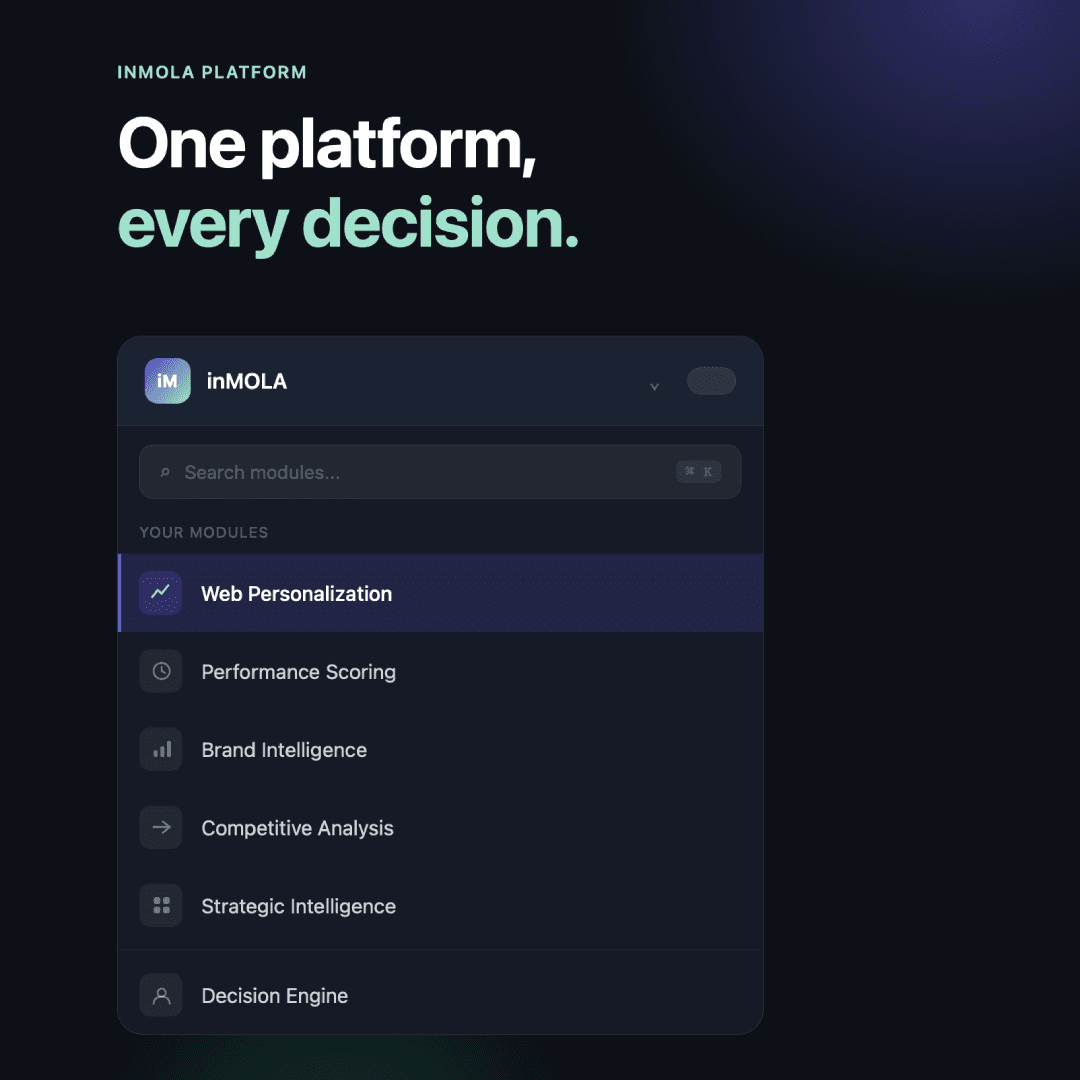
inMOLA is an AI-powered marketing decision engine built on proprietary marketing algorithms developed over years of real-world practice across global brands and industries. It doesn't add another silo to your stack. It unifies your existing data — across marketing, digital, sales, brand, and communication — and transforms it into strategic intelligence.
The platform generates performance scores across all active channels, surfaces the relationships between data points that manual analysis misses, and delivers clear, prioritized recommendations. Not reports. Decisions.
The competitive advantage in marketing is no longer who has the most data. It's who can turn data into action — faster, more accurately, and more consistently than anyone else.
The teams that win won't be the ones with the biggest dashboards. They'll be the ones who figured out how to stop drowning and start deciding.
Marketing Intelligence
Decision Intelligence
Marketing Intelligence