Marketing Intelligence
AI and Strategy · April 7, 2026 · 9 min read
Most marketing AI platforms in 2026 are analytics tools with a chatbot bolted on. This is the framework CMOs are using to tell the difference between cosmetic AI and genuine decision intelligence.
There are now more than 14,000 marketing technology products on the market in 2026. Roughly a third of them describe themselves as AI-powered. Most of them are not. They are the same dashboards, the same automation rules, and the same attribution models as five years ago — with a chatbot bolted onto the front and a price increase attached to the back.
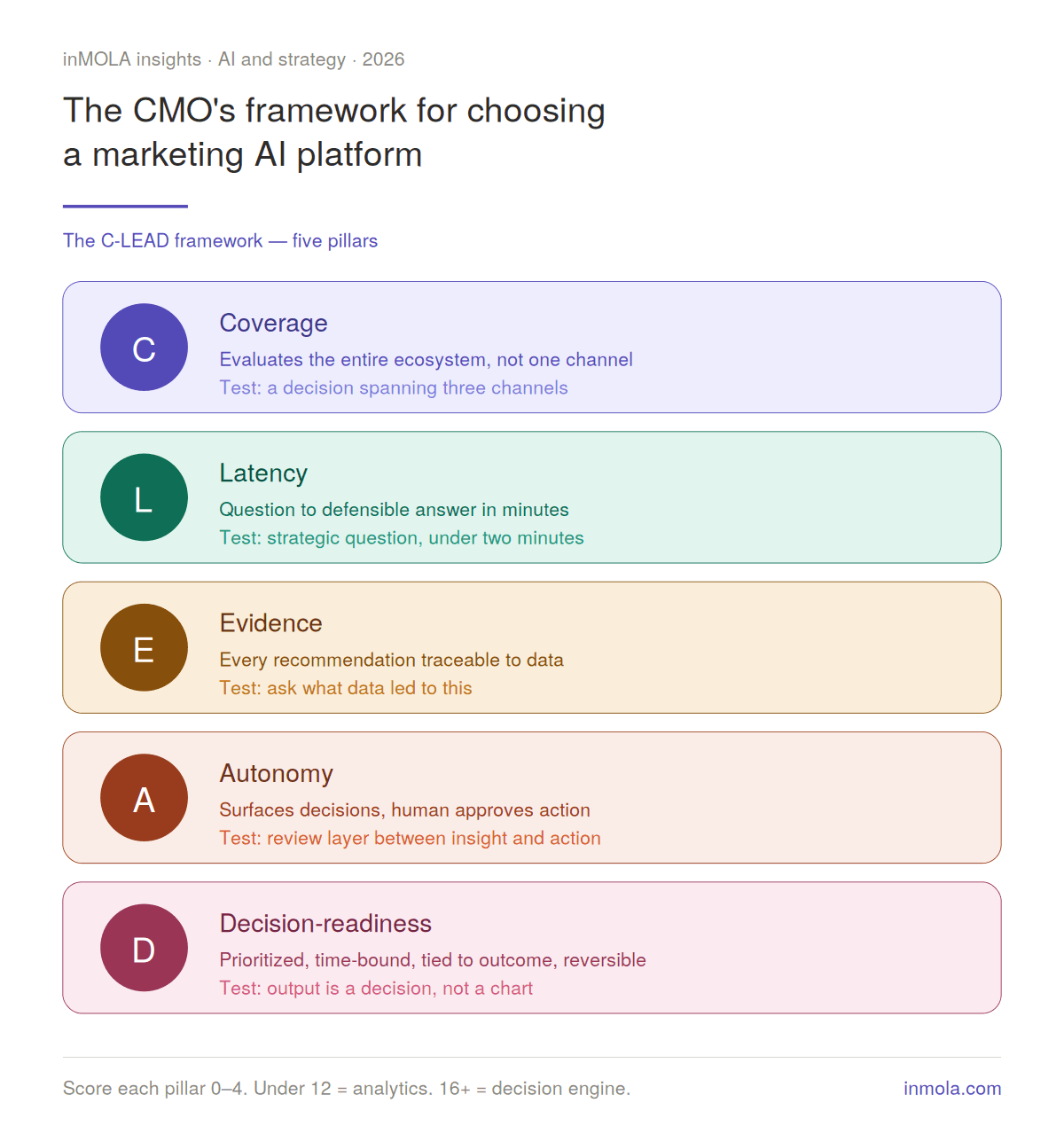
For a CMO, the job is no longer to find a marketing AI platform. The job is to tell the genuine ones apart from the cosmetic ones. The framework below is built for exactly that decision. It uses five evaluation pillars — what we call the C-LEAD framework: Coverage, Latency, Evidence, Autonomy, and Decision-readiness.
In 2020, the right questions to ask a marketing platform vendor were about integrations, dashboards, attribution models, and seats. Those criteria are now table stakes. Every serious platform integrates with GA4, HubSpot, Salesforce, Segment, and the major ad networks. Every serious platform has a dashboard.
What separates platforms in 2026 is not what they connect to. It is what they decide.
Does the platform evaluate the entire marketing ecosystem, or only one slice of it? A genuine marketing AI platform unifies data across brand, content, digital performance, competitive position, sales pipeline, and customer experience. A cosmetic one optimizes a single channel — usually paid media — and ignores the rest.
Test it: ask the vendor to demonstrate how their platform evaluates a decision that spans three channels. If they cannot, the coverage is too narrow.
How long does it take the platform to convert a question into a defensible answer? In 2026, the benchmark for a marketing AI platform is minutes, not days. If the workflow still requires an analyst to build a report, the AI layer is decorative.
Test it: ask a strategic question during the demo — "where is our largest source of wasted spend this quarter?" — and time the response. If the answer is not on screen inside two minutes with supporting evidence, latency is the constraint.
Can the platform show its work? A genuine AI platform exposes the data and reasoning behind every recommendation. A cosmetic one produces confident-sounding answers with no traceability — which is worse than no answer at all, because it is harder to challenge.
Test it: for every recommendation, ask "what data led to this?" If the platform cannot trace a recommendation back to specific signals across your stack, do not buy it.
Where on the spectrum does the platform operate? At one end is passive analytics that waits to be asked. At the other end is fully autonomous execution. The right answer for most enterprises in 2026 is the middle: the platform proactively surfaces decisions and ranks them, but a human approves before action. Avoid platforms that promise full autonomy without a review layer — and avoid platforms that require a human to ask every question.
This is the test that matters most. Does the platform produce decisions, or does it produce reports? A decision-ready output has four properties:
If the output is a chart that requires a human to interpret it, the platform failed the decision-readiness test. It is analytics with a marketing label, not marketing AI.
For each of the five pillars, score the platform from 0 to 4 during the evaluation:
A platform scoring under 12 across the five pillars is not a marketing AI platform. It is an analytics product. A platform scoring 16 or above is a genuine decision engine. Anything in between is a transitional product — useful for some teams, insufficient for an enterprise CMO.
When you run C-LEAD across the market, three clusters emerge:
Stop asking vendors what their AI can do. Start asking what their AI has decided. Specifically:
Vendors who cannot answer these questions in a discovery call are not selling marketing AI. They are selling analytics with a new label.
Stop asking what the AI can do. Ask what the AI has decided.
In 2026, the CMOs winning their categories are not the ones with the largest stacks. They are the ones who removed three or four tools and added one decision engine on top. The C-LEAD framework is the fastest way to find that engine — and the fastest way to walk out of a demo that does not deserve a contract.
Run C-LEAD on your shortlist this quarter. The platforms that pass will be obvious. The ones that fail will be too, and that is just as valuable.
Marketing Intelligence
Decision Intelligence
Marketing Intelligence