Marketing Intelligence
Decision Intelligence · April 4, 2026 · 8 min read
Marketing analytics tells you what happened. Marketing intelligence tells you what to do next. Here are the five differences that separate the two — and why 2026 is the year the distinction finally matters.
Marketing analytics and marketing intelligence are not the same thing. They are often used interchangeably — by vendors, by consultants, even by marketing teams themselves — and that confusion is now costing enterprises real money in 2026.
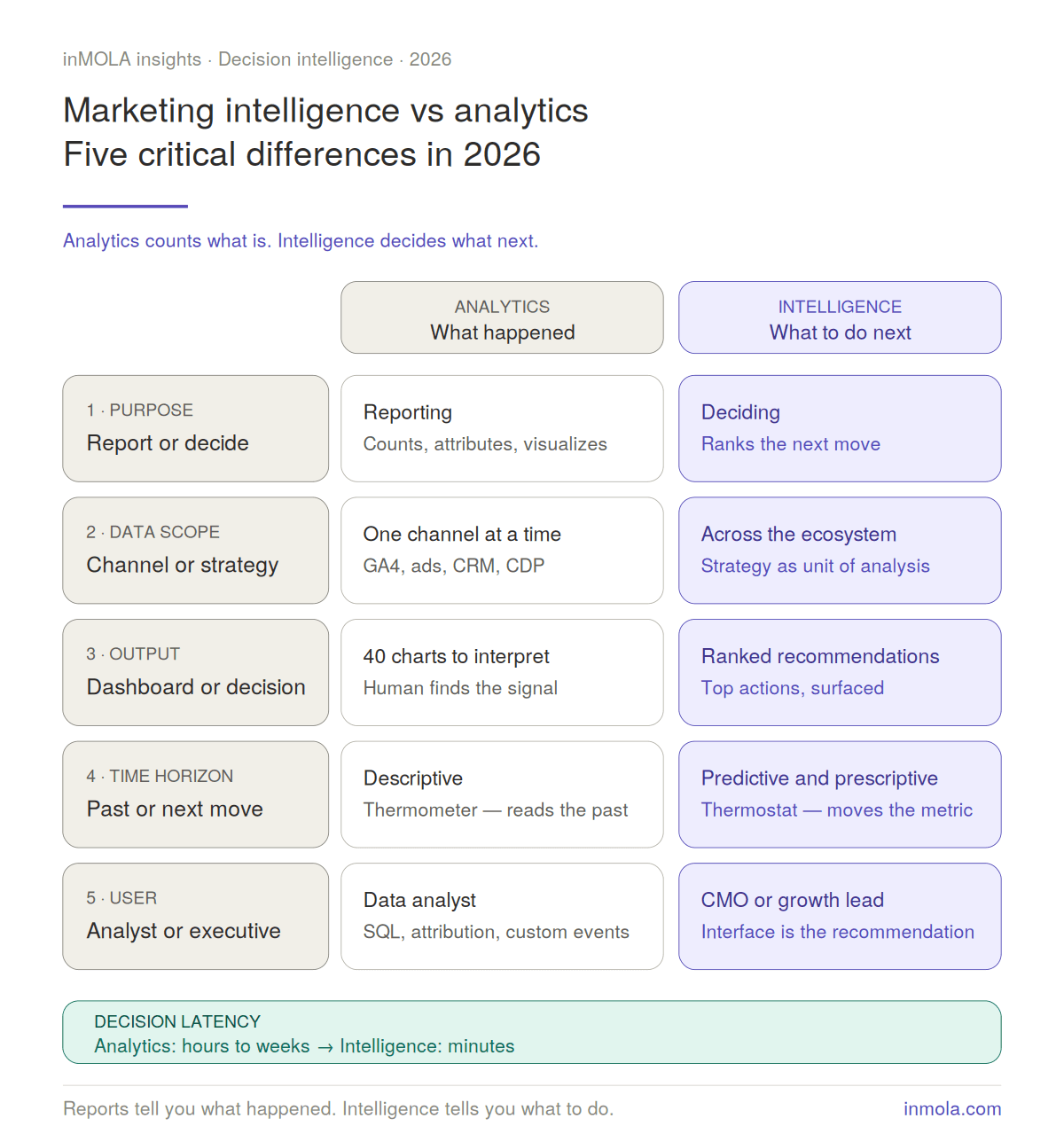
Here is the clean definition. Marketing analytics is the discipline of measuring and reporting on marketing activity. Marketing intelligence is the discipline of turning that measurement into prioritized strategic decisions. One looks backward. The other looks forward. One produces dashboards. The other produces direction.
Below are the five critical differences every CMO, growth lead, and marketing operations director should understand before signing another platform contract this year.
Marketing analytics platforms — GA4, Looker, Tableau, Mixpanel, Adobe Analytics — were built to answer the question: what happened? They count sessions, attribute conversions, calculate cost per acquisition, and visualize trends. They are excellent at this. They are also, by design, retrospective.
Marketing intelligence platforms answer a fundamentally different question: what should we do next? They synthesize data from across channels, evaluate it against strategic objectives, and surface ranked recommendations. The output is not a chart. It is a decision.
Analytics is a noun. Intelligence is a verb.
Analytics tools are typically organized by channel. GA4 owns the web. HubSpot or Salesforce owns the CRM. Meta and Google Ads own paid. Segment or a CDP unifies events. Each tool optimizes for its own slice of the funnel.
Marketing intelligence operates one layer above. It does not replace these tools. It connects them. It evaluates performance across every channel simultaneously and scores the entire marketing ecosystem against business outcomes. The unit of analysis is not a campaign. It is the strategy.
A dashboard is a commodity in 2026. Every analytics platform produces one, and most of them look the same. The bottleneck is no longer visualization. It is interpretation.
Marketing intelligence collapses interpretation into the platform itself. Instead of producing 40 charts and leaving a human to find the signal, an intelligence engine like inMOLA Core surfaces a ranked list:
This shift — from dashboard to decision — is the single most important change in marketing technology since the move from on-premise BI to cloud analytics.
Marketing analytics is descriptive by default. It tells you what your bounce rate was last week. With effort, some platforms layer in basic predictive models — forecasting next month's traffic, for example.
Marketing intelligence is predictive and prescriptive by design. It does not just forecast outcomes. It evaluates the cost of inaction, models alternative scenarios, and recommends the specific intervention most likely to move the metric that matters. The difference is the same as the difference between a thermometer and a thermostat.
Marketing analytics is built for analysts. It assumes the user knows SQL, understands attribution windows, can configure custom events, and has time to build reports. That is a reasonable assumption for a data team. It is a poor assumption for a CMO making a budget decision on Monday morning.
Marketing intelligence is built for the decision-maker. The interface is the recommendation. The complexity is hidden. The user does not need to know how the Marketing Mix Score was calculated. They need to know what action it implies — and they need that answer fast.
Yes. Marketing analytics is the substrate. Marketing intelligence is the layer that turns it into action. The mistake most organizations make in 2026 is assuming that more analytics will eventually produce intelligence. It will not. Volume of data does not create direction. Synthesis does.
The companies pulling ahead this year are not the ones with the biggest data lakes. They are the ones who added an intelligence layer on top of their existing analytics stack — and who stopped asking their marketing teams to do the synthesis manually.
Analytics counts what is. Intelligence decides what next.
If you are a marketing leader evaluating your stack in 2026, ask one question of every vendor in your pipeline: does this tool produce reports, or does it produce recommendations? If the answer is reports, it is analytics. If the answer is ranked, prioritized, time-bound recommendations tied to business outcomes, it is intelligence.
Both have a role. But only one of them will tell you what to do next.
Marketing Intelligence
Decision Intelligence
Marketing Intelligence