
Marketing Intelligence
Influencer Marketing · June 26, 2026 · 11 min read
For fifteen years, influencer selection has been dominated by a simple heuristic: bigger reach wins. In 2026 the ROI data has made that heuristic quietly indefensible. Micro-tier creators — the 10K to 500K follower band — routinely produce higher ROI per dollar than mega-tier partners at a fraction of the reach, and enterprises that still sort candidates by follower count are systematically overpaying for underperforming campaigns. Here is what changed, why the paradox is durable, and how to build a portfolio that captures the micro edge without abandoning the reach mega delivers when reach genuinely matters.
For most of the past fifteen years, influencer selection has been dominated by a single heuristic. Bigger reach wins. Sort candidates by follower count. Pick the biggest names your budget can afford. Assume that reach translates into performance in proportion to the follower number attached to it. That heuristic was never particularly rigorous, but it was easy to defend to a CMO who wanted to see impressive numbers in the campaign brief, and it produced campaigns whose results were mixed enough to be attributed to any number of variables other than the selection itself.
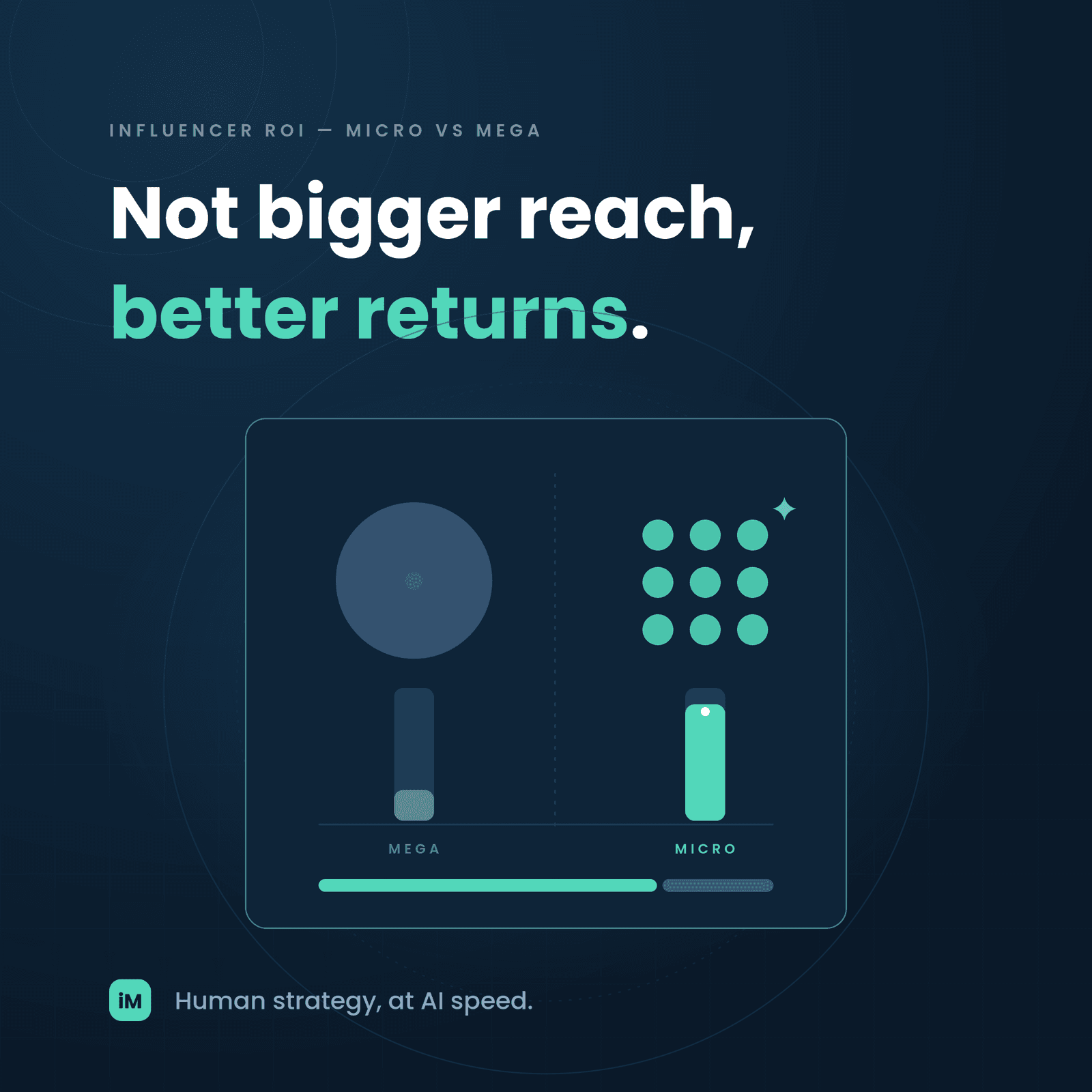
In 2026 the ROI data has made the follower-count heuristic quietly indefensible. Micro-tier creators — roughly the 10K to 500K follower band — routinely produce higher ROI per dollar than mega-tier partners at a fraction of the reach. Not by a small margin. Not in isolated categories. Across category after category, region after region, campaign objective after campaign objective, the micro tier keeps beating the mega tier on the measurement that actually matters to CFOs: dollars of revenue attributable to the campaign, divided by dollars of campaign spend.
The paradox is not that the effect exists. Marketing analysts have observed it for at least seven years. The paradox is that so many enterprises continue to allocate their influencer budgets as if the effect did not exist, running mega-tier campaigns quarter after quarter while the internal ROI reviews quietly show the micro-tier partnerships outperforming them by three to five times per marketing dollar. This piece walks through what changed to make the paradox durable, why enterprises still overspend on mega despite the data, and how to build an influencer portfolio that captures the micro edge without abandoning the mega reach that still matters where mass exposure is the actual objective.
The micro-tier advantage is not a single effect. It is the compounding result of four independent forces that all push in the same direction, and understanding the four together is what separates enterprises that can capture the edge from enterprises that only observe it.
The first force is the well-documented inverse relationship between follower count and engagement rate. A creator with 50,000 followers on Instagram typically earns engagement rates in the 3% to 8% range. A creator with 5 million followers typically earns engagement rates below 1%, often significantly below. The mega creator's audience is larger by a factor of a hundred, but the share of that audience that reacts to any given post is smaller by a factor of five or more. The reach math looks impressive; the engagement math is less kind.
Some of this is algorithmic — platforms optimize for retention across a broader audience and dilute the connection between individual posts and individual followers. Some of it is audience composition — mega creators accumulate followers who are casually interested or who followed for a moment of viral content that had nothing to do with the brand's category. Some of it is trust — audiences of micro creators feel like they know the person; audiences of mega creators feel like they follow a personality. The result is that engagement rate per follower declines steeply with tier, and engagement is closer to the conversion signal than raw reach is.
The second force is pricing. A micro creator with 100,000 followers might charge $2,000 to $5,000 for a sponsored post. A mega creator with 5 million followers might charge $50,000 to $200,000 for the equivalent placement. The mega creator has 50 times the follower count and charges 25 to 50 times the price. The pricing scale has kept pace with the reach scale but does not adjust for the falling engagement rate, so the effective cost per genuine audience interaction rises with tier.
The advertiser is buying reach at the mega tier and paying reach prices, but the reach is being delivered to an audience that interacts with the content at a lower rate. That is the exact recipe for weak ROI. The higher the tier, the more you pay for each unit of exposure, and the fewer units of that exposure translate into anything a CFO can attribute to revenue.
The third force is niche fit. A micro creator's audience is typically concentrated around a specific interest — a category, a lifestyle segment, a professional identity — that the creator has built the account around. A mega creator's audience is typically much more heterogeneous, accumulated from viral moments, cross-platform crossover, and general-interest recognition that has little to do with any particular category.
For a brand whose product speaks to a specific niche, this is decisive. The micro creator's audience is aligned with the product's target segment; the mega creator's audience overlaps with the product's target segment in some fraction that is often surprisingly small. A brand selling a specialty skincare product to a specific demographic gets a much higher conversion rate from a 200,000-follower creator whose entire audience is in that demographic than from a 5-million-follower creator whose audience is largely outside it, even though the reach numbers look wildly different.
The fourth force is portfolio construction. An enterprise that spends $200,000 on a single mega-tier partnership captures one voice, one audience, one moment in the calendar. The same $200,000 spread across forty micro-tier partnerships at $5,000 each captures forty voices, forty audiences with different niche compositions, and forty moments distributed through the campaign period. The reach of any single micro placement is small, but the combined reach — filtered through forty different audiences that overlap only partially with each other — often exceeds the mega placement's total, and the engagement across the forty is materially higher.
The portfolio effect compounds the individual-partner effect. Even if micro were only slightly better per dollar than mega on average, the ability to run forty small bets versus one large bet is a portfolio advantage in its own right. The micro strategy captures both the per-partnership ROI edge and the portfolio-diversification advantage. The mega strategy captures the reach concentration but pays for it with both effects working against ROI.
If the ROI data has been visible for years, the reasonable question is why enterprises still allocate the majority of their influencer budgets to mega-tier partnerships. The answer is a combination of institutional habit, executive-visibility bias, and operational friction, and naming the three helps enterprises recognize which is driving their own allocation choices.
Marketing organizations that have been running mega-tier campaigns for a decade have processes, agency relationships, and internal reporting templates built around them. The mega-tier campaign is easy to brief — one name, one contract, one deliverable. The micro portfolio is harder to brief — forty names, forty contracts, forty briefs. The mega workflow fits the institutional muscle memory; the micro workflow requires new muscle. Enterprises that recognize this often shift by starting with a hybrid — one mega placement plus twenty micros — and letting the ROI numbers make the case for continued rebalancing quarter by quarter.
Mega-tier campaigns produce metrics that look impressive in an executive slide. Twenty million impressions. Coverage across major outlets. A recognizable name attached to the brand. The micro portfolio produces metrics that require explanation — thousands of smaller reach numbers, high engagement rates that are not the metric executives are used to seeing, revenue attribution that comes from many small sources rather than one large one. The executive-visibility bias pulls campaign allocation toward mega even when the ROI clearly favors micro, because the campaign's success needs to be legible to executives in the language they are used to reading. The correction is to build a monthly executive summary that shows ROI per dollar and total revenue attribution rather than impressions and reach — and to prove the pattern over several campaigns before defending it against an executive who wants a bigger name.
Running forty micro partnerships requires infrastructure the mega workflow does not. Discovery of candidate creators. Assessment of their engagement rates and authenticity. Contracting and briefing at scale. Content review across many partners. Attribution and ROI measurement per partnership. Without tooling that supports these operations, the friction of running the micro strategy exceeds the ROI advantage it captures, and the strategy fails not because it is wrong but because it is unmanageable. Enterprises that solve the tooling problem — either through internal platforms or through purpose-built influencer software — capture the micro edge; enterprises that try to run micro-scale campaigns on mega-scale infrastructure quietly give up and revert to mega.
The right response to the micro ROI paradox is not to abandon mega-tier campaigns entirely. Mega still delivers value where mass reach is the objective — brand-awareness pushes for major product launches, category-defining moments where the enterprise wants to plant a flag, campaigns whose success is measured in category-mention share rather than revenue attribution. The right response is to build a portfolio in which each tier is allocated against the objective it genuinely serves, and to stop cross-subsidizing weak ROI at the mega tier by underinvesting in the micro tier that could produce it.
The enterprises that have moved fully to this portfolio approach report ROI improvements per marketing dollar that are hard to achieve through any other single lever available to a CMO. The paradox is durable because the four forces underlying it are not going away — engagement declines with tier, pricing scales faster than results, niche fit favors specialists, and portfolios beat concentrations. The advantage is available to enterprises that structure their approach around those four forces. The advantage remains unclaimed by enterprises that continue to allocate as if bigger reach automatically means better return.
The mega-tier campaign was the right answer when the objective was mass reach and the pricing sheet respected the follower count. In 2026 the objectives have diversified, the engagement rates have declined, the pricing has stayed high, and the ROI comparison is decided. The paradox is durable. The advantage is available. The enterprises still asking whether it applies to their category will find out from the ones that already stopped asking.
inMOLA's Influencer Marketing module is built around the micro ROI paradox as a first-class assumption rather than as a footnote. Instagram, TikTok, and YouTube creators are surfaced with the tier sweet-spot explicitly captured in the Quality Score — micro-tier candidates are ranked higher on the same underlying engagement and cadence data because the ROI-per-dollar edge lives in that tier. Brand-fit scoring adds the niche and audience alignment on top, so the micro creators surfaced are not just high-engagement across the board but high-engagement in the specific niche and geography your brand actually needs to reach.
The module operates the discovery, scoring, and shortlist workflow at the scale that the micro portfolio strategy requires. A campaign that used to involve one mega placement and hours of manual scouting can be rebuilt as thirty scored micro candidates, ranked by both quality and brand-fit, evaluated in the same view where the campaign brief lives. The operational friction that quietly forces enterprises back to mega — because forty micro placements are unmanageable without tooling — is exactly the friction the module removes.
The strategic payoff is not that the module produces a better influencer report. The payoff is that the enterprise's influencer budget starts producing the ROI the underlying data has always been able to deliver, and the paradox stops being an interesting observation and starts being a lever the CMO can actually pull. In 2026 the enterprises pulling that lever are compounding their marketing efficiency against the enterprises still buying names by follower count — and the compounding does not slow as long as the four forces underlying the paradox continue to hold.
Marketing Intelligence

Decision Intelligence

Marketing Intelligence