
Marketing Intelligence
Brand Reputation Monitoring · July 1, 2026 · 11 min read
A single tweet from an influential account can push a brand into a reputation crisis in under four hours. The cascade is well understood — the trigger post, the amplification wave, the mainstream pickup — and yet most brand monitoring is still calibrated to catch aggregate patterns rather than single high-velocity mentions. The result is a systematic mismatch where the crisis of the modern era is invisible to the tooling designed for a slower one. Here is the anatomy of a viral negative mention, why the response window has compressed to something closer to an hour than to a day, and how enterprises are rebuilding their alerting to catch the specific pattern before it consolidates.
A single tweet from an influential account — a journalist, a category expert, a former customer with credibility, a rival executive — can push a brand into a reputation crisis in under four hours. The pattern has become common enough that most enterprise marketing leaders have a specific example in mind when they hear the phrase 'viral negative mention.' A well-worded complaint. A screenshot of a bad experience. A single accusation. A moment of comparison unfavorable to the brand. Twenty thousand retweets by lunchtime. Category media picking it up by evening. The board asking about it the next morning.
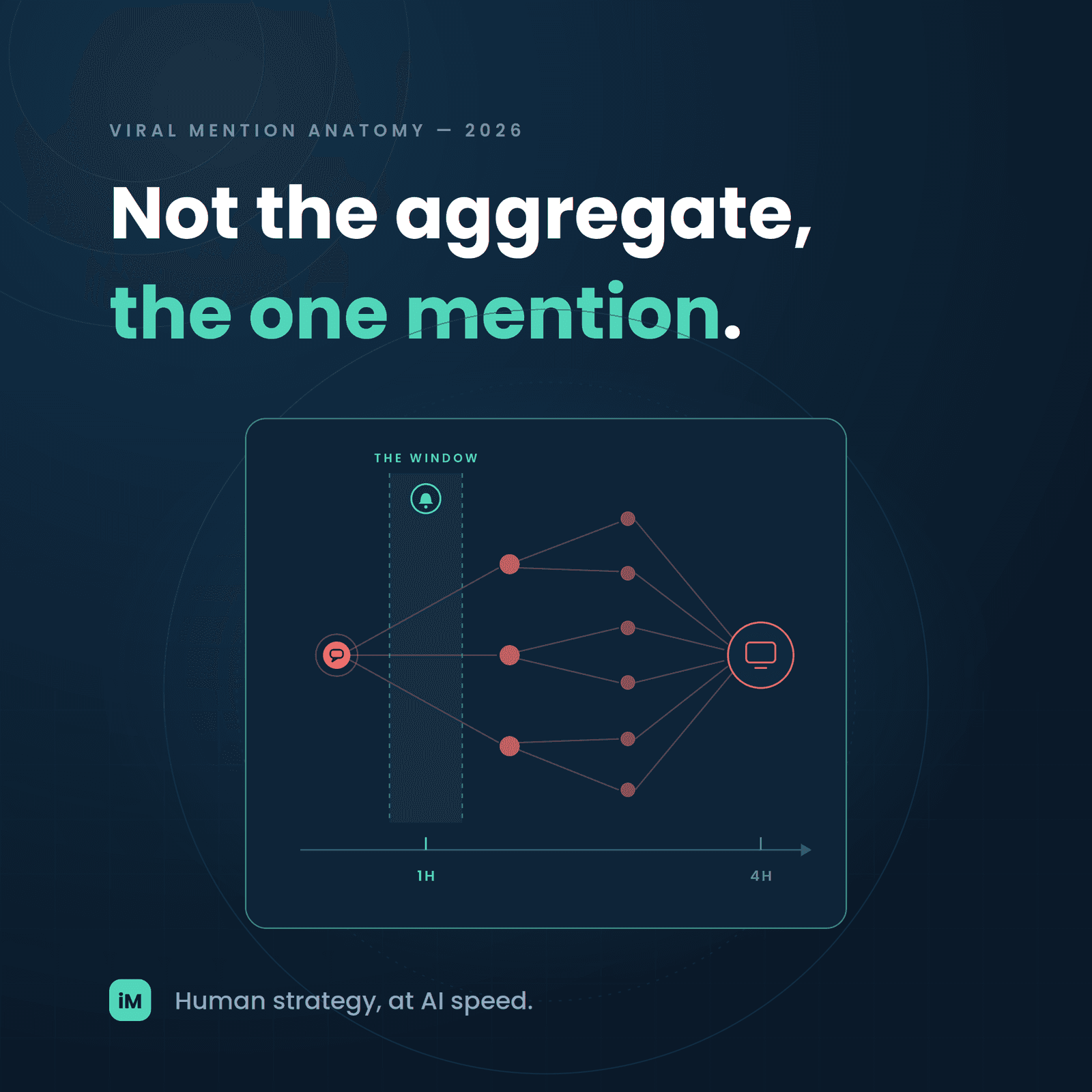
The cascade is well understood in general terms. The industry has been talking about single-post virality since at least 2014. And yet most enterprise brand monitoring is still calibrated to catch aggregate patterns — total mention volume, aggregate sentiment share, weekly summaries — rather than single high-velocity mentions. The result is a systematic mismatch. The crisis of the modern era is often triggered by a single post that consolidates in hours. The monitoring is often tuned to catch patterns that develop over days or weeks. The mismatch is not subtle; it is the specific mechanism by which most brands miss the response window on the crises they eventually spend the most on.
This piece walks through the actual anatomy of a viral negative mention — the specific pattern the post follows as it moves from initial visibility to full amplification — the response window mechanics that determine whether the brand can shape the outcome, and how enterprises are rebuilding their alerting to catch the specific pattern in the specific window while it is still actionable.
A viral negative mention follows a fairly consistent pattern across most enterprise categories. The specific timing varies by platform, by the account that triggered it, and by the category context. The shape is stable enough to describe, and the phases are what determine when a brand can still act on it.
The trigger post lands. In the first thirty minutes it is visible to the original account's followers and to the algorithmically served audience whose interests intersect with the topic. Engagement is accumulating but not yet at viral velocity. The specific text of the post, the specific screenshot or reference attached, and the tone the account takes are all still being read for the first time by an audience that is forming its initial reaction. This is the phase where the brand, if it is monitoring for high-follower mentions, receives the first signal. It is also the phase where most brand monitoring completely misses the signal because the alert is tuned to aggregate patterns that have not yet developed.
The post crosses into amplification. Retweets from moderately-influential accounts push it into feeds that would not otherwise have seen it. The engagement metrics — retweets, quote-tweets, likes — start climbing at a rate that is orders of magnitude faster than the original account's baseline. Comment threads develop, and the specific framings of the comments start to accumulate. The audience is no longer just reading the trigger post; they are reading the trigger post plus the top comments, and the framing of the top comments is starting to shape the interpretation. This is the specific phase where the response window is most valuable, because a response landing in this phase can still shape which framing dominates. A response landing after this phase is arguing against a framing that has already consolidated.
Category media and mainstream press pick up the story. Journalists who follow the category on the platform have already seen the viral post, and by hour three or four they are deciding whether to write about it. The decision to write about it accelerates the cascade further — press coverage produces new engagement, which produces further amplification, which produces further press coverage. By hour twelve the story is often on category news sites; by hour twenty-four it may have crossed into mainstream press if the topic is sensitive enough. The brand's response, if it is coming, needs to be in the reporter's inbox before the article is written, not after. Enterprises whose response arrives on hour thirty-six are responding to articles that have already been written and read.
The active virality subsides. The engagement metrics on the original post slow, the mainstream press moves to the next story, the audience attention drifts. What persists is the search residue. When someone searches the brand or the specific topic, the coverage from Phase 3 shows up in the results. The tweet itself, if it went viral enough, gets embedded in articles that continue to be read for months. The specific frame the audience selected in Phase 2 has hardened, and it is the frame that appears when the topic comes up in future coverage of the brand. This tail is where the reputation cost of a viral negative mention actually accumulates. The active crisis lasts a day. The residue lasts years.
The response window for a viral negative mention has compressed materially over the past five years. Where a brand might have had a full day to prepare a considered response in 2019, the same brand in 2026 has closer to two hours before the amplification cascade has consolidated a framing that the response then has to work against.
Three developments explain the compression.
Viral posts no longer stay on the platform where they originate. A tweet that goes viral migrates to LinkedIn discussions, to TikTok explainer videos, to Instagram screenshots, sometimes to YouTube commentary. Each cross-platform migration widens the audience and accelerates the framing consolidation. The response window on a single-platform crisis was slower because the amplification was bounded by the platform's own reach. The response window on a cross-platform crisis is faster because the amplification compounds across audiences that were originally disjoint.
Platform algorithms have shifted toward interest-based content distribution rather than follower-based, and the shift has made viral posts reach non-followers much faster than they used to. A tweet from a moderately-influential account with 50,000 followers now regularly reaches audiences of a million or more when the algorithm decides the post matches broad interest. The virality no longer requires the trigger account to be famous; it requires the trigger post to be interesting. And the algorithm's interest detection operates on a timescale that is faster than any human editorial decision.
Even if the original post is deleted, screenshots persist. The screenshot culture that surrounds negative posts specifically has professionalized — accounts exist whose entire purpose is to archive brand-critical posts before they can be deleted. The brand's ability to make the post disappear by getting the original account to delete it has essentially vanished. Once the screenshot exists, the amplification continues even if the source is gone. The response has to address the content, not the platform artifact.
The specific detection challenge for a viral negative mention is different from the challenge for aggregate negative-sentiment surge. Aggregate surge is a pattern that develops across many mentions and can be detected against a trailing baseline. Viral single-post virality is a pattern in a single post that requires per-post detection, and the alert has to fire on the specific post before it consolidates into a framing that has already taken hold.
Enterprises that respond well to viral negative mentions typically have a specific playbook. The playbook does not solve every case, but it produces materially better outcomes than the ad-hoc response most enterprises default to.
The first step is triage in under fifteen minutes. Is this a genuine crisis or a false alarm? What is the trigger? What is the audience segment engaging? Is the specific claim in the post factual, contested, or false? Triage decisions get made against pre-defined categories rather than reasoned from scratch, so the response owner can move to strategy within fifteen minutes of the alert.
The second step is response strategy within the next thirty minutes. The strategy is one of a small number of options — direct engagement with the original poster, a public statement, a customer-facing acknowledgement, a legal notice, or an intentional choice not to respond because engagement would amplify. The choice is calibrated to the specific trigger type. Enterprises with playbooks have the choice pre-mapped for common trigger categories. Enterprises without playbooks spend hours debating the choice, and by the time they decide, the response window has narrowed materially.
The third step is execution within the following hour. The response ships. Whether it is a post from the brand account, a call to the reporter who is about to write the story, a statement issued through an official channel, or a specific correction to the audience of the original post, the execution happens fast enough to influence Phase 2 rather than to argue against Phase 3.
The fourth step is monitoring of the response's effect. Did the engagement trajectory on the original post shift? Did the framing of the top comments change? Did the mainstream press coverage that was about to appear reflect the response's framing or ignore it? The monitoring feeds back into the next viral event's playbook, refining the response for the specific patterns that produce better outcomes in the enterprise's specific category.
The viral negative mention is the specific reputation event that most reliably compresses to a window measured in hours rather than days. The enterprises that catch the pattern in the specific window walk out of the event with a manageable outcome. The enterprises that catch it after the window has closed walk out arguing against a framing that has already consolidated, and the arguing typically makes it worse.
inMOLA's Brand Sentinel module includes viral-negative-mention detection as a first-class alarm type. The specific pattern the alarm catches is a single mention crossing a defined engagement threshold, calibrated to the mention's author baseline rather than to a global constant, filtered through the sentiment and theme classification so the alert fires specifically on the negative variant of the viral pattern.
The alert includes the context required for fast triage. The full text of the post. The author's follower count and recent posting pattern. The current engagement trajectory. The specific sentiment and theme classification. The direct link to the post, so the response owner can move from the alert to the post without a separate lookup. This context is what enables the fifteen-minute triage rather than the two-hour investigation that response teams without this context are forced into.
The strategic value of the alarm is not that it eliminates viral negative mentions. Those happen; some of them are outside the brand's control. The value is that the enterprise catches them in the window where the response can still shape the framing, rather than reading about them after the framing has consolidated. In 2026 the brands operating with per-mention viral detection catch the specific pattern that compresses the response window fastest, and the operational muscle they build around fast response compounds across every future viral event. The enterprises relying only on aggregate monitoring continue to miss the specific window where response has leverage, and the residue of the events they miss late accumulates into the reputation cost that they eventually spend the most explaining.
Marketing Intelligence
Decision Intelligence

Marketing Intelligence