Marketing Intelligence
AI Visibility · May 22, 2026 · 10 min read
In 2026, roughly 40% of B2B research journeys — and closer to 50% in software — now begin inside an AI assistant, not a search engine. That shift decides which vendors make the shortlist before the traditional funnel even opens. Here is what is actually happening, where AI search reshapes the buying journey, and how enterprises are learning to capture that early attention.
In the first half of 2026, multiple enterprise buying-behavior studies converged on a startling number: roughly 40% of B2B research journeys — and closer to 50% in software categories — now begin with a question typed into an AI assistant rather than a search engine. That number is not the ceiling. It is the floor.
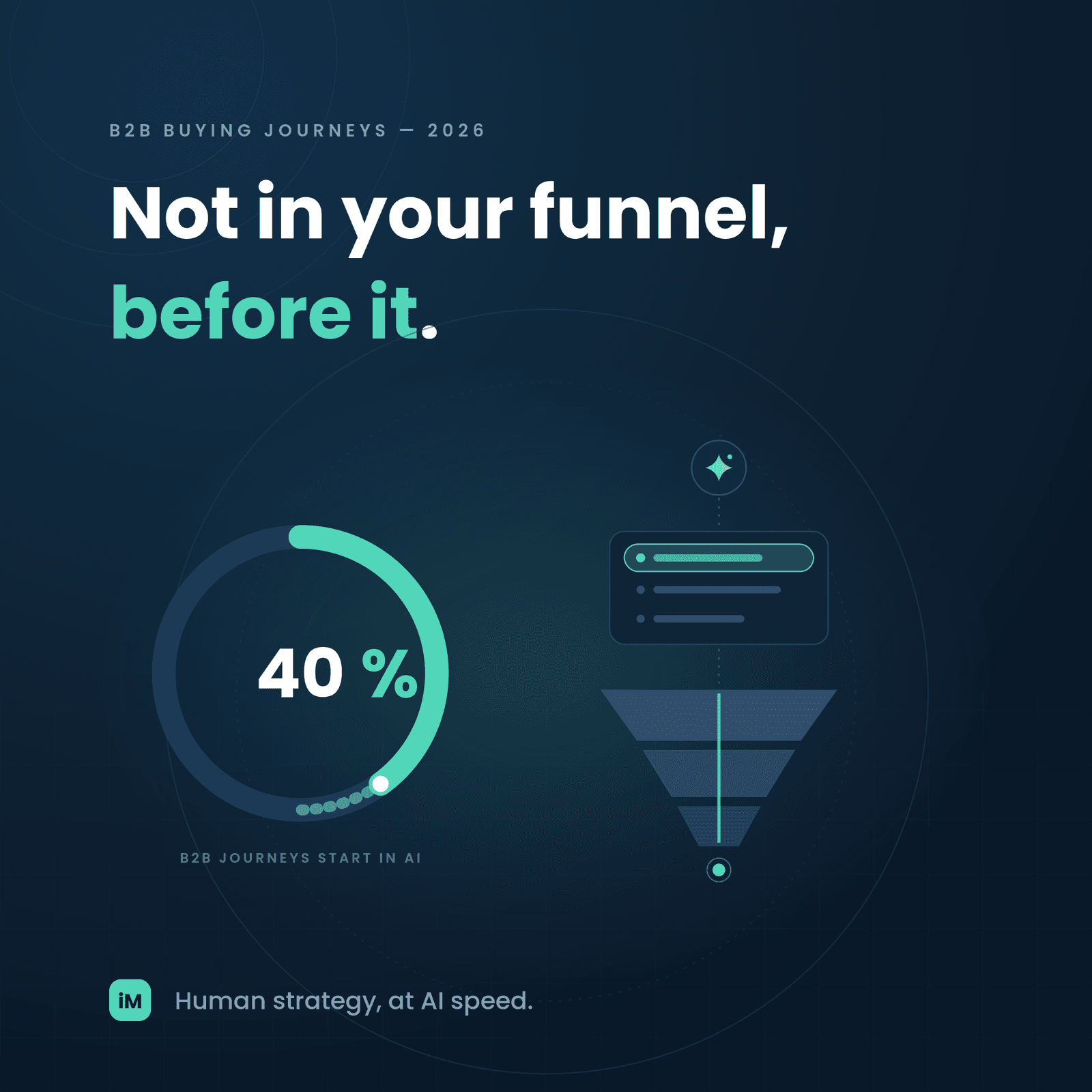
The buyer used to Google. Now the buyer talks to ChatGPT, Perplexity, or Gemini. And when the AI gives an answer, it often names three or four vendors in the same sentence. Your brand is either in that sentence or it is not. If it is, you are on the shortlist. If not, you are not on the shortlist, and no downstream marketing spend will efficiently put you there.
This piece explains what is actually happening inside B2B buying journeys in 2026, where AI search reshapes the funnel, and how enterprise marketers are learning to capture that early attention — not through SEO tactics, but through a different measurement and content operating model. It also names where inMOLA's AI Visibility module fits, honestly, because measuring across the AI answer layer is exactly what the module was built for.
The number is not an artifact of tech-forward sectors. Enterprise buying-behavior studies published in Q1 and Q2 2026 by consulting firms, research houses, and B2B media outlets converge on a range: 38–46% of research-heavy B2B journeys begin in an AI assistant. In software and SaaS categories, the number is higher — closer to half. In more traditional B2B categories (industrial, financial services, professional services), the number is lower but rising fast, approximately 25–35% and growing quarter over quarter.
A subtlety matters. "Starting in AI" does not mean "ending in AI." Most journeys still touch a website, a product review site, or a peer conversation before purchase. But the framing of the shortlist — which vendors the buyer considers seriously — is now decided in the AI conversation, often before the buyer visits a single vendor site.
The implication for enterprise marketing is direct. The traditional funnel used to start with organic search, paid search, and social discovery. Those channels still matter. But upstream of all of them, a new discovery layer has appeared, and that layer decides which brands the buyer will bother researching further. If your brand is not surfaced by AI at the top of the funnel, most of your downstream marketing is optimizing for a shortlist that already excludes you.
B2C search has always been high-volume, transactional, and often local. B2B search has been low-volume, high-intent, and often global or multi-region. AI search inherits and amplifies both patterns, but with important twists.
First, AI search collapses evaluation. In classical B2B research, the buyer would visit multiple vendor sites, download comparison guides, read peer reviews, and consult analyst reports. Some of that still happens, but the initial evaluation now often happens inside the AI conversation. The buyer asks "which platforms are best for X" and gets a comparison paragraph directly. That paragraph often includes descriptors that would have taken weeks of research to synthesize.
Second, AI search is inherently comparative. When you ask a Google search "best CRM for enterprise," you get a list of ten pages. When you ask ChatGPT the same, you get a paragraph naming three or four vendors, comparing them, and sometimes recommending one. The comparison is built into the answer. This means AI search is not just discovery — it is competitive positioning by default.
Third, AI search cites less than it used to. In early 2024, Perplexity's default response format included visible citations for every claim. In 2026, cite rates vary widely: Perplexity still cites heavily, ChatGPT cites more selectively (and only in browsing mode), Gemini cites when it uses live retrieval, Claude cites when explicitly asked. This means the buyer often sees a recommendation without seeing where it came from. The vendor being cited never knows.
B2B marketing has always distinguished top-of-funnel awareness, mid-funnel evaluation, and bottom-of-funnel decision. AI search touches all three, but reshapes each differently. Enterprise teams that treat AI search as a single channel miss the fact that it functions as three distinct moments, each with its own measurement and its own fix.
The first time a buyer asks an AI assistant "who are the leading vendors in category X," the AI's answer forms the buyer's shortlist. Vendors named in that answer enter the buyer's consideration set. Vendors not named have to compete their way in later — through peer recommendations, sales outreach, or ads — at much higher cost per acquisition and with lower close rates.
The measurement here is share of AI answers at the category level. For a defined query like "best marketing intelligence platforms 2026," what percentage of responses across ChatGPT, Perplexity, Gemini, and Claude mention your brand? That is your shortlist inclusion rate. Below 30%, you are structurally disadvantaged in most B2B journeys. Above 60%, you are the default consideration.
Once the buyer has a shortlist, the next AI queries are comparative. "How does X compare to Y." "Is X better than Z for use case A." The AI generates comparison paragraphs that describe each vendor's strengths, weaknesses, positioning, and fit. Buyers often paste those comparisons directly into internal Slack channels, vendor evaluation documents, or procurement briefs.
The measurement here is descriptor accuracy and framing. When AI describes your brand in a comparison, what adjectives does it use? What use cases does it associate you with? Do the descriptors match how you position yourself? If not, you have a framing problem that no amount of website copy will fix. The AI is describing you the way the wider web describes you — which is often not the way your marketing team describes you.
Late in the buying journey, buyers use AI for validation. "Is X a good choice for our situation." "What are the concerns with picking X." This is the moment when AI's summary of reviews, complaints, and risk factors most directly influences the buying decision. A negative descriptor at this stage — "concerns about scale," "less established," "limited features for X" — can kill a deal that was otherwise closing.
The measurement here is descriptor sentiment on validation queries. What are the risks and objections AI raises about your brand when a buyer is validating? Are those objections accurate? Are they current? Every objection is either a real issue to address or an information gap to close, and enterprises that ignore this layer discover the objections only after they lose a deal.
Enterprise marketers often treat AI search as a top-of-funnel awareness channel. It is, but it is more than that. Capturing AI search across the buying journey means three distinct efforts, not one.
Capturing the shortlist means being included when the AI names vendors. This is a discoverability and authority problem, and the fix is systematic — earning authoritative citations, being present in reference-style content, and having a stable, clearly categorized brand identity across the sources AI engines trust. Publishing more of your own content alone will not move this metric significantly; being cited by others is what does.
Capturing the comparison means shaping the descriptors AI uses about you. This is a content strategy problem, and the fix is deliberate positioning content — pages that clearly state what you are best at, what you are not, and what specific use cases you serve. Vague marketing content produces vague AI descriptors. Precise, honest content produces precise, accurate descriptors that carry your framing into the AI conversation.
Capturing the validation means proactively addressing the objections AI will raise. This is a reputation and content operations problem, and the fix is systematic — identify the real objections buyers raise late-stage, publish substantive responses, ensure those responses live in places AI engines can retrieve. The specific fix here often is not more marketing content; it is targeted case studies, third-party validation, and clear risk-mitigation resources.
AI search is not a marketing channel that reports to the SEO team. It is the discovery layer that sits above every marketing channel. Enterprise teams that assign AI search to a specialist role — even a senior one — under-resource the effort. The right owner is the CMO or CMO-adjacent leader who can coordinate content, PR, product marketing, and analyst relations toward a unified AI visibility outcome. Anything less produces siloed improvements that fail to compound.
Many enterprises begin AI visibility measurement by tracking how often their brand appears in category-level queries. That is a good start, but it captures only the top-of-funnel moment. The teams pulling ahead in 2026 track all three moments — shortlist inclusion, comparison framing, and validation objections — and treat them as separate performance areas with separate improvement plans. A brand can be doing well on shortlist inclusion and losing deals at validation, and a single-number AI visibility score obscures that entirely.
The instinct when discovering an AI visibility gap is often to publish more content. Sometimes that is right. More often, the fix is in the sources AI engines trust — third-party citations, industry inclusion, analyst coverage, expert commentary in authoritative outlets. Publishing your own content matters, but the compounding gains come from being cited by others in the sources AI engines weight most heavily. Content velocity is not the same as authority.
The shortlist is decided upstream of every other marketing channel. In 2026, the shortlist is decided by AI.
inMOLA's AI Visibility module was built to measure the three buyer moments across all four major AI engines — ChatGPT, Perplexity, Gemini, and Claude. Rather than reporting a single "AI visibility score," it separates shortlist inclusion, comparison descriptor quality, and validation objection surface into distinct measurement areas, each with its own competitive baseline and its own recommended next move.
The reason this matters: a brand can be doing well on shortlist inclusion (top of funnel) and terribly on validation (bottom of funnel), and a single-number AI visibility score would obscure that. The inMOLA module surfaces the specific moment where your brand is weakest and the specific competitive comparison where the gap opens, so the fix is targeted, not generic. That precision is what turns AI visibility measurement from a curiosity into a lever.
Because AI Visibility is one of 64 interconnected modules inside inMOLA's decision engine, the output does not stop at measurement. It connects to the broader marketing decision layer — brand health, PR media value, competitive intelligence, campaign performance — so a shift in AI visibility is contextualized against the rest of the marketing engine, not read in isolation. Enterprise CMOs get one integrated picture rather than another siloed dashboard.
If AI search is not currently a measured part of your marketing operations, four practical moves will get you to a baseline:
Doing those four things moves you from unmeasured to measured. That alone is a meaningful advantage over most enterprise competitors, who in mid-2026 are still treating AI search as a curiosity rather than as the layer where 40%+ of buying journeys now begin. The gap between measured and unmeasured brands is compounding every quarter.
The buyer's first stop is no longer your website. It is a conversation with an AI. What that conversation says about your brand — whether you are named, how you are described, what objections are raised — is now the most important marketing question of 2026. The brands treating it that way are compounding their advantage. The rest are still optimizing for a shortlist they were never included on.
Marketing Intelligence
Decision Intelligence
Marketing Intelligence