Marketing Intelligence
Pricing Strategy · June 27, 2026 · 11 min read
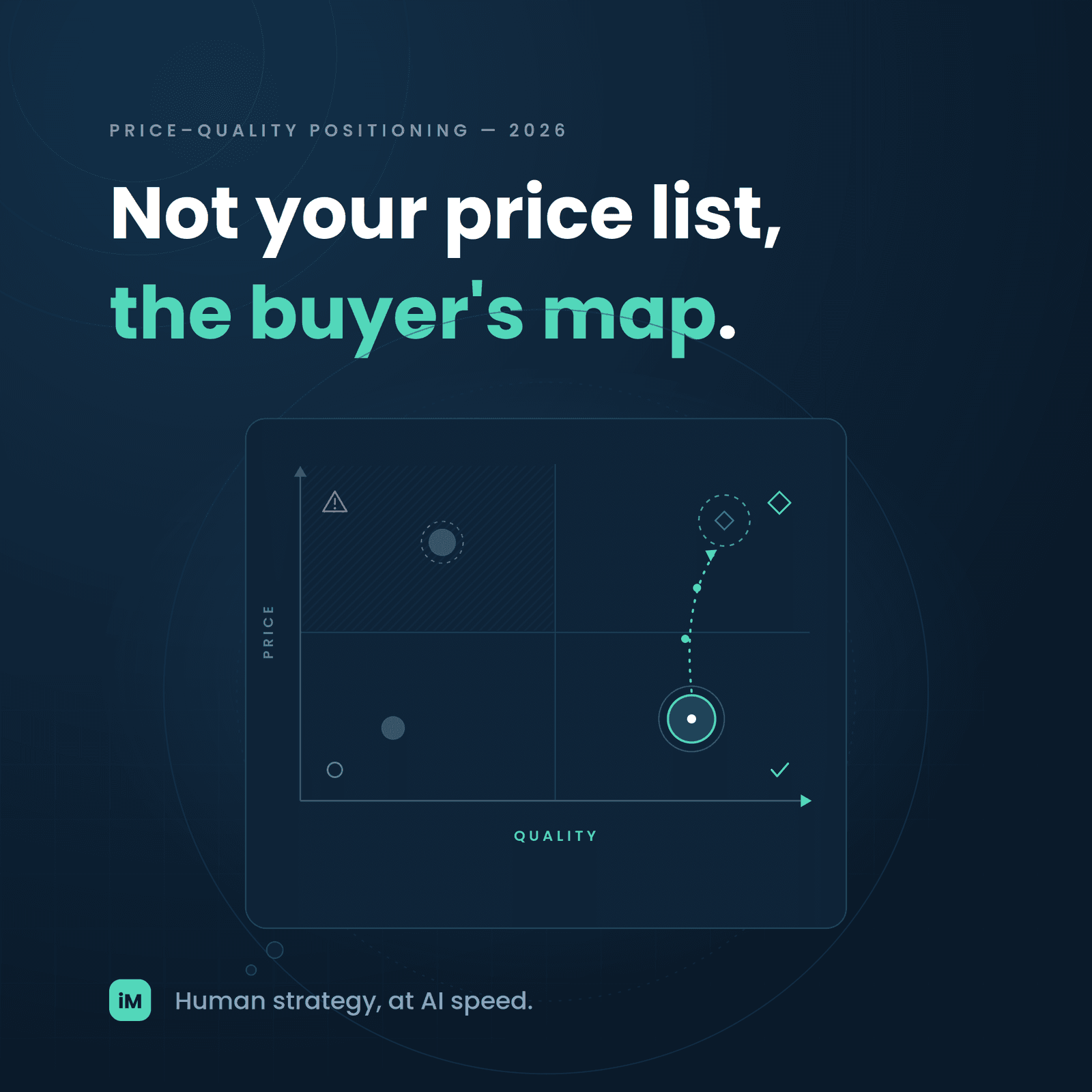
Every buyer runs a mental 2x2 when they see your product — price on one axis, quality on the other. Where the buyer places you on that map decides more than the pricing calculation does: it decides whether they consider you at all, whether they see you as premium, and whether they treat your price as credible. Here is what the four quadrants of the price-quality map actually mean, why some positions are stable and others are dangerous, and how to move deliberately from one position to another when the strategy calls for it.
Before a buyer decides whether to purchase your product, they place it on a mental map. The map has two axes. Price on one axis — how expensive the product is relative to what they expected. Quality on the other — how good the product appears to be relative to alternatives. The buyer does not draw this map on paper. They construct it in seconds from the signals they encounter: your marketing, your competitor set, your reviews, your positioning, your presentation, and — critically — your price.
Where the buyer places you on that mental map decides more than the pricing calculation does. It decides whether you enter the consideration set at all. It decides whether your price feels justified or feels like an anomaly. It decides whether your product is described in premium language or in value language. It decides, ultimately, whether the buyer's decision is "why should I buy this over the alternative" or "why would I buy something else when this is so obviously right for me."
This piece walks through what the four quadrants of the price-quality map actually mean in operating terms, why some positions are stable strategic homes and others are dangerous transitional zones, and how to move deliberately from one position to another when the strategic case calls for it. The map itself is not new — variants of it have appeared in marketing literature for fifty years. What is new is the specificity of the moves each position requires, and the tighter connection between position and price that 2026's competitive environment enforces.
The map has four quadrants formed by the two axes crossed at each axis's midpoint. Each quadrant represents a different strategic position in the buyer's mind, with different implications for pricing, marketing, and the operating structure that supports the position.
The Economy quadrant is where products sit when both their price and their perceived quality are below the market's middle. This is a legitimate strategic home, not a failure state. Value brands live here deliberately. Private-label operators live here structurally. The buyer who chooses an Economy product is doing so with awareness of the trade-off — accepting lower quality for a lower price — and that awareness is what makes the position stable.
The pricing decision in this quadrant is bounded by the credible band's lower edge. Even in Economy positioning, the price cannot fall below the too-cheap floor without triggering doubt about the product. The quadrant supports a low price, but it does not support any price. The operating structure has to match — low product cost, low overhead, low go-to-market cost — because the price cannot be raised to compensate for structural inefficiency. Economy is a discipline more than a shortcut.
The High Value quadrant is where products sit when their perceived quality is above the market's middle but their price is below it. This is the most desirable-looking position on the map from the buyer's perspective — they feel they are getting more quality than the price would suggest. It is also the position that most enterprises try to occupy and find harder to sustain than they expected.
The sustainability challenge is structural. A High Value position requires the operating structure to deliver premium quality at below-premium cost — often through scale, technology, or process efficiency that the enterprise has built up over time. If any of those foundations weaken, the position becomes untenable and the enterprise has to move either up in price (to a Premium position) or down in quality (to an Economy position). Enterprises that occupy High Value positions successfully tend to invest heavily in protecting the operating structure that makes the position possible, because losing it is expensive.
The pricing decision in this quadrant is delicate. The price has to be low enough to be perceived as good value relative to the quality, but not so low that it triggers the too-cheap trap and undermines the perceived quality. High Value positions typically price in the middle to upper-lower half of the credible band — visibly below premium competitors, but not near the floor.
The Premium quadrant is where products sit when both their price and their perceived quality are above the market's middle. This is the classic aspirational position — the buyer is paying more and is confident that they are getting more. Premium positions are stable when the perceived quality genuinely justifies the price and when the brand consistently reinforces the position through every buyer touchpoint.
The pricing decision in this quadrant lives near the top of the credible band. Premium buyers expect a price that reflects the position, and pricing too far below the top can undermine the perception rather than driving volume. The paradox of premium is that raising the price sometimes increases demand rather than reducing it, because the higher price reinforces the position the buyer is buying into. This is only true within the credible band's upper edge — above the too-expensive ceiling the price still prices the product out of consideration — but within the band, premium pricing is often less price-sensitive than mid-market pricing.
Premium positions are expensive to sustain. The operating structure has to deliver quality that genuinely justifies the price, and the marketing has to reinforce the position across every channel. Enterprises that treat premium as a marketing choice rather than an operating discipline tend to lose the position over time as the quality delivery slips beneath the price the marketing continues to command.
The Overpriced quadrant is where products sit when their price is above the market's middle but their perceived quality is not. This is the dangerous position on the map, the one that most enterprises want to avoid and some occupy without realizing it. The buyer who places a product in this quadrant is deciding not to buy — the price feels like overpayment for the quality on offer, and no amount of marketing spend or sales pressure will overcome the mismatch.
Products end up in the Overpriced quadrant through several routes. A brand may have historically been Premium and quietly slipped in perceived quality without lowering the price. A brand may have raised the price to hit a target margin without correspondingly upgrading the perceived quality. A brand may have entered a market with a home-market price that lands above the local band. The route matters because it points to the correction — recovering quality perception, adjusting the price back to the band, or repositioning to a lower quality tier that the price supports.
The Overpriced quadrant is dangerous specifically because the enterprise sometimes does not know it is there. The pricing team sees a target margin being met on unit sales, without noticing that the total volume has dropped below what the position could support. The Overpriced position produces exactly the pattern of "busy but not earning" that layered pricing catches — and the pattern is often the last symptom, showing up quarters after the position first drifted.
The four quadrants are useful, but the map is only useful if the enterprise understands how the buyer actually places products on it. Buyers do not use a rigorous methodology. They read signals quickly and combine them into a placement judgment, and the signals they use are often not the signals the enterprise thinks are most important.
Perceived quality is constructed from a mix of signals — the marketing framing of the product, the visual and verbal presentation, the strength and consistency of the brand's reputation, the peer reviews and third-party opinion, and increasingly the way the product is described by AI engines when the buyer researches the category. The single most important signal is often the description language that surrounds the product in the buyer's information environment. A product described as "the credible choice for professional users" places higher on the quality axis than a product described as "a solid option in a competitive segment," even if the underlying products are similar.
Perceived price is constructed from the same information environment. The buyer sees the price alongside the competitive prices they can easily check, and the comparison is what produces the placement. A price that is objectively low can feel high if it is placed alongside cheaper competitors in the buyer's information environment; a price that is objectively high can feel appropriate if it is placed alongside premium competitors. The information environment is where the placement happens, and enterprises that want to shift their placement need to shift the surrounding environment as much as they shift the price.
Movement across the map is possible, but it is not free and it is not fast. Each transition follows a specific pattern with a specific timeframe and a specific set of investments required. The strategic case for each transition is different, and the transitions that look similar on paper are often very different in operating reality.
The most common desired transition. The enterprise wants to hold its price advantage but be perceived as delivering higher quality. This transition requires investment in the quality perception rather than in the price — the price can stay similar, but the marketing framing, the product presentation, the reviews and third-party opinions, and the description language across the buyer's information environment need to shift up the quality axis. This typically takes two to four quarters of consistent investment to move materially, and it requires the actual product quality to support the shifted perception, or the perception cannot hold.
The enterprise wants to capture the higher price that its quality position would support. This transition requires the price to move up the price axis without the buyer decoding the increase as opportunistic. The move is easier when it is framed as a repositioning — a new version, a refined product, a shift in the target segment — rather than as a raw price increase. The transition typically takes one to two quarters and produces a materially higher earnings per unit, sometimes at slightly lower volume, with the net earnings typically higher.
The enterprise wants to broaden the market by moving down the price axis while holding the premium quality perception. This transition is more difficult than it appears. Lowering the price of a Premium product often reduces the perceived quality because the price was part of the quality signal. The transition works when the price move is framed as a scale or efficiency-driven improvement rather than as a general price cut, and when the surrounding presentation maintains the premium signals that supported the position. Enterprises that get this transition wrong end up in the Economy or Overpriced quadrant rather than in the intended High Value position.
The urgent transition. The enterprise is in the danger zone and needs to move. Two paths are usually available: raise perceived quality up to justify the price (a Premium repositioning) or lower the price down to match the perceived quality (an Economy or High Value repositioning). The choice depends on whether the enterprise can genuinely raise the quality delivery within a reasonable timeframe, and whether the market currently supports a premium position for the brand. Enterprises that misdiagnose the situation and try to solve an Overpriced position by raising the price further make the situation worse.
The pricing decision looks different in each quadrant, and the aggressive-balanced-premium scenario language maps to different anchors depending on where the product currently sits and where the enterprise wants it to sit.
The 2x2 is not a strategy tool that hangs on a wall. It is the mental map the buyer constructs in seconds every time they encounter your product. Meeting the buyer where the map places you — or moving the placement deliberately when the strategy calls for it — is what pricing decisions actually accomplish.
inMOLA's Pricing Strategy module builds the 2x2 as a first-class output of the pricing analysis rather than as an afterthought. For each product-market combination, the module plots where the product currently sits on the price-quality map — informed by the observed competitor prices, the observed competitor quality signals, and the perception data drawn from the broader inMOLA decision engine. The plot is not a general framework; it is a specific placement grounded in the market's current state.
The three-scenario range — aggressive, balanced, premium — is generated with awareness of the current position and the intended position. If the enterprise is currently in the Overpriced quadrant, the scenarios include the corrective move; if the enterprise is deliberately transitioning from Economy to High Value, the scenarios are calibrated to that transition. The pricing decision is not made in isolation from the positioning decision; it is made in explicit connection with it.
The strategic value of building the 2x2 into the pricing decision is that pricing stops being a purely financial exercise and starts being a positioning exercise with financial consequences. That reframing is what turns pricing from a supporting function into a strategic function. In 2026 the enterprises that treat pricing as a positioning decision — grounded in the buyer's mental map and calibrated to the market's real state — are the ones that use pricing as a competitive lever rather than as an accounting output.
Marketing Intelligence
Decision Intelligence

Marketing Intelligence