Marketing Intelligence
Brand Reputation Monitoring · June 15, 2026 · 11 min read
Every brand assumes it will catch its next reputation crisis early. Almost none do. The gap between the moment a crisis begins on social platforms and the moment the marketing team is notified has widened rather than closed over the past five years — because the platforms have compressed the crisis window while most brands still rely on monitoring cadences that were built for a slower era. Here is what happens inside a crisis window, why detection speed is the single variable that most reliably decides the outcome, and how enterprises are rebuilding their monitoring to catch the surge in the first six hours instead of the first six weeks.
Every brand assumes it will catch its next reputation crisis early. Almost none actually do. The gap between the moment a crisis begins on social platforms and the moment the marketing team is notified about it has widened rather than closed over the past five years, because platforms have compressed the crisis window to a fraction of what it used to be while most enterprise monitoring practices have stayed calibrated to a slower era. The result is a systematic mismatch — the crisis is happening on a timescale of hours, and the monitoring is running on a timescale of weeks.
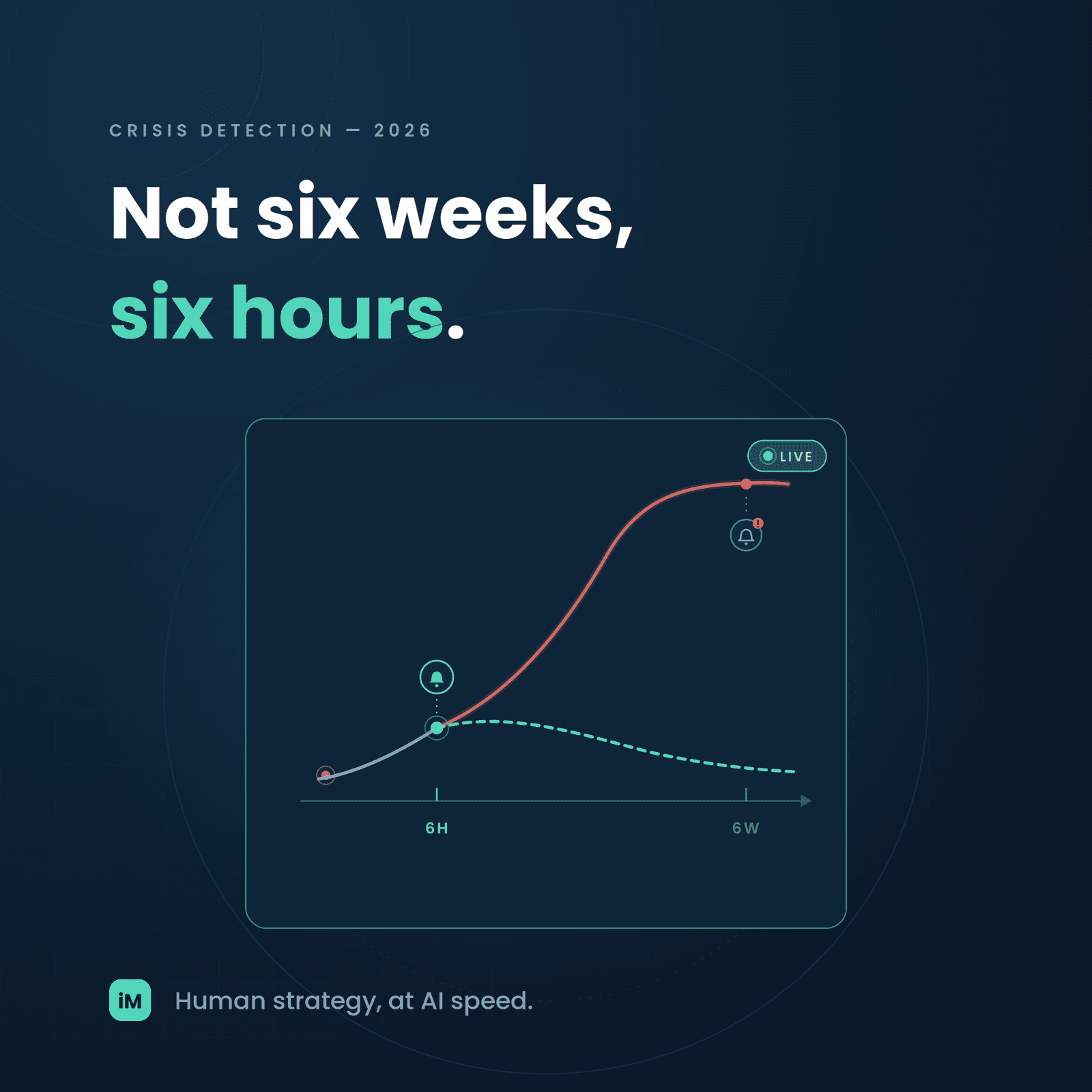
The consequence of that mismatch is not a marginal difference in outcome. A crisis that is caught in the first six hours after it begins is a crisis the brand can shape — statement issued, correction posted, sentiment trajectory bent while the audience is still forming its view. A crisis that is caught six weeks later is a crisis the brand has already lost. The audience view is set. The narrative has consolidated. The correction, if it comes, arrives after the reputation damage has already been booked. Detection speed is the single variable that most reliably decides whether the brand walks out of a reputation event with damage that heals or damage that carries into the next quarter's brand health survey.
This piece walks through what actually happens inside a modern crisis window, why detection speed matters more than detection accuracy for most real crises, and how enterprises are rebuilding their monitoring architecture to catch the surge while there is still time to act on it rather than to explain it.
The traditional model of a brand crisis has the reputation incident spreading outward from an initial trigger, gathering audience attention over days, reaching a peak of coverage, and then subsiding as the story is displaced by the next news cycle. That model was accurate in the pre-social era and remained roughly accurate into the mid-2010s. It does not describe how crises unfold in 2026.
The current crisis window has three phases, and the phases run on much tighter timescales than most enterprise monitoring assumes.
The crisis begins with a specific triggering event — an incident, a viral post, an emerging complaint pattern, a competitor accusation. In the first six hours the emergent activity is visible to anyone monitoring for it but not yet consolidated into a coherent narrative. The audience is talking about the trigger but has not agreed on what it means. The mainstream press has not yet decided whether to cover it. The brand's own team, if it is monitoring correctly, sees a specific pattern — negative-sentiment share rising, mentions of the trigger accelerating, high-follower accounts starting to amplify — and can act. This is the phase where the brand can most cheaply shape the outcome, because the narrative has not yet hardened. This is also the phase most enterprise monitoring completely misses.
In the second phase, the emergent noise consolidates into a narrative that the audience uses to describe the event. The specific vocabulary, the specific villains, the specific angles that stick get selected by the audience through their sharing patterns. This is the phase where the mainstream press picks up the story, because the audience selection has already told them which frame is going to travel. Enterprise brands whose monitoring catches the surge during Phase 1 are typically able to influence which narrative consolidates in Phase 2. Brands whose monitoring catches the surge only after Phase 2 has already consolidated find themselves responding to a narrative that has already been chosen, and their response reads as an argument against a story rather than as a shaping of it.
The third phase is the tail — the coverage subsides, the audience attention drifts, but the reputation impact persists. The specific way the audience remembers the crisis, the specific search results that appear when someone looks up the brand, the specific frame the next journalist reaches for when reporting on the category — these are set in Phase 2 and hardened in Phase 3. Brands that shaped Phase 2 typically have a much softer tail. Brands that missed both Phase 1 and Phase 2 are dealing with the tail for months, sometimes years, without ever being able to bend the trajectory back to where it was.
Most enterprise brand health monitoring runs on a quarterly cadence. A survey goes out, respondents are asked to rate the brand across dimensions, results are compiled, the report arrives on the CMO's desk six to eight weeks after the survey field period closes. That report captures Phase 3 residue in aggregate. It captures none of the Phase 1 emergence and none of the Phase 2 consolidation. By the time the survey signal indicates a problem, the crisis window has closed and the reputation damage has already been booked.
The quarterly survey is not useless. It is useful as a slow-moving thermometer for aggregate brand health and for detecting long-arc drift that no other instrument catches. It is deeply useless as a crisis-detection tool because its cadence is orders of magnitude too slow for the crisis timescale. Enterprises that rely on the quarterly survey as their primary reputation-monitoring layer are essentially asking to be told about crises after the crises are done.
A step up from quarterly surveys is monthly social media reporting — an analyst compiles mentions, sentiment, and volume metrics into a report that arrives at the end of each month. That reporting cadence catches crises that occurred in the first weeks of the month by the time the report arrives. It catches crises that occurred in the last weeks of the month roughly a month later. For a crisis that unfolds and peaks over 48 to 72 hours, monthly reporting is still the wrong instrument. It catches the residue after the fact, in the same way the quarterly survey does but a bit earlier.
The gap between crisis timescale and monitoring cadence is the specific mechanism by which most enterprise brands miss most of their reputation events. The problem is not that the brand does not care about reputation. The problem is that the monitoring instrument was calibrated for a slower era and has not been updated to match how reputation events actually unfold now.
Continuous monitoring — the specific practice of running mention detection, sentiment scoring, and threshold-based alerting on an always-on basis rather than a periodic-report basis — catches Phase 1 emergence in the six-hour window where the brand can most cheaply act. The differences between what continuous detection catches and what periodic reporting catches are stark.
Once the alert fires, the enterprise has a limited window to act before the crisis moves from Phase 1 to Phase 2. The specific length of the window varies by category, by the nature of the trigger, and by the platform on which the surge is happening. But some heuristics hold across most cases.
The first hour is spent on triage. Is this a genuine crisis or a false-positive alarm? What is the specific trigger? What is the specific audience segment engaging with it? What is the platform pattern? Enterprises that have practiced this triage make the assessment in under an hour. Enterprises without the muscle spend the first day just deciding whether the alert warrants a response, and by the time they conclude it does, the response window has narrowed materially.
The second through fourth hour is where the response strategy gets shaped. A statement, if needed. A customer-facing correction, if the trigger involves customer harm. Executive attention if the trigger will reach a level that requires it. Legal review if the trigger has legal exposure. Enterprises with playbooks for common crisis types make these decisions quickly. Enterprises without playbooks spend hours or days debating who owns the decision, and by the time the response ships, the narrative has consolidated without them.
The fifth through twenty-fourth hour is where the response actually reaches the audience. The response's effectiveness depends heavily on how much of Phase 1 the enterprise caught. Responding at hour six of Phase 1 is a response that helps shape which narrative consolidates. Responding at hour thirty-six, when Phase 2 is already underway, is a response that argues against a consolidating story. Responding at hour ninety-six, after Phase 2 has consolidated, is a response that reads as an attempt to relitigate a settled narrative, and typically produces a worse outcome than not responding at all.
There is a legitimate concern that continuous monitoring produces false positives — alerts that fire on activity that is not actually a crisis. Enterprises adopting continuous detection sometimes ask whether the cost of false positives justifies the earlier detection of real events.
The math on this question turns out to favor speed by a wide margin. A false positive costs an hour of triage. A missed real positive, caught six weeks late instead of six hours early, costs a reputation event that unfolds without the brand's ability to shape it. The ratio of cost between the two is not close, and it holds across almost every category. Enterprises that have run the math typically conclude that they would rather investigate ten false positives than miss one real positive, because the aggregate cost of the false positives is a fraction of the aggregate cost of a single missed crisis.
The false-positive concern also gets smaller as the monitoring system learns. Threshold calibration improves with data — the specific level at which a negative-sentiment surge signals a real event versus routine noise gets tighter as the enterprise accumulates history. Enterprises that have been running continuous detection for a year report false-positive rates that are markedly lower than the rates they saw in the first month, because the calibration converges. The initial adoption cost of higher false positives is real but temporary.
Detection speed is the single variable that most reliably decides whether a brand walks out of a reputation event with damage that heals or damage that carries. The instruments built for a slower era catch none of the crisis window. The instruments built for the current era catch the surge in the first six hours, while the brand can still shape the outcome. The difference between the two compounds across every reputation event the brand faces.
inMOLA's Brand Sentinel module operates as the always-on layer that catches Phase 1 emergence in the six-hour window. Sentiment is scored continuously on incoming mentions rather than aggregated into monthly reports. Threshold-based alerts fire when negative-sentiment share crosses the trailing baseline, when a single mention crosses a viral engagement threshold, or when a defined silence window elapses without brand-adjacent conversation. The alerts land in the marketing team's inbox in the hour the pattern develops, not in the summary at the end of the month.
The module pairs the sentiment detection with theme classification, so when an alert fires the enterprise sees not just that a negative surge is happening but what specifically is driving it. A defective batch. A founder statement. A viral customer complaint. A competitor accusation. The theme drives the triage question — is this a legal exposure, a customer service failure, an executive communications issue, a product problem — and the triage question drives the response path.
The strategic value of continuous detection is not that it eliminates crises. Crises happen; some of them are outside the brand's control. The value is that the enterprise catches them in the window where response is still possible, rather than reading about them in the residue after the window has closed. In 2026 the brands operating with this capability walk out of reputation events with damage that heals within a quarter. The brands still relying on periodic reporting walk out of the same events carrying damage that lingers into the next brand health survey, and the compounding across events is the specific mechanism by which some brands hold reputation across cycles while others watch it erode.
Marketing Intelligence
Decision Intelligence

Marketing Intelligence