Brand & Market Overview · inMOLA Core
Brand Sentinel
Stop reading about your brand crises in yesterday's news — get an alert in the hour a negative surge, a viral mention, or brand silence starts to develop, while there is still time to shape the outcome.
- Home
- Products
- inMOLA Core
- Brand Sentinel
Stop reading about your brand crises in yesterday's news. Brand Sentinel monitors how your brand is being talked about across social platforms 24/7, scores every mention for sentiment and theme, and sends you an alert the hour a negative surge, a viral negative post, or brand silence starts to develop — while there is still time to shape the outcome, not to explain it.
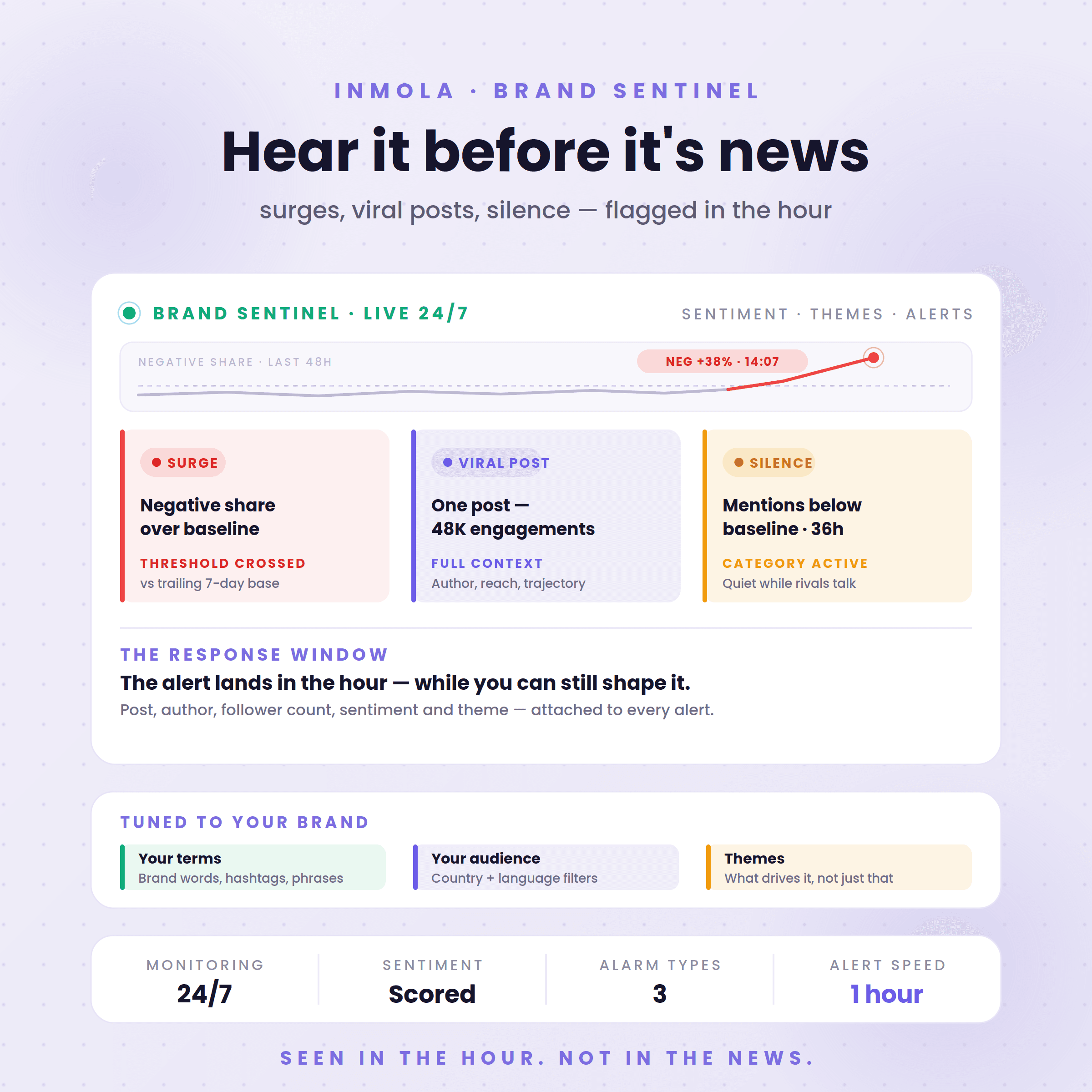
For most enterprises, brand reputation monitoring runs on the wrong timescale. A monthly report arrives after the crisis window has closed. A quarterly brand health survey catches residue from events that already unfolded. And even continuous social listening tools typically alert on volume anomalies rather than on the specific patterns that most reliably signal a reputation event. Brand Sentinel replaces that cadence. It runs continuous mention detection, sentiment scoring, and theme classification against the specific brand terms, hashtags, and search phrases you define — with country and language filters that keep the signal grounded in the audience you actually care about. Three alarm types cover the reputation patterns that most reliably matter: a negative-trend surge when the share of negative mentions crosses a threshold above the trailing baseline, a viral negative mention when a single post crosses an engagement threshold with negative sentiment attached, and brand silence when mention volume drops below baseline for a sustained window while the category is still active. The alerts land in the inbox in the hour the pattern develops, with the full context — post text, author, follower count, engagement trajectory, sentiment, theme — attached, so the response team can move from alert to triage to action in minutes rather than hours.
For CMOs and brand leads, this means the reputation events that used to be discovered after an assistant forwarded a news article get caught while there is still a response window to work with. The board question about the viral tweet no longer arrives before the marketing team has even seen it. For lean brand teams without a dedicated reputation function, it means the continuous monitoring runs whether or not someone is watching — the alerts route to the response owner, the AI insight surfaces the specific patterns worth investigating, and the theme classification tells the team what specifically is driving the signal rather than just that a signal is present.
Coverage is not limited to a single platform. X, LinkedIn, YouTube and Instagram sit in the same stream as news sites and general web content — social, press and digital on one screen, scored on the same sentiment and theme model. On YouTube it reads the comments under a video, not just the video title; reputation arguments usually start in the comments, and title-level monitoring misses them entirely. LinkedIn — where corporate reputation is discussed most and which most monitoring tools skip — is covered. Refresh cadence is configurable and can be tightened to five minutes: hourly is enough on a normal week, but when an event is developing the scale drops to minutes.
The report does not make you wait. A full report can be pulled at any moment, and it contains: a channel-by-channel total / positive / neutral / negative breakdown with the period's negativity rate; a prioritised 'handle these first' list — author, follower count, impact score and the full text of the content; a complete listing of every mention in the period; and the history of triggered alarms — which alarm type, at what date and time, at what engagement level. Event periods can also be set up separately: across a multi-day trade show, launch or corporate event, your brand and your competitors are tracked side by side and share of voice and agenda themes are broken out day by day — so you see your position while the event is running, not the verdict after it ends.
What used to require a monitoring specialist checking dashboards through the day, a monthly report that arrived after the events it described had already consolidated, and a scramble every time an executive forwarded a tweet with the question "did you see this" — now lives as a continuous, alert-driven layer that catches the specific reputation patterns worth catching in the specific window where the response can still shape the outcome.
Frequently asked questions
Which channels does Brand Sentinel monitor?
On social: X, LinkedIn, YouTube and Instagram — alongside news sites and general web content. All six sit in one stream and are scored on the same sentiment and theme model, so social, press and digital are on one screen rather than in separate reports.
Why it matters: Reputation does not live on one channel. By the time an argument that started on social reaches the news, you are already late; seeing all six at once means catching it in the channel it started in.
Are YouTube and LinkedIn really covered?
Yes. On YouTube it reads the comments under a video, not just the video title. LinkedIn is covered too — the channel where corporate reputation is discussed most, and the one most monitoring tools skip.
Why it matters: Reputation arguments usually start in the comments, not the title. Title-level monitoring misses them entirely, and you only see the event once it has grown.
How often is the data refreshed?
Refresh cadence is configurable and can be tightened to five minutes when needed. Hourly is enough on a normal week; when an event starts developing, the scale drops to minutes.
Why it matters: A crisis window is measured in hours. A tool that scans once a day closes the window you could have responded in, before you even hear about it.
What triggers an alert?
Three patterns: the share of negative mentions crossing a threshold above the trailing baseline (trend surge), a single negative post crossing an engagement threshold (viral mention), and mention volume dropping below baseline while the category is still active (brand silence). Every alert arrives with post text, author, follower count, engagement and sentiment attached.
Why it matters: Tools that alert on raw volume anomalies send you chasing noise. These three patterns separate the situations that actually need a response.
Do I have to wait for month end to get a report?
No. A full report can be pulled at any moment. It contains a channel-by-channel total / positive / neutral / negative breakdown with the negativity rate, a prioritised action list (author, followers, impact score, full text of the content), a complete listing of every mention in the period, and the history of triggered alarms.
Why it matters: The board question does not wait for month end. Producing the report on the day the question is asked moves the conversation off defence and onto data.
Can monitoring be set up for a specific event period?
Yes. Across a multi-day trade show, launch or corporate event, your brand and your competitors are tracked side by side, with share of voice and agenda themes broken out day by day. Multi-brand, multi-day event tracking is run as hands-on engagements.
Why it matters: A report that arrives after the event is an archive document. Seeing your position while the event is still running lets you change your communications for the days that remain.
Can I track competitors at the same time?
Yes. Competitor brands are monitored across the same channel set, and share of voice, sentiment distribution and agenda themes are compared side by side.
Why it matters: A 13% negativity rate means nothing on its own. If your competitor sits at 25% you are in good shape; if they sit at 5% you have a problem.
More in Brand & Market Overview
Related modules
PR Media Value
Stop calling PR a "soft" function — put a number on every piece of earned coverage and walk into the budget conversation with an answer, not an apology.
More detailsBrand Trends
Stop measuring brand health like a still photograph — see in real time whether your brand is gaining strength or quietly losing ground, and why.
More detailsVisual Impact Score
Stop finding the mistake in a campaign visual after it ships — audit the creative before it goes live, in fifteen seconds, on numbers rather than taste.
More details