Stop making the call in one panel and chasing the work in another tool. The Operations modules take ownership of what inMOLA's intelligence layer produces — who does what, by when, with whom, and how far it has come — and run all of it on the screen where the data lives.
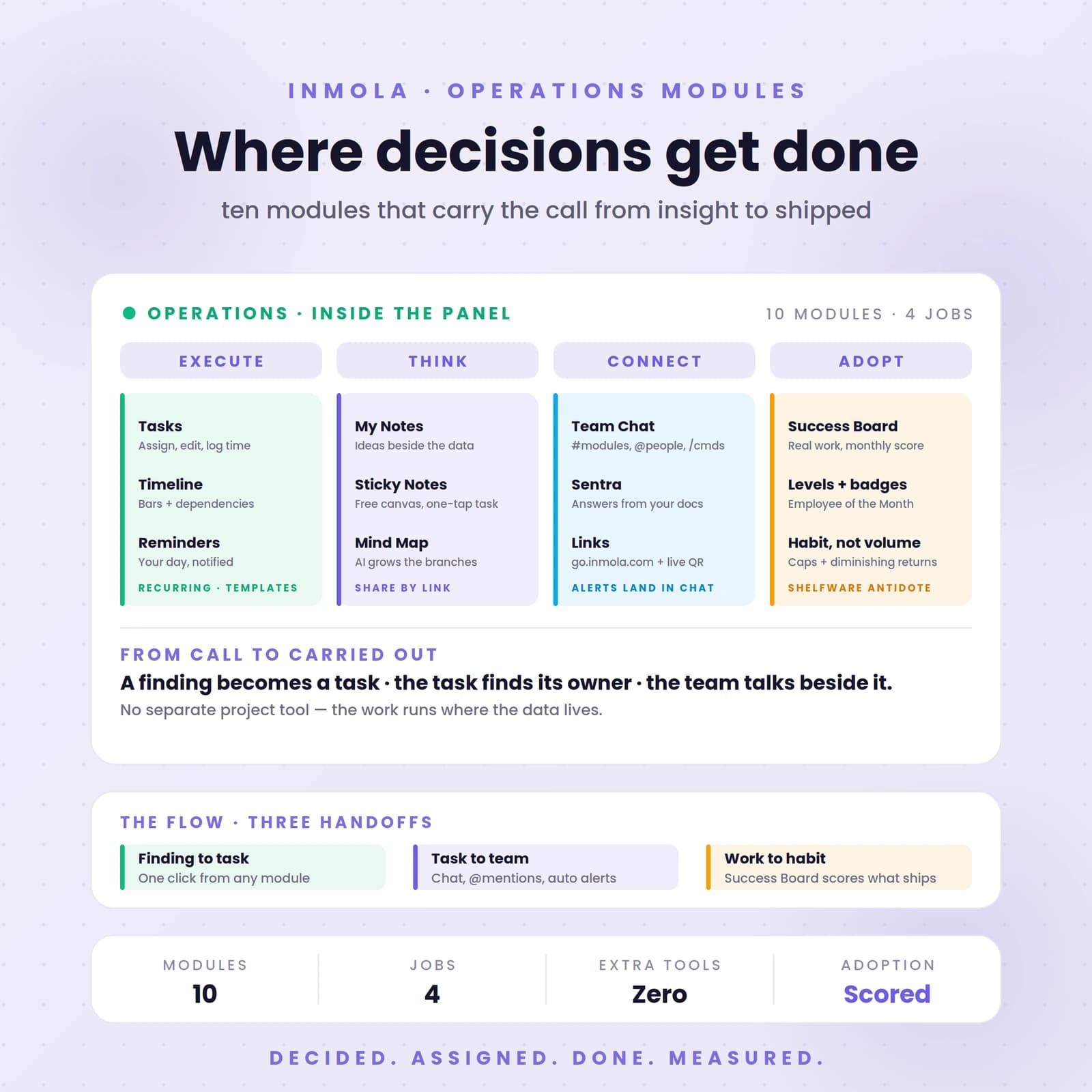
For most teams there is a gap between deciding and doing: analysis in one tool, tasks in a second, conversation in a third, ideas in a fourth. A finding caught in competitor analysis loses its context on the manual trip to the project tool; "have you seen this score" drowns in Slack; the idea born in a meeting is forgotten three apps later. The Operations modules close that gap. On the execution side, Tasks turns the decision into work — assignment, inline editing, comments, time logging, recurring tasks and one-click templates; Timeline lays the same tasks on a calendar with dependencies, so a delay shows up as the delay of the work blocking the launch, not of the launch itself; Reminders keeps your own day, firing browser notifications even when the panel is closed. On the thinking side, My Notes holds what crosses your mind right where you look at the data, Sticky Notes is the free canvas for work that is not a task yet — one tap converts it when it matures — and Mind Map offers AI-assisted branching for work that thinks in diagrams, shareable by link with people outside the panel. For communication, Team Chat brings the discussion next to the data — #module links, @mentions, /commands, and system alerts that land in the channel on their own; inMOLA Sentra answers from your company's own documents, not from the internet; Links produces branded short links and QR codes whose destination you can change after printing. And the Success Board measures adoption itself: it scores habit, not volume — with caps and diminishing returns — awards levels and badges, and names an employee of the month.
For CMOs and marketing leads, this means the question "we decided — then what happened?" disappears: the finding becomes a task, the task finds its owner, the team talks beside the work, and finished work shows up on the board. For lean teams split across five tools, it means there is nowhere left to lose context.
What used to require a project management tool, a team chat app, a notebook, a link shortener, and a manager who could not answer "are we actually using the tools" — now lives as ten modules inside the analytical view: decision, task, conversation and adoption, in one panel.