Stop saying your brand is transparent — show it. Open Brand measures exactly where your brand sits between closed and open across ten axes, and shows what that posture earns you. No surveys, no self-assessment forms; only externally observable data.
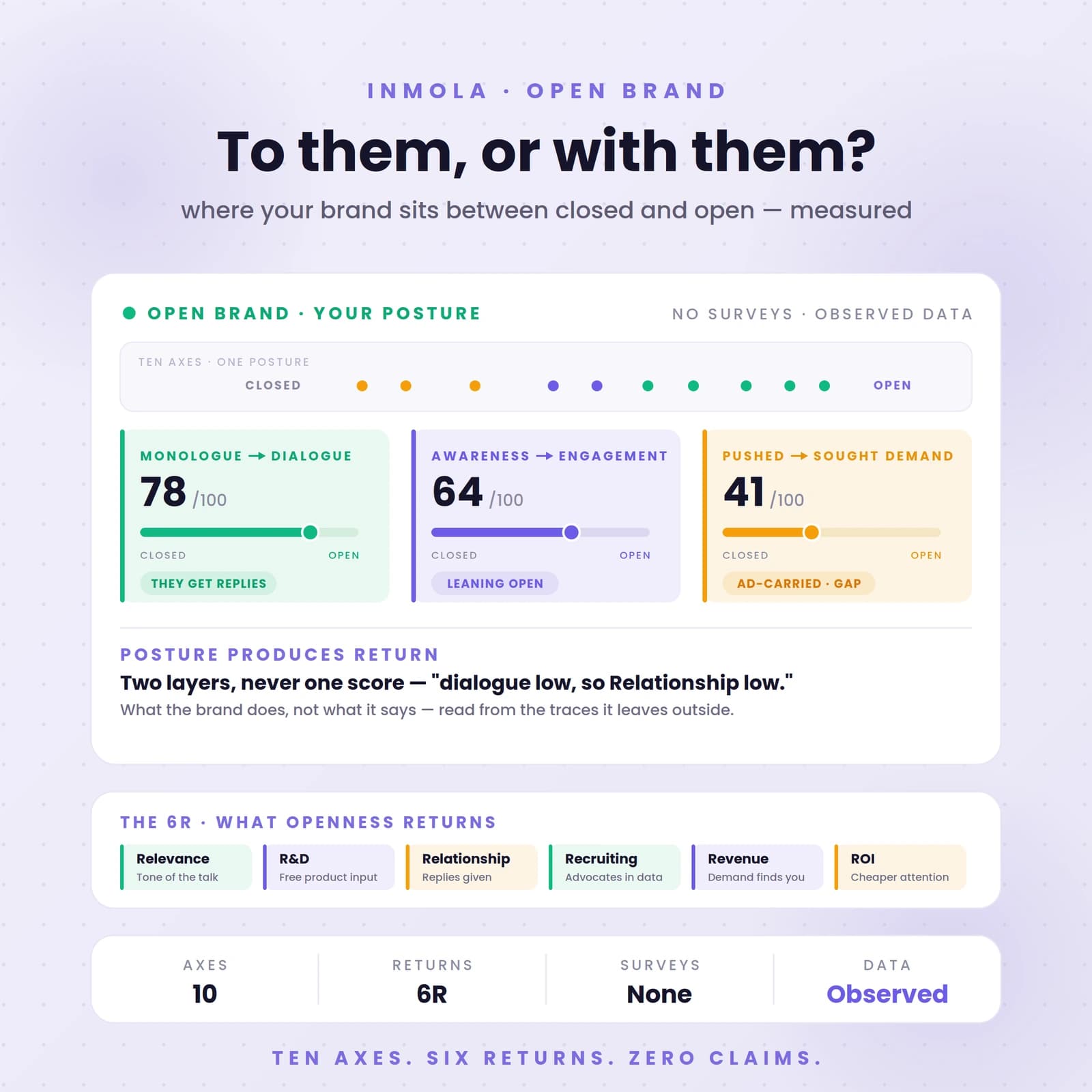
Every brand claims to be transparent, to listen, to co-create. None of them can show it as a number. Because openness is not an intention — it is behaviour, and behaviour is read from the traces a brand leaves outside itself, never from its own claims: how many people speak to the brand, whether they get an answer, whether demand finds the brand on its own or has to be carried by advertising, whether a customer can solve their own problem, who gets to describe the product. Open Brand reads those traces. It sees what a brand does, not what it says — and measures posture across ten axes: from monologue to dialogue, awareness to engagement, ad-carried demand to demand that seeks the brand out, marketer-produced to co-created. Under each axis sit the real figures that produced it.
Open Brand works in two layers and never collapses them into one score. The first layer is posture: where the brand sits on ten axes. The second is the 6R — what openness returns: Relevance, R&D, Relationship, Recruiting, Revenue, ROI. Because the two stay separate, this sentence can be written: "Your dialogue axis is low, which is why your Relationship return is low." Posture produces return; a single score kills that causality.
And when something cannot be measured, it says so. An unmeasured axis is left out of the average, marked "not measured" on screen, with the reason stated. Axes that cannot be observed from outside take the brand's own declaration — but it never counts toward the score. Gaps are not filled with proxy metrics. If your score rests on eight axes, you see that.
For CMOs and brand leads, this means "we are community-driven" becomes a claim you can defend in the boardroom. You see which axes you are genuinely open on, which axis produces which return, and how you compare with competitors — on externally observable axes only — in a single view. Each axis comes with a concrete step tied to your posture on it: which channel, which cadence, which team. You will not find "improve your content strategy" here. For CEOs and the board, openness stops being a marketing slogan and becomes a trackable behavioural indicator: if the brand is investing in community, the return on that investment — demand that arrives on its own, falling cost of sale, free product input — is discussed in data, not in feelings.
What used to require a brand-health survey, an agency's annual reputation report, and gut-feel answers to "is community working" — now lives as a continuous two-layer view fed by data inMOLA already collects: posture, return, the real list of your advocates, and the next step for every axis, on one screen.